


BPSPrep

Free lesson

Adult ICU Pharmacist Scope

The first lesson of BCCP Prep Course (BCCP), free to read.

Adult ICU Pharmacist Scope

Topic: 1.1.1

Course: BCCP Prep Course (BCCP)

Audience: Adult critical care pharmacists preparing for BPS Board Certified Critical Care Pharmacist certification

What you’ll learn

  • Domain: Foundations of ICU practice → Scope of pharmacist-centered critical care decision making → distinguish medication-management tasks from non-pharmacist procedural tasks
  • Domain: Foundations of ICU practice → Medication assessment workflow → identify what ICU data the pharmacist must interpret before recommending therapy
  • Domain: Foundations of ICU practice → Safety and stewardship → recognize when to initiate, adjust, hold, clarify, de-escalate, or urgently escalate therapy
  • Domain: Foundations of ICU practice → Interdisciplinary communication → frame the most appropriate pharmacist recommendation using board-style language
  • Domain: Foundations of ICU practice → Monitoring and reassessment → select efficacy and safety parameters relevant to ICU pharmacotherapy

Blueprint mapping

  • Inferred BCCP study grouping: Foundations of ICU Practice → pharmacist role boundaries in adult critical care medication management
  • Inferred BCCP study grouping: Foundations of ICU Practice → medication-related problem identification and prioritization
  • Inferred BCCP study grouping: Medication safety/stewardship → interdisciplinary accountability, documentation, escalation, and reassessment
  • Official wording and weighting may vary by exam cycle; confirm against current BPS materials

Estimated time: 45–60 minutes

Prereqs: None in this course sequence; upcoming connected topics: Medication Problem-Solving Framework ICU Data Prioritization

Key outputs: You should be able to choose what the pharmacist should recommend, what data must be reviewed first, when a medication issue needs urgent escalation, and when a question is testing pharmacist scope rather than pure diagnosis or bedside procedure.

Why it matters

  • BCCP questions often hinge on role framing: the best answer is not the physician’s procedure, but the pharmacist’s medication recommendation, clarification, or escalation.
  • In ICU cases, the same drug can be right, wrong, or incomplete depending on hemodynamics, organ dysfunction, drug exposure, and monitoring burden.
  • Scope errors create exam traps: choosing a diagnosis-only answer, ignoring safety surveillance, or missing the need to urgently communicate a high-risk medication concern.
  • A clear pharmacist workflow improves speed: identify the medication task, extract the ICU data that matter, apply the governing rule, then verify efficacy and toxicity.

Key Terms & Must-Know Facts

Key terms

  • Medication-related problem: any issue involving indication, drug choice, dose, route, timing, duration, interaction, toxicity, monitoring, or de-escalation
  • Pharmacist-centered recommendation: a medication action framed within collaborative ICU practice
  • Urgent escalation: immediate communication of a safety-critical medication issue to the ICU team
  • Clarify order: verify intent when dose, route, indication, or patient-specific fit is uncertain
  • Hold parameter: a threshold that should pause or interrupt medication administration pending reassessment
  • Stewardship: selecting the narrowest, safest, and shortest appropriate therapy with reassessment
  • PK/PD: pharmacokinetic and pharmacodynamic reasoning used to individualize ICU drug therapy
  • Organ dysfunction fit: whether renal, hepatic, cardiac, or neurologic status changes drug choice or dose
  • High-alert medication: drug with elevated risk of serious harm if used incorrectly
  • Monitoring plan: defined efficacy and safety parameters with timing
  • Therapeutic reassessment: repeat review of response, toxicity, and need for continuation
  • Board-style stem task: the specific action requested, such as best initial therapy, most appropriate recommendation, or most important to monitor

Must-know facts

  • The BCCP perspective is adult critical care medication management, not performance of bedside procedures.
  • The pharmacist is expected to recommend, dose-adjust, monitor, prevent harm, and escalate concerns.
  • Many questions test whether you can identify the single missing patient variable that changes the correct medication plan.
  • On exam day, the first step is often to identify what medication decision is being asked, not to chase every abnormality in the stem.
  • High-risk ICU answers commonly involve vasopressors, antimicrobials, sedatives, anticoagulants, insulin, electrolytes, and renal dose adjustments.
  • A tempting answer may be correct in a similar patient but wrong here because of renal failure, hepatic dysfunction, shock, drug interaction, or contraindication.
  • If a stem requires action outside pharmacist scope, the correct frame is usually recommend, clarify, verify, or urgently escalate.
  • Monitoring is part of the answer, not an afterthought.
Fig 1. ICU pharmacist scope map
Exam takeaway: Use this map to separate pharmacist medication decisions from tempting but out-of-scope procedural actions.
flowchart TD
A[ICU patient scenario] --> B{What is the task?}
B --> C[Choose or adjust medication]
B --> D[Identify safety risk]
B --> E[Design monitoring plan]
B --> F[Recommend escalation]
C --> G[Review hemodynamics organ function interactions]
D --> G
E --> G
F --> H[Communicate urgently to ICU team]
G --> I[Pharmacist-centered recommendation]
H --> I
B --> J[Procedure or diagnosis-only task]
J --> K[Reject as primary answer if no medication action]

See Fig 1 for the high-yield separation between pharmacist medication management and tempting out-of-scope answer choices.

Adult ICU pharmacist workflow board
Exam takeaway: Visualize the pharmacist standing at the intersection of vitals, labs, infusions, and organ function rather than at the procedural bedside.
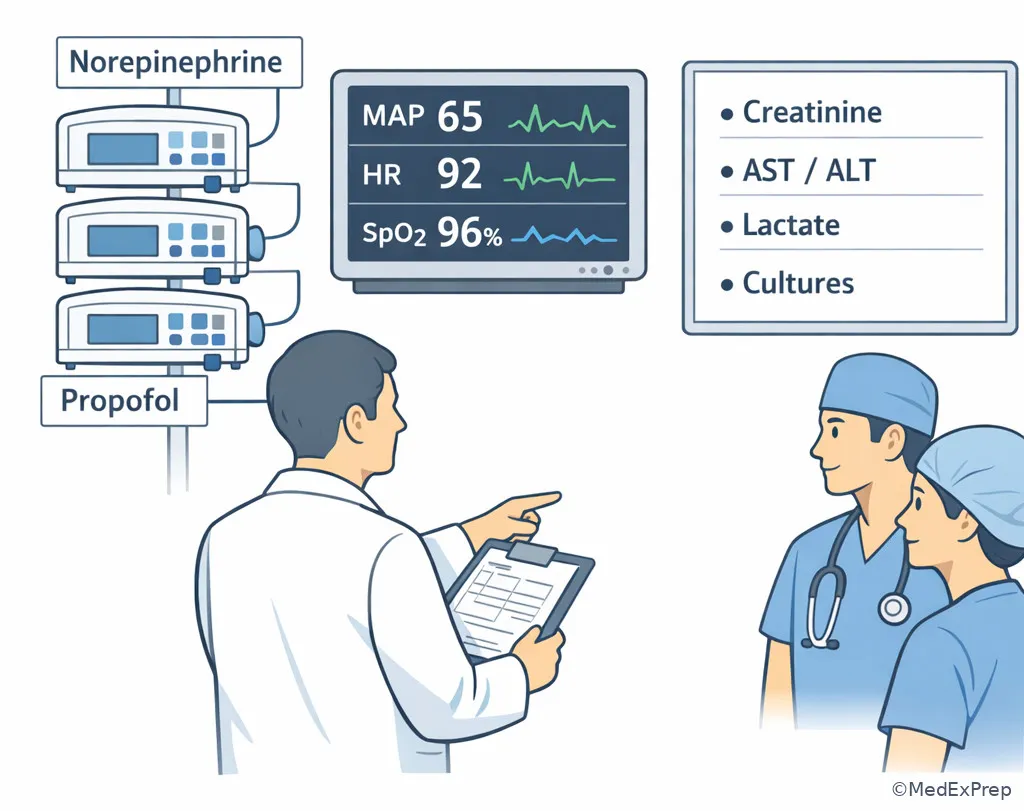
Adult ICU pharmacist workflow board

Core content

1.1.1.1 Foundational scope: what the ICU pharmacist is expected to do

A. Explanation

The decision conflict here is simple but heavily tested: choose the answer that centers medication management versus reject the answer that centers procedure, diagnosis-only reasoning, or non-pharmacist bedside execution. In BCCP-style cases, the pharmacist is not tested on performing intubation or inserting lines. The pharmacist is tested on selecting drug therapy, identifying interactions, adjusting for organ dysfunction, prioritizing monitoring, and communicating urgent recommendations. The single resolving rule is: if the stem asks what the pharmacist should do, look for the option that changes medication therapy safely and collaboratively.

WHY THIS IS TESTED: exam writers place correct pharmacotherapy decisions next to plausible intensivist or nursing actions to see whether you stay inside pharmacist scope while still protecting the patient.

Recall: This is the first topic in the course, so there is no prior lesson to build from yet. In the next lesson, Medication Problem-Solving Framework, we will convert this scope boundary into a repeatable stepwise approach for every ICU case.
Key rule: The best pharmacist answer usually contains one or more of these verbs: recommend, clarify, adjust, monitor, hold, de-escalate, verify, document, or escalate urgently.
Fig 2. Pharmacist action ladder
Exam takeaway: Start with the medication task, then move to patient-specific fit, then monitoring and communication.
Identify the task
Choose drug, adjust dose, monitor, or clarify a high-risk order.

Scope check
If the option is a procedure or diagnosis-only action, reject it unless paired with the pharmacist medication role.

Fit the patient
Review organ function, hemodynamics, interactions, allergies, and current exposures.

Recommend and monitor
State the medication plan and what must be followed for efficacy and toxicity.

See Fig 2 for the basic action ladder you should apply before reading any answer choices.

B. Worked example

A 66-year-old man in septic shock is receiving norepinephrine 0.18 mcg/kg/min, piperacillin/tazobactam 4.5 g IV every 6 hours, and vancomycin. He has atrial fibrillation, stage 3 chronic kidney disease, and type 2 diabetes. Serum creatinine increased from 1.4 to 2.1 mg/dL over 24 hours; lactate is improving; potassium is 3.4 mEq/L. The intensivist asks for pharmacy input because propofol is being considered for new agitation after intubation. One answer choice says to “perform bedside airway reassessment and set the ventilator mode.” Another says to “review hemodynamics and recommend an analgosedation strategy with dose selection and monitoring.”

Reasoning chain: Identify task → this is a pharmacist recommendation about ICU sedation. Extract key facts → shock on vasopressor, acute kidney injury, multiple infusions, intubated, agitation. Apply rule → choose medication-management action within scope; reject ventilator setup because that is not the pharmacist’s primary role. Eliminate distractors → potassium of 3.4 is relevant but not the main task; improving lactate means resuscitation trend matters but does not replace the sedation decision. Verify → the best pharmacist action is to recommend a sedative plan that accounts for hemodynamic tolerance and required monitoring.

C. Exam trap

Common wrong answer: choose the option that sounds most emergent, such as performing a bedside procedural or ventilator action. WHY IT IS TEMPTING: the ICU setting makes hands-on urgent actions sound more “critical care.” The SINGLE CLUE that eliminates it: the exam tests pharmacist-centered medication management, so the correct answer must involve recommending, adjusting, clarifying, or monitoring drug therapy.

D. Checkpoint

Question: A 58-year-old woman in the medical ICU is receiving dexmedetomidine 0.7 mcg/kg/hr, cefepime 2 g IV every 8 hours, and unfractionated heparin 5,000 units subcutaneously every 8 hours. She has cirrhosis and acute kidney injury. The team asks pharmacy for the most appropriate next step after new bradycardia and increasing somnolence. Which option best fits the pharmacist’s role?

  1. A. Independently diagnose the neurologic cause of somnolence before reviewing medications
  2. B. Review current sedative exposure and organ function, then recommend dexmedetomidine reassessment with monitoring and escalation if instability persists
  3. C. Perform a bedside neurologic procedure to determine sedation depth
  4. D. Set the mechanical ventilator mode to compensate for oversedation

Answer: B

  • A: Tempting because it sounds thorough; wrong because the pharmacist should first address the medication contribution and communicate concerns rather than independently diagnosing outside the medication task.
  • B: Tempting because it directly addresses the likely drug cause; right because it matches pharmacist scope and integrates organ function with medication monitoring.
  • C: Tempting because sedation depth matters; wrong because the answer shifts into bedside procedural execution rather than pharmacist recommendation.
  • D: Tempting because respiratory support may need adjustment; wrong because ventilator mode selection is not the pharmacist-centered medication action the stem is asking for.
If you missed this: Review 1.1.1.1 Foundational scope: what the ICU pharmacist is expected to do — focus on the scope check rule that rejects procedural and diagnosis-only distractors.
Pharmacist Action: NOTICE: whether the task is drug selection, dose fit, or adverse effect review. SAY: “I recommend reassessing the medication regimen and organ function before changing therapy.” MONITOR: vital signs, organ function, and drug-specific toxicity at the interval driven by the agent. HOLD/CLARIFY/ESCALATE: escalate immediately when a high-alert medication is causing instability or when the order falls outside safe patient-specific use.

1.1.1.2 Foundational task recognition: what data matter before you recommend anything

A. Explanation

The second foundational conflict is choosing between collecting all possible ICU data and extracting only the medication-relevant data that determine therapy. Strong candidates do not get lost in the stem. They identify the task, then prioritize hemodynamics, organ function, current drug exposure, indication, timing, cultures if infection is involved, and the most immediate safety variables. The single resolving rule is: the best recommendation depends on the smallest set of data that changes drug choice, dose, route, or monitoring.

WHY THIS IS TESTED: ICU questions are noisy by design. The exam rewards pharmacists who can separate signal from distraction and tie each abnormality to a medication consequence.

High-Yield Connection: This concept is tested alongside ICU Data Prioritization. Know both which data move the medication decision and which abnormalities are noise in that specific stem for exam day.
Concept flow: medication-relevant data filter
Exam takeaway: Pull only the variables that change the drug plan, not every ICU number in the chart.
Name the medication task
Selection, dose adjustment, toxicity review, or de-escalation.

Pull critical data
Hemodynamics, renal/hepatic function, allergies, interactions, cultures, and exposure history.

Ignore noise
Discard details that do not alter the drug decision in the current question.

Act
Recommend therapy plus monitoring tied to the same data points.

Fig 3. Data priorities before a pharmacist recommendation
Exam takeaway: Hemodynamics, organ function, exposure history, and safety variables outrank incidental abnormalities in most ICU medication questions.
flowchart LR
A[Medication task] --> B[Hemodynamics]
A --> C[Renal function]
A --> D[Hepatic function]
A --> E[Current drugs and interactions]
A --> F[Indication and timing]
A --> G[Relevant cultures or drug levels]
B --> H[Recommendation]
C --> H
D --> H
E --> H
F --> H
G --> H
A --> I[Incidental data]
I --> J[Do not let noise drive the answer]

See Fig 3 when stems overload you with data. Start with the variables that actually change therapy.

B. Worked example

A 72-year-old woman in the surgical ICU is receiving meropenem 1 g IV every 8 hours, enoxaparin 40 mg subcutaneously daily, and fentanyl infusion 75 mcg/hr. She has obesity, chronic heart failure, and nonalcoholic fatty liver disease. Blood pressure is stable, urine output fell overnight, serum creatinine rose from 0.9 to 2.3 mg/dL, AST is mildly elevated, and magnesium is 1.6 mg/dL. A question asks for the most appropriate pharmacist recommendation regarding antimicrobial dosing. The distracting clues are obesity and mild transaminitis, but the decisive variable is acute kidney injury because meropenem clearance is primarily renal.

Reasoning chain: Identify task → antimicrobial dose adjustment. Extract key facts → meropenem exposure, acute renal decline, hemodynamic stability, mild hepatic abnormality. Apply rule → choose the data that change antimicrobial dosing now: renal function and severity of infection. Eliminate distractors → magnesium matters for overall ICU safety but not the primary dose adjustment decision; mild transaminitis is less influential for meropenem than creatinine rise. Verify → recommend reassessment of renal-adjusted dosing and response monitoring.

C. Exam trap

Common wrong answer: chase the most abnormal lab in the stem even when it does not drive the medication task. WHY IT IS TEMPTING: exam stems often place a striking but secondary abnormality near the end of the vignette. The SINGLE CLUE that eliminates it: ask which variable changes the specific drug’s PK, contraindication, or safety threshold right now.

D. Checkpoint

Question: A 64-year-old man with septic shock is receiving norepinephrine 0.12 mcg/kg/min, cefepime 2 g IV every 8 hours, and stress-dose insulin infusion. He has chronic kidney disease, COPD, and recent atrial fibrillation with rapid ventricular response now controlled. Which data point is most important for the pharmacist to prioritize before recommending cefepime dose adjustment?

  1. A. Current serum creatinine trend and urine output
  2. B. Remote COPD history
  3. C. Corrected calcium level
  4. D. Prior home antihypertensive regimen

Answer: A

  • A: Tempting because cefepime is commonly renally adjusted; right because renal function most directly affects current dosing and neurotoxicity risk.
  • B: Tempting because COPD affects ICU care broadly; wrong because it does not drive cefepime dose adjustment in this stem.
  • C: Tempting because electrolyte abnormalities can matter in critical illness; wrong because it is not the main determinant of cefepime exposure here.
  • D: Tempting because medication reconciliation matters; wrong because home antihypertensives do not determine cefepime dosing.
If you missed this: Review 1.1.1.2 Foundational task recognition: what data matter before you recommend anything — focus on selecting the smallest data set that changes the drug decision.
Pharmacist Action: NOTICE: the data linked mechanistically to the drug’s disposition or toxicity. SAY: “For this medication, the creatinine trend is the key determinant of dose fit.” MONITOR: the parameter most likely to alter drug exposure, plus response. HOLD/CLARIFY/ESCALATE: clarify immediately if the order ignores a major change in organ function.
Quick Recall:

  • The most common reason a tempting ICU answer is wrong in this lesson is that it falls outside pharmacist scope.
  • True or False: The most abnormal lab is always the most important data point for the medication question. False.
  • Name the 3 highest-yield data buckets before a pharmacist recommendation: hemodynamics, organ function, current drug exposure.

1.1.1.3 Application: choosing the right pharmacist action verb

A. Explanation

Once you know the scope and have filtered the data, the next conflict is choosing which pharmacist action verb fits the stem: initiate, adjust, hold, discontinue, de-escalate, clarify, or urgently escalate. Many answer choices contain clinically reasonable drugs, but only one action fits the timing and risk. The single resolving rule is to match the urgency of the medication problem to the action verb. If the patient is unstable because of a current therapy, urgent escalation or immediate clarification is stronger than routine monitoring. If the therapy is effective but broader than necessary, de-escalation is stronger than discontinuation. If the indication exists but patient-specific fit changed, dose adjustment is stronger than starting over.

WHY THIS IS TESTED: BCCP questions often hinge less on the drug name and more on the correct medication-management move at that exact moment.

Memory anchor: RACE for pharmacist action verbs: Review data, Adjust or advise, Clarify/communicate, Escalate if unstable.
High-Yield Connection: This concept overlaps with Medication Problem-Solving Framework. Know both the action verb and the evidence rule that supports it; exam stems often ask for the most appropriate next pharmacist recommendation, not just the best drug in isolation.
Concept flow: choosing the pharmacist action verb
Exam takeaway: Match the urgency and reversibility of the medication problem to the strongest appropriate pharmacist action.
Therapy needed but absent
Initiate or recommend starting the drug.

Therapy present but misfit
Adjust dose, route, interval, or agent.

Immediate harm risk
Hold or urgently escalate when the current order is unsafe now.

Response allows narrowing
De-escalate or discontinue when indication has changed.

Medication action verbs in the ICU
Exam takeaway: Pair each pharmacist action with the clinical trigger that makes it the safest next recommendation.
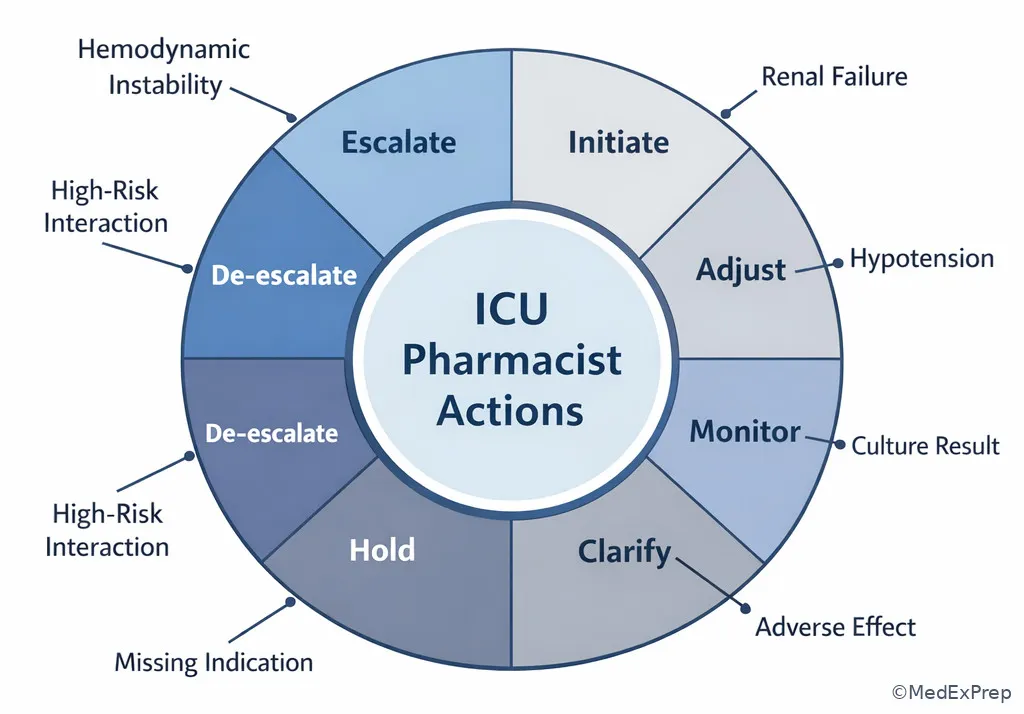
Medication action verbs in the ICU

B. Worked example

A 59-year-old man in the neuro ICU is receiving levetiracetam 1,500 mg IV every 12 hours, enoxaparin 40 mg daily, and nicardipine infusion. He has obesity, hypertension, and newly developed acute kidney injury after contrast exposure. He is seizure-free. Platelets are normal, magnesium is 1.7 mg/dL, and his spouse reports he takes herbal supplements at home. The stem asks for the most appropriate pharmacist recommendation regarding levetiracetam. The key issue is not initiation, not discontinuation, and not de-escalation for lack of indication. It is dose adjustment because the indication remains but renal clearance changed.

Reasoning chain: Identify task → current anticonvulsant management. Extract key facts → active order, renal injury, ongoing indication, no evidence of toxicity yet. Apply rule → therapy needed but patient fit changed, so adjust rather than stop. Eliminate distractors → stopping would be appropriate only if the indication resolved or toxicity outweighed benefit; escalating would fit an unstable adverse event, which is not present. Verify → recommend renal reassessment and dose fit monitoring.

C. Exam trap

Common wrong answer: discontinuation when the real issue is dose fit. WHY IT IS TEMPTING: the stem highlights a new organ dysfunction, making the current drug look dangerous. The SINGLE CLUE that eliminates it: if the indication remains and the drug can be used safely with adjustment, the best action is to modify rather than stop.

D. Checkpoint

Question: A 70-year-old woman in septic shock is receiving vancomycin, cefepime, and amiodarone infusion. She has chronic kidney disease, obesity, and recent culture data showing methicillin-susceptible Staphylococcus aureus. She is hemodynamically improved. Which pharmacist action verb best fits vancomycin management now?

  1. A. Escalate
  2. B. De-escalate
  3. C. Clarify because vancomycin has no Gram-positive activity
  4. D. Hold permanently because any kidney disease contraindicates vancomycin

Answer: B

  • A: Tempting because the patient was recently unstable; wrong because improvement and culture data support narrowing rather than broadening.
  • B: Tempting because MSSA cultures point toward a narrower beta-lactam; right because stewardship and pathogen-specific therapy now drive the action.
  • C: Tempting only if the student confuses spectrum; wrong because vancomycin does cover Gram-positive organisms, so this rationale is false.
  • D: Tempting because kidney injury raises toxicity concern; wrong because renal dysfunction requires monitoring and adjustment, not universal permanent discontinuation.
If you missed this: Review 1.1.1.3 Application: choosing the right pharmacist action verb — focus on matching action verbs to timing, ongoing indication, and stability.
Pharmacist Action: NOTICE: whether the drug is absent, present-but-misfit, harmful now, or broader than necessary. SAY: “The indication remains, but the current regimen needs adjustment/de-escalation rather than discontinuation.” MONITOR: response, organ function, and drug-specific safety markers. HOLD/CLARIFY/ESCALATE: escalate immediately when ongoing exposure poses current harm.

1.1.1.4 Application: monitoring, reassessment, and safety surveillance are part of the answer

A. Explanation

A frequent exam conflict is choosing between the answer that names the correct drug and the answer that names the correct drug plus monitoring plan. In critical care, therapy selection is incomplete without a follow-up strategy. The single resolving rule is: if two answers seem therapeutically plausible, choose the one that includes the parameter most likely to detect efficacy, toxicity, or the need for dose change. Monitoring should be mechanistically linked: vasopressors need hemodynamics and perfusion reassessment; renally cleared drugs need kidney function and exposure review; sedatives need sedation depth and cardiorespiratory safety checks; anticoagulants need bleeding surveillance and context-specific laboratory review.

WHY THIS IS TESTED: ICU pharmacotherapy is dynamic. The board expects the pharmacist to design surveillance, not just suggest a one-time medication order.

Common pitfall: choosing a correct ICU drug without naming what must be tracked after the recommendation. On the exam, the safer and more complete answer usually wins.
Fig 4. Monitoring links to medication class
Exam takeaway: The best pharmacist recommendation connects each ICU drug decision to a concrete monitoring parameter and reassessment trigger.
flowchart TD
A[Medication chosen] --> B{What can change quickly?}
B --> C[Hemodynamics]
B --> D[Organ function]
B --> E[Drug level or exposure]
B --> F[Adverse effect signal]
C --> G[Adjust or escalate]
D --> G
E --> G
F --> G
G --> H[Document and reassess]

See Fig 4 to remember that monitoring is not separate from therapy selection; it is part of the therapeutic recommendation.

Concept flow: monitoring after recommendation
Exam takeaway: Every ICU medication decision should end with a specific follow-up parameter and timing plan.
Choose therapy
Pick the safest drug or dose for the current patient state.

Define efficacy marker
MAP, infection response, sedation target, glucose, or anticoagulation goal.

Define safety marker
Bleeding, renal injury, hypotension, delirium, arrhythmia, or hepatotoxicity.

Set reassessment threshold
If target missed or toxicity appears, adjust, hold, or escalate.

B. Worked example

A 61-year-old woman in cardiogenic shock is receiving norepinephrine 0.08 mcg/kg/min, dobutamine 5 mcg/kg/min, and furosemide infusion. She has chronic kidney disease, atrial fibrillation, and diabetes. Potassium is 3.2 mEq/L, magnesium is 1.5 mg/dL, and urine output improved slightly. A question asks for the most appropriate pharmacist recommendation regarding ongoing dobutamine therapy. The right answer must include what to monitor: heart rate/rhythm, perfusion, blood pressure, and electrolytes that may amplify arrhythmic risk.

Reasoning chain: Identify task → optimize active inotrope therapy. Extract key facts → inotrope exposure, arrhythmia history, electrolyte depletion, shock state. Apply rule → choose recommendation plus monitoring. Eliminate distractors → urine output alone is incomplete; renal function matters but does not replace rhythm surveillance; magnesium and potassium are not just incidental because they alter safety risk. Verify → recommend continued hemodynamic and rhythm monitoring with electrolyte correction considerations.

C. Exam trap

Common wrong answer: choose the option with the correct drug but no follow-up plan. WHY IT IS TEMPTING: students anchor on first-line therapy names. The SINGLE CLUE that eliminates it: ICU pharmacists are expected to monitor response and toxicity, so the better answer states what to follow and when to act.

D. Checkpoint

Question: A 63-year-old man is receiving unfractionated heparin infusion for acute VTE in the ICU. He also has sepsis, recent surgery, and acute kidney injury. Which pharmacist recommendation is most complete?

  1. A. Continue heparin because it is guideline-supported, with no additional plan needed
  2. B. Continue heparin and monitor the institution’s anticoagulation parameter plus bleeding signs and platelet trend
  3. C. Switch immediately to low-molecular-weight heparin without reviewing renal function
  4. D. Stop anticoagulation because recent surgery makes all anticoagulation inappropriate

Answer: B

  • A: Tempting because heparin is often reasonable in ICU patients; wrong because the answer omits essential monitoring.
  • B: Tempting because it sounds operationally complete; right because anticoagulation management requires efficacy and safety surveillance.
  • C: Tempting because LMWH is commonly used for VTE; wrong because renal dysfunction and ICU context require individualized assessment first.
  • D: Tempting because postoperative bleeding risk is real; wrong because surgery is not an automatic universal contraindication, and the stem does not justify blanket discontinuation.
If you missed this: Review 1.1.1.4 Application: monitoring, reassessment, and safety surveillance are part of the answer — focus on pairing every drug plan with an efficacy marker and a toxicity marker.
Pharmacist Action: NOTICE: the drug-specific adverse event most likely to appear early. SAY: “My recommendation includes the monitoring parameter and the threshold for modification.” MONITOR: one efficacy marker and one safety marker at a clinically meaningful interval. HOLD/CLARIFY/ESCALATE: escalate when instability, bleeding, severe hypotension, or rapidly worsening organ function changes the benefit-risk balance.
Quick Recall:

  • True or False: A correct ICU medication choice without a monitoring plan may still be an incomplete answer. True.
  • The best paired monitoring buckets are efficacy and toxicity.
  • Name one high-risk ICU class where monitoring is inseparable from therapy selection: vasopressors, anticoagulants, sedatives, antimicrobials, insulin.

1.1.1.5 Integration: escalation, communication, and stewardship within pharmacist scope

A. Explanation

The highest-yield integration question asks what the pharmacist should do when a medication issue is both time-sensitive and interdisciplinary. The conflict is choosing between passive observation and active escalation. The single resolving rule is: when a medication problem creates immediate risk, the pharmacist should urgently communicate the recommendation and document the rationale, while still staying inside collaborative scope. This includes unsafe infusions, major interaction risks, omitted life-saving therapies, incorrect renal dosing in unstable patients, and continued broad-spectrum therapy without reassessment. Stewardship is also part of scope: once instability resolves or data narrow the diagnosis, the pharmacist should recommend de-escalation, discontinuation, or duration optimization.

WHY THIS IS TESTED: the board expects you to protect patients by recognizing when the medication issue is urgent enough that routine note-only communication is inadequate.

Key rule: In ICU stems, urgency upgrades the action from “monitor” to “communicate now and recommend change now.”
Fig 5. Escalate now versus reassess routinely
Exam takeaway: Immediate instability or major medication harm triggers urgent pharmacist communication, while stable optimization issues can follow routine reassessment.
flowchart TD
A[Medication issue identified] --> B{Immediate harm or instability?}
B -->|Yes| C[Urgently communicate recommendation]
C --> D[Hold adjust or reverse if appropriate]
D --> E[Document and monitor closely]
B -->|No| F[Routine reassessment]
F --> G[Optimize dose duration or de-escalation]
G --> E

See Fig 5 for the escalation threshold that separates urgent communication from routine optimization.

Concept flow: pharmacist escalation sequence
Exam takeaway: Unsafe medication exposure should trigger rapid recommendation, communication, documentation, and reassessment.
Identify imminent risk
Interaction, overdose, contraindication, instability, or missing critical therapy.

Recommend the medication change
Hold, adjust, reverse, start, or de-escalate as appropriate.

Communicate with urgency level matched to risk
Immediate verbal escalation for unstable hazards; routine communication for stable optimization.

Document and verify outcome
Confirm that therapy changed and the patient response is tracked.

B. Worked example

A 68-year-old man in a mixed ICU is receiving linezolid 600 mg IV every 12 hours, fentanyl infusion 150 mcg/hr, and vasopressin 0.03 units/min. He has shock, chronic kidney disease, and depression treated with home sertraline that was accidentally continued. Temperature is 39.1°C, heart rate 132/min, and he is increasingly rigid. Creatinine is elevated, and platelet count is mildly decreased. A tempting but wrong clue is the thrombocytopenia, which may push the learner toward linezolid toxicity alone. The more urgent medication issue is the possible serotonergic interaction requiring immediate pharmacist communication.

Reasoning chain: Identify task → urgent medication safety recommendation. Extract key facts → linezolid plus sertraline, autonomic instability, hyperthermia, rigidity. Apply rule → immediate-harm interaction means urgent escalation, not passive monitoring. Eliminate distractors → mild thrombocytopenia is real but not the immediate threat; renal dysfunction matters but does not change the interaction urgency. Verify → recommend urgent review of serotonergic exposure and communication to the ICU team now.

C. Exam trap

Common wrong answer: continue to monitor because the patient is already in the ICU. WHY IT IS TEMPTING: students assume close ICU observation can substitute for intervention. The SINGLE CLUE that eliminates it: if the medication issue is causing current instability or major preventable harm, the pharmacist should escalate immediately rather than simply observe.

D. Checkpoint

Question: A 56-year-old woman on piperacillin/tazobactam, vancomycin, and norepinephrine develops rapidly worsening acute kidney injury. Cultures now show a susceptible Escherichia coli bloodstream infection. Which pharmacist recommendation best reflects stewardship and scope?

  1. A. Continue both antibiotics indefinitely because broad coverage is safer in all ICU patients
  2. B. Recommend narrowing therapy based on cultures and reassessing renal-adjusted dosing
  3. C. Wait for complete resolution of shock before considering any antimicrobial changes
  4. D. Independently discontinue vasopressor support to reduce kidney injury

Answer: B

  • A: Tempting because severe infection initially warrants broad therapy; wrong because culture-directed de-escalation is part of pharmacist stewardship.
  • B: Tempting because it addresses both pathogen-specific fit and renal safety; right because it stays within pharmacist scope and integrates reassessment.
  • C: Tempting because instability can delay some changes; wrong because culture data already support targeted optimization and dose fit now.
  • D: Tempting because hemodynamics affect kidney function; wrong because stopping vasopressors independently is outside pharmacist role and misses the antimicrobial stewardship task.
If you missed this: Review 1.1.1.5 Integration: escalation, communication, and stewardship within pharmacist scope — focus on when urgent harm or new microbiology changes the recommended pharmacist action.
Pharmacist Action: NOTICE: whether the issue is immediate harm, interaction, dose-related toxicity, or unnecessary spectrum. SAY: “This medication issue requires urgent team communication because current exposure is unsafe / can now be narrowed.” MONITOR: outcome after the recommendation, not just before it. HOLD/CLARIFY/ESCALATE: escalate immediately for active harm, high-alert medication misfit, or dangerous interaction.
Fig 6. ICU medication escalation handoff
Exam takeaway: The pharmacist’s highest-yield ICU action is often urgent communication of a medication change tied to a specific safety threat.
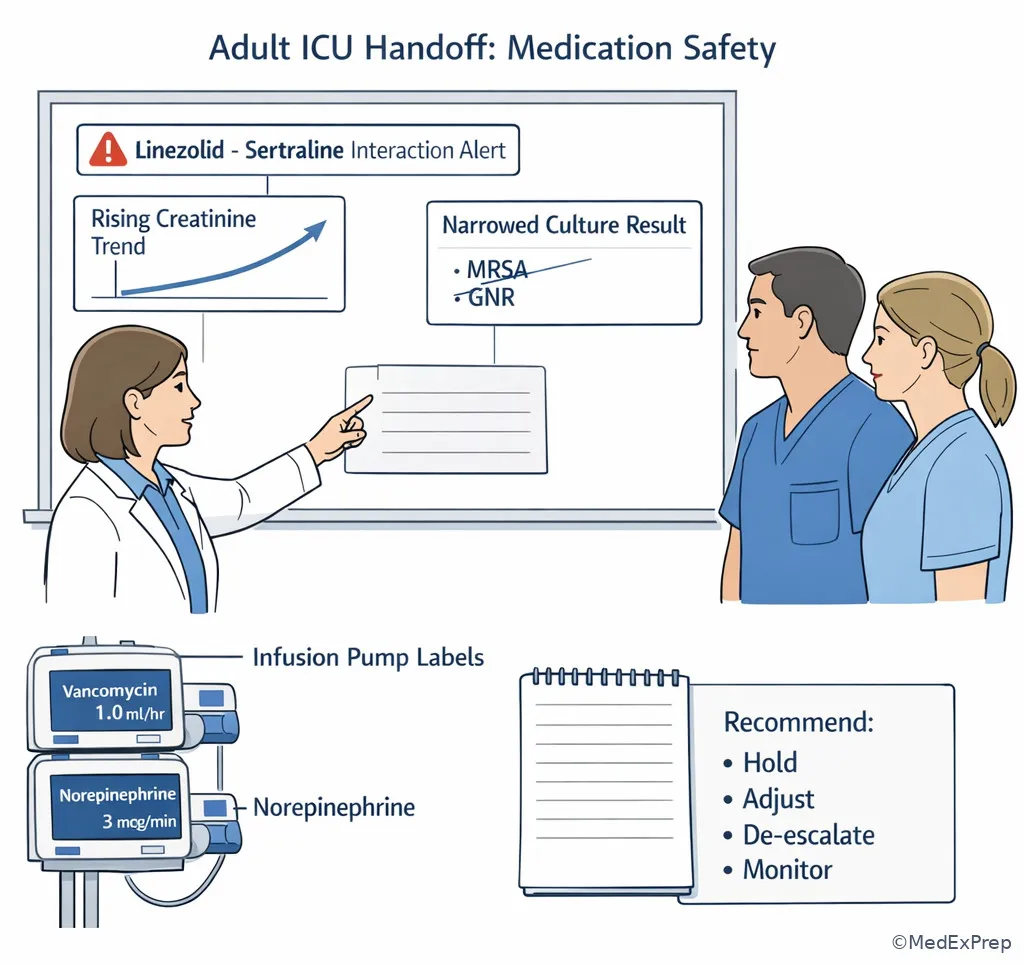
Fig 6. ICU medication escalation handoff

See Fig 6 for the pharmacist-centered escalation frame: identify the threat, recommend the change, communicate urgently, and verify follow-through.

Exam Traps & Differentiators

Common traps & distractors:

  • Most common wrong answer: the procedural or diagnosis-only option. Why: it feels more urgent and more “ICU.” Discriminator: if the stem asks for the pharmacist recommendation, choose the medication-management action.
  • Second common wrong answer: the correct drug without a monitoring plan. Why: students anchor on treatment names. Discriminator: the complete ICU answer includes efficacy and toxicity follow-up.
  • Third common wrong answer: chasing the most abnormal lab instead of the most medication-relevant one. Why: the stem is designed to distract. Discriminator: prioritize the variable that changes drug choice, dosing, or contraindication.
  • Fourth common wrong answer: discontinuing a needed drug when adjustment is enough. Why: new organ dysfunction makes the drug look dangerous. Discriminator: if the indication persists and the drug remains usable with modification, adjust rather than stop.

Looks similar but isn’t

Tempting pair Looks similar because Single clue that separates them Pharmacist-centered answer
Urgent escalation vs routine monitoring Both involve ongoing surveillance Current instability or preventable harm Escalate now when the medication issue is actively dangerous
Discontinue vs dose-adjust Both change the current regimen Whether the indication still exists and safe use remains possible Adjust if still indicated and modifiable
De-escalate vs continue broad therapy Both can be initially reasonable in severe infection Culture data or clinical reassessment supporting narrower coverage Recommend targeted therapy plus reassessment
Correct drug vs correct drug plus monitoring Both may appear therapeutically sound One option names a follow-up parameter and action threshold Choose the more complete ICU plan
Medication task vs diagnosis-only task Both sound clinically important The stem asks for pharmacist action on therapy Recommend, adjust, hold, clarify, or monitor

If the stem says “most appropriate pharmacist recommendation”, think medication action verb plus monitoring.

If the stem says “requires immediate clarification”, think unsafe order, major interaction, dose mismatch, or contraindication.

If the stem says “best next step” in an unstable patient, think urgent escalation rather than passive observation.

If the stem says “hemodynamically improved with culture data available,” think stewardship and de-escalation opportunities.

If the stem says “new organ dysfunction,” think patient-specific fit before abandoning a needed therapy.

If the stem says “multiple abnormal labs,” think which one mechanistically changes the drug decision.

Related topic trap: In the upcoming Medication Problem-Solving Framework lesson, a major error will be skipping the “identify task” step. Here, that same error appears as choosing a good ICU fact that does not answer the medication question being asked.
Review connection: The traps above test scope framing and task recognition. If any felt unfamiliar, revisit 1.1.1.1 Foundational scope: what the ICU pharmacist is expected to do and 1.1.1.2 Foundational task recognition: what data matter before you recommend anything before attempting the Self-check quiz.

Tables

Pharmacist scope task What you should assess Typical output on exam Immediate safety flag
Drug selection Indication, allergies, hemodynamics, cultures, interactions Recommend best initial therapy Contraindication or mismatch to syndrome
Dose individualization Renal function, hepatic function, weight, organ support, drug levels Recommend adjusted dose or interval Rapid organ function change with unchanged order
Safety surveillance Adverse effects, duplicate therapy, interactions, infusion rates Clarify, hold, or escalate Current harm or imminent toxicity
Monitoring plan Efficacy marker, toxicity marker, timing, thresholds State what to monitor and when No follow-up plan for high-alert drug
Stewardship Culture results, duration, response, spectrum fit De-escalate or discontinue when appropriate Broad therapy continued without reassessment
Interdisciplinary communication Urgency, recommended action, rationale, documentation Communicate and verify implementation Major interaction or unsafe order requiring immediate attention
Action verb When to choose it Close-call distractor Why distractor is wrong
Initiate Indicated therapy is missing Monitor only Observation does not fix an untreated medication need
Adjust Drug is needed but dose or interval no longer fits Discontinue Stopping is too strong if the indication remains
Hold Current administration is unsafe pending reassessment Continue with watchful waiting Ongoing exposure may worsen harm
Clarify Order intent, indication, or fit is uncertain Assume the order is correct High-alert medications require verification when details conflict
De-escalate Narrower or lower-intensity therapy is now supported Continue broad coverage Misses stewardship and avoidable toxicity
Escalate urgently Immediate medication-related harm or instability Routine documentation only Urgent hazards require real-time communication
Question pattern Primary differential Best discriminator Likely answer form
Most appropriate pharmacist recommendation Medication action vs procedural task Scope framing Recommend/adjust/clarify/monitor
Requires immediate clarification Minor imperfection vs major safety mismatch Imminent harm threshold Hold or urgently communicate
Most important to monitor Interesting abnormality vs drug-linked marker Mechanistic connection to therapy Efficacy or toxicity parameter
Best next step after new renal dysfunction Discontinue vs adjust Persistent indication Dose reassessment
Cultures now finalized Continue empiric breadth vs narrow regimen Stewardship opportunity De-escalate
Unstable patient on high-alert drug Observe vs escalate Current harm from medication Urgent communication and change
Adult ICU high-alert medication dashboard
Exam takeaway: High-alert drugs demand a linked safety parameter and a clear escalation threshold in the pharmacist plan.
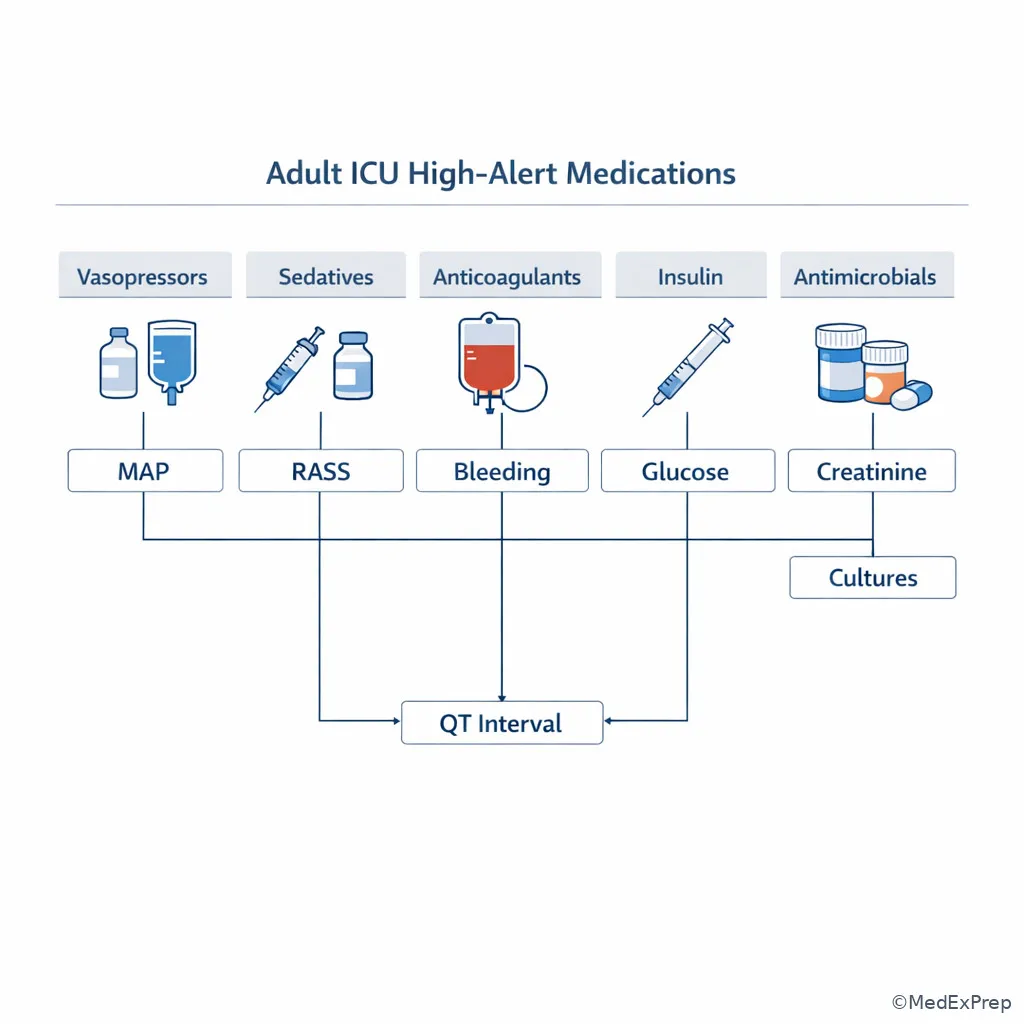
Adult ICU high-alert medication dashboard
Renal function and drug dose reassessment board
Exam takeaway: New kidney injury changes the pharmacist’s recommendation only when the drug or toxicity risk is actually renal-linked.
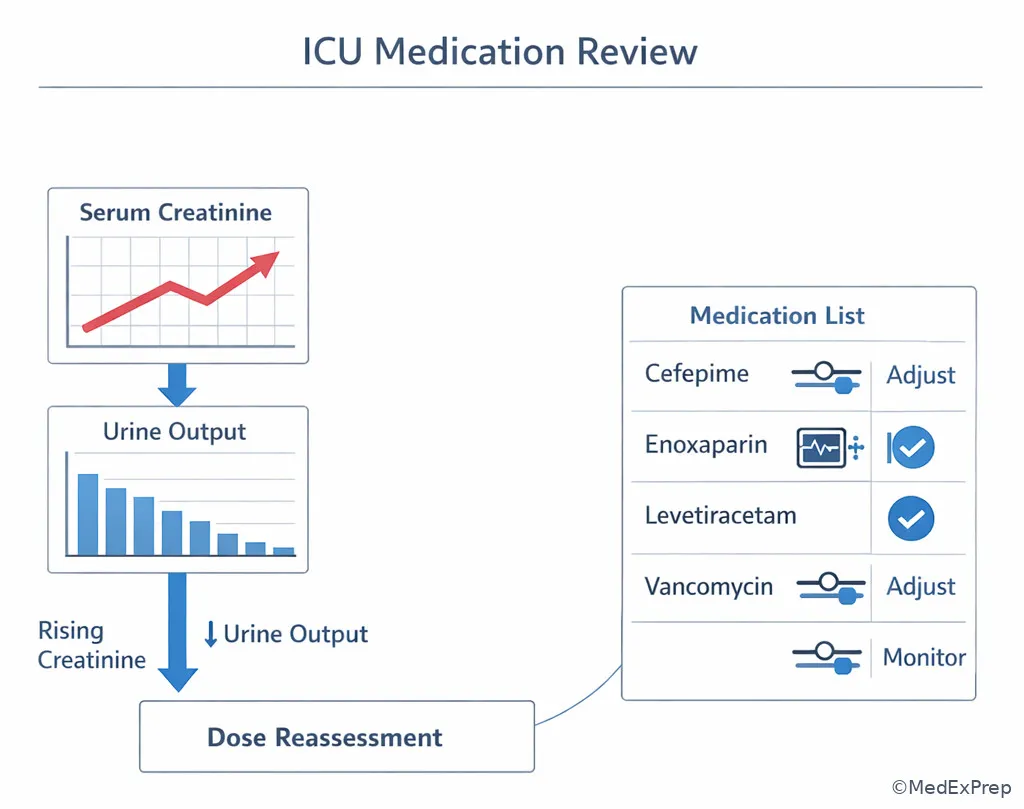
Renal function and drug dose reassessment board
Culture-guided antimicrobial de-escalation map
Exam takeaway: Once microbiology narrows the target, the pharmacist should think stewardship, duration, and toxicity reduction.
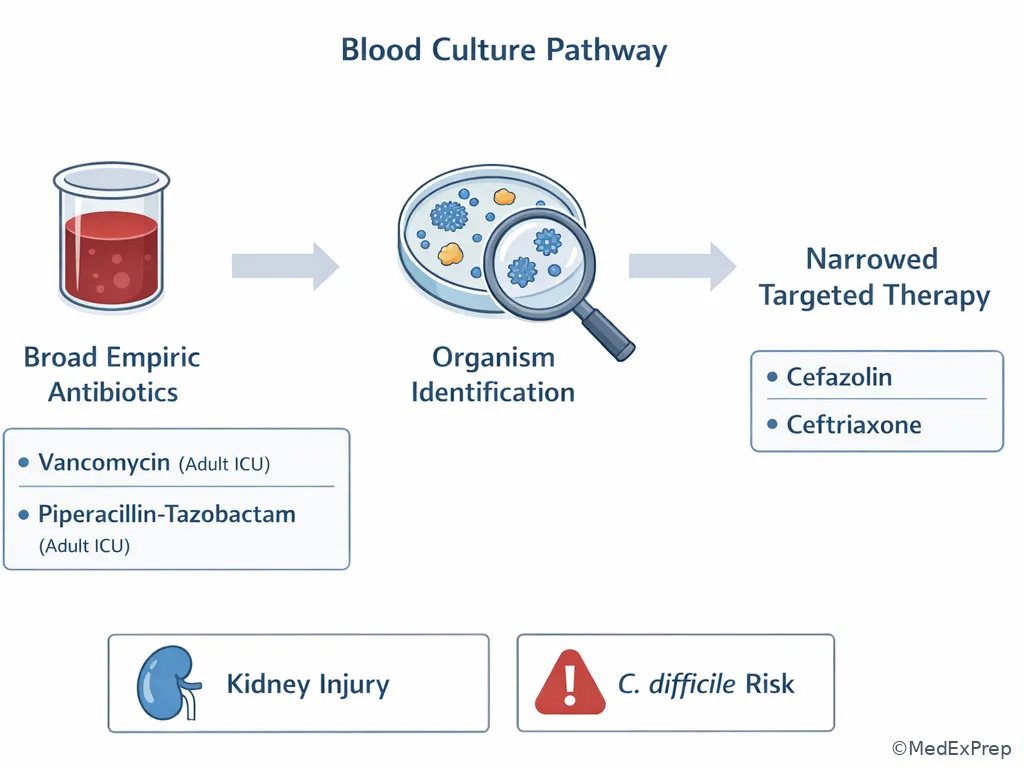
Culture-guided antimicrobial de-escalation map

Algorithm / Approach

Concept flow: Pharmacist-first ICU question approach
Start with the stem task
Ask whether the question wants drug selection, dose fit, monitoring, clarification, de-escalation, or urgent escalation.

Scope check
If an answer is primarily a procedure, bedside task, or diagnosis-only action, reject it unless paired with the pharmacist medication role.

Pull the deciding variables
Hemodynamics, renal/hepatic function, current drug exposure, interactions, indication, and the single toxicity or efficacy signal that matters most.

Choose the action verb
Initiate, adjust, hold, clarify, de-escalate, or escalate urgently based on risk and timing.

Complete the answer
Add monitoring, communication level, and reassessment trigger.

Forward reference: the next lesson, Medication Problem-Solving Framework, takes this algorithm and formalizes it into a repeatable case-solving sequence.

Rapid Review

  • Pharmacist scope → choose medication management, not bedside procedure
  • Best next step → identify the task before interpreting the entire stem
  • Noisy vignette → prioritize the variable that changes drug fit
  • New renal dysfunction → think dose adjustment before discontinuation if indication persists
  • Two good treatment options → pick the one with the stronger monitoring plan
  • Immediate medication harm → urgent communication beats passive observation
  • Culture finalization → stewardship and de-escalation opportunity
  • High-alert drug → define a hold or escalation threshold
  • Action verb trap → discontinue is too strong when modify is sufficient
  • Scope distractor → reject diagnosis-only or procedural answers lacking medication action
  • Monitoring pearl → one efficacy marker plus one toxicity marker
  • ICU pharmacist role → recommend, clarify, verify, document, escalate
Memory anchor: TASK for ICU stems: Task first, Action verb, Scope check, Key data only.

Self-check quiz

1. A 67-year-old man in septic shock is receiving norepinephrine 0.1 mcg/kg/min, cefepime 2 g IV every 8 hours, and fentanyl infusion 50 mcg/hr. He has chronic kidney disease and diabetes. The team asks for the most appropriate pharmacist recommendation. Which option best fits pharmacist scope?

  1. A. Recommend medication review with renal dose assessment and monitoring
  2. B. Perform bedside central line insertion
  3. C. Set the ventilator mode
  4. D. Independently diagnose the source of shock before addressing medications

2. A 60-year-old woman is receiving meropenem 1 g IV every 8 hours, dexmedetomidine 0.5 mcg/kg/hr, and heparin prophylaxis. She has obesity, hypertension, and new acute kidney injury. Which data point is most important before recommending meropenem dose adjustment?

  1. A. Serum creatinine trend and urine output
  2. B. Remote migraine history
  3. C. Morning cortisol level
  4. D. Home vitamin supplement list

3. A 74-year-old man with ventilator-associated pneumonia is receiving vancomycin, piperacillin/tazobactam 4.5 g IV every 6 hours, and norepinephrine 0.04 mcg/kg/min. He has stage 4 chronic kidney disease and atrial fibrillation. Cultures now show susceptible MSSA, creatinine is rising, and lactate is improving. Which is the most appropriate pharmacist recommendation?

  1. A. Continue vancomycin unchanged because Gram-positive coverage remains necessary
  2. B. De-escalate from vancomycin to a targeted anti-MSSA beta-lactam and reassess renal-adjusted dosing
  3. C. Stop all antibiotics because lactate is improving
  4. D. Increase vancomycin dose to offset critical illness volume of distribution

4. A 62-year-old woman in the neuro ICU receives levetiracetam 1,500 mg IV every 12 hours, nicardipine infusion, and enoxaparin 40 mg daily. She has obesity and contrast-associated acute kidney injury; she remains seizure-free. Which action verb best fits levetiracetam management?

  1. A. Discontinue permanently
  2. B. Adjust dose
  3. C. Escalate urgently because any renal dysfunction makes the drug prohibited
  4. D. De-escalate because seizure freedom means no further therapy is ever needed

5. A 65-year-old man receives unfractionated heparin infusion for acute PE, with aPTT-guided titration per local protocol. He has sepsis, recent abdominal surgery, and acute kidney injury. Which pharmacist recommendation is most complete?

  1. A. Continue heparin and monitor anticoagulation parameter, platelet trend, and bleeding
  2. B. Continue heparin without monitoring because the protocol handles it
  3. C. Change to enoxaparin 1 mg/kg every 12 hours without renal review
  4. D. Discontinue anticoagulation because surgery occurred during this admission

6. A 69-year-old man in mixed shock is receiving linezolid 600 mg IV every 12 hours, fentanyl infusion 125 mcg/hr, and home sertraline was resumed. He has chronic kidney disease and diabetes. He develops fever, tachycardia, and rigidity. Which pharmacist recommendation requires immediate escalation?

  1. A. Continue current therapy and recheck a CBC tomorrow
  2. B. Urgently communicate concern for serotonergic interaction and recommend immediate medication reassessment
  3. C. Wait until cultures finalize before changing medications
  4. D. Increase fentanyl to treat presumed agitation-related sympathetic surge

7. A 71-year-old woman in septic shock is receiving cefepime 2 g IV every 8 hours, vancomycin, amiodarone infusion, and insulin infusion. She has chronic kidney disease, obesity, and mild baseline confusion. Over 48 hours, creatinine doubles and she becomes more encephalopathic; QTc is stable and glucose is controlled. Which pharmacist recommendation is most appropriate?

  1. A. Focus on amiodarone because QT prolongation is always the main issue
  2. B. Review cefepime exposure and renal dose fit as a priority medication-related cause of worsening encephalopathy
  3. C. Stop insulin infusion because neurologic change means hypoglycemia until proven otherwise despite controlled glucose
  4. D. Make no changes because encephalopathy is expected in all septic ICU patients

8. A 57-year-old man with bacteremic sepsis is receiving piperacillin/tazobactam 4.5 g IV every 6 hours, vancomycin, norepinephrine 0.03 mcg/kg/min, and stress ulcer prophylaxis. He has chronic kidney disease and heart failure. Blood cultures finalize as susceptible E. coli, creatinine is worsening, and hemodynamics are improving. Which option is the best pharmacist-centered recommendation?

  1. A. Continue broad-spectrum therapy until ICU discharge because shock was present initially
  2. B. Recommend narrowing to a targeted agent and reassessing renal-adjusted dosing now
  3. C. Discontinue all antimicrobials once norepinephrine is stopped
  4. D. Independently change the vasopressor regimen to improve renal perfusion before addressing antibiotics

Answer key

1. Answer: A

  • A: Tempting because it sounds less dramatic than procedural options; correct because it stays within pharmacist scope by linking renal dose assessment and monitoring to current medications. The single stem clue is “most appropriate pharmacist recommendation.” Confirmed by pharmacist-centered critical care practice expectations in ACCP critical care training standards and standard ICU pharmacy role texts.
  • B: Tempting because septic shock often involves line-related procedures; incorrect because bedside central line insertion is outside pharmacist procedural scope. The single clue is that the task is medication management, not invasive access. Supported by BCCP scope framing and ICU pharmacy role descriptions.
  • C: Tempting because ventilated ICU patients need ventilator adjustment; incorrect because setting ventilator mode is not the pharmacist-centered answer here. The single clue is that the question asks for a recommendation on medications, not device operation.
  • D: Tempting because diagnosis informs treatment; incorrect because independently diagnosing shock before addressing drug therapy misses the medication task and exceeds the intended pharmacist role. The single clue is the presence of active ICU medications requiring review now.

Sources: DiPiro et al.; ACCP critical care pharmacy guidance.

If you missed this: Review 1.1.1.1 Foundational scope: what the ICU pharmacist is expected to do — focus on rejecting procedural distractors when the stem asks for a pharmacist recommendation.

2. Answer: A

  • A: Tempting because meropenem is commonly renally adjusted; correct because creatinine trend and urine output directly affect meropenem exposure and dose fit. The single clue is new acute kidney injury. Supported by Lexicomp, AHFS, and FDA labeling for renal dose adjustment.
  • B: Tempting because comorbid histories can matter in ICU care; incorrect because migraine history does not drive meropenem dosing in this scenario. The single clue is that the question asks specifically about dose adjustment.
  • C: Tempting because endocrine issues can complicate critical illness; incorrect because cortisol does not determine meropenem clearance. The single clue is the antimicrobial PK task.
  • D: Tempting because home medication review may reveal interactions; incorrect because supplement history is lower priority than renal function for this drug. The single clue is the acute change in kidney status.

Sources: Lexicomp; AHFS Drug Information; FDA meropenem labeling.

If you missed this: Review 1.1.1.2 Foundational task recognition: what data matter before you recommend anything — focus on the variable that mechanistically changes the drug dose.

3. Answer: B

  • A: Tempting because vancomycin covers MSSA and was appropriate empirically; incorrect because finalized MSSA data favor targeted beta-lactam therapy, and rising creatinine increases the cost of unnecessary vancomycin exposure. The single stem clue is “susceptible MSSA” plus renal worsening. IDSA stewardship principles and drug references support de-escalation.
  • B: Tempting because it addresses both microbiology and renal safety; correct because targeted anti-MSSA beta-lactam therapy is preferred once cultures identify MSSA, with renal fit reassessed. The single clue is final culture data with clinical improvement. Supported by IDSA principles, Lexicomp, and standard infectious diseases references.
  • C: Tempting because lactate improvement suggests recovery; incorrect because improving perfusion does not justify stopping active infection treatment. The single clue is ongoing documented pneumonia with positive cultures.
  • D: Tempting because critical illness can increase volume of distribution; incorrect because the patient now has rising creatinine and a narrower pathogen-directed option, not a reason for vancomycin escalation. The single clue is renal injury plus MSSA susceptibility.

Sources: IDSA stewardship guidance; Lexicomp; AHFS.

If you missed this: Review 1.1.1.3 Application: choosing the right pharmacist action verb — focus on when culture data change the answer from continue to de-escalate.

4. Answer: B

  • A: Tempting because renal injury makes continued therapy feel risky; incorrect because the indication persists and levetiracetam often remains usable with dose adjustment. The single clue is that the patient remains at risk and seizure-free on therapy rather than experiencing a definitive contraindication. Supported by Lexicomp and FDA labeling.
  • B: Tempting because it preserves therapy while addressing new renal mismatch; correct because renal clearance changes drug fit without necessarily eliminating the indication. The single clue is contrast-associated acute kidney injury in a patient on an actively indicated renally cleared medication.
  • C: Tempting because kidney dysfunction raises concern for accumulation; incorrect because renal dysfunction does not universally prohibit levetiracetam. The single clue is absence of a true contraindication or acute severe toxicity.
  • D: Tempting because seizure freedom looks like treatment success; incorrect because being controlled does not mean prophylaxis or ongoing therapy is no longer needed in the ICU context. The single clue is that the question asks about dose fit, not stopping based on success alone.

Sources: Lexicomp; FDA levetiracetam labeling.

If you missed this: Review 1.1.1.3 Application: choosing the right pharmacist action verb — focus on the discriminator between discontinuation and dose adjustment when the indication remains.

5. Answer: A

  • A: Tempting because it sounds detailed; correct because UFH management in critically ill adults requires protocol-based anticoagulation monitoring plus bleeding and platelet surveillance. The single clue is active therapeutic heparin infusion in a high-risk ICU patient. Supported by CHEST/anticoagulation guidance and institutional protocol principles.
  • B: Tempting because protocols standardize titration; incorrect because the pharmacist is still responsible for recognizing and following efficacy and safety parameters. The single clue is that the question asks for the most complete recommendation.
  • C: Tempting because enoxaparin is commonly used for VTE treatment; incorrect because acute kidney injury makes blind conversion inappropriate and the stem emphasizes ongoing UFH management. The single clue is renal dysfunction with a currently titratable ICU anticoagulant.
  • D: Tempting because recent surgery increases bleeding risk; incorrect because surgery alone does not mandate cessation of indicated therapeutic anticoagulation without more bleeding context. The single clue is acute PE requiring treatment.

Sources: CHEST antithrombotic guidance; Lexicomp; AHFS.

If you missed this: Review 1.1.1.4 Application: monitoring, reassessment, and safety surveillance are part of the answer — focus on why the complete answer includes both efficacy and safety monitoring.

6. Answer: B

  • A: Tempting because linezolid can cause delayed hematologic toxicity that merits CBC review; incorrect because fever, tachycardia, and rigidity with sertraline coexposure point to a more urgent serotonergic safety issue. The single clue is the symptomatic linezolid-sertraline combination. Supported by FDA labeling, Lexicomp interaction data, and critical care drug references.
  • B: Tempting because it escalates a drug interaction concern quickly; correct because the combination plus current symptoms suggests immediate medication-related harm requiring urgent communication and reassessment. The single clue is active instability with a known interaction pair.
  • C: Tempting because antimicrobial decisions often depend on cultures; incorrect because an acute safety interaction cannot wait for microbiology. The single clue is the current syndrome of toxicity, not pathogen uncertainty.
  • D: Tempting because agitation can increase sympathetic tone; incorrect because increasing fentanyl misses the probable interaction and may worsen assessment difficulty. The single clue is rigidity and serotonergic coexposure, not undertreated pain alone.

Sources: Lexicomp interaction monographs; FDA linezolid labeling; AHFS.

If you missed this: Review 1.1.1.5 Integration: escalation, communication, and stewardship within pharmacist scope — focus on the threshold for urgent escalation when a medication interaction is causing current harm.

7. Answer: B

  • A: Tempting because amiodarone often raises QT concerns in ICU patients; incorrect because the stem specifically says QTc is stable, while renal failure plus encephalopathy makes cefepime exposure the more discriminating medication issue. The single clue is stable QTc with doubling creatinine.
  • B: Tempting because cefepime neurotoxicity is a known renal exposure problem; correct because worsening encephalopathy in the setting of rising creatinine should trigger review of cefepime dose fit and neurotoxicity risk. The single clue is renal deterioration temporally linked to neurologic decline. Supported by Lexicomp, FDA cefepime labeling, and ICU antimicrobial references.
  • C: Tempting because hypoglycemia can cause neurologic change; incorrect because the stem says glucose is controlled, removing that as the best medication explanation. The single clue is absence of glucose evidence for insulin-related neurotoxicity.
  • D: Tempting because septic encephalopathy is common; incorrect because the board expects pharmacists to identify medication-related causes when a known drug-risk pattern is present. The single clue is cefepime plus acute kidney injury.

Sources: Lexicomp; FDA cefepime labeling; AHFS.

If you missed this: Review 1.1.1.2 Foundational task recognition: what data matter before you recommend anything — focus on matching the symptom to the drug-specific risk signal most changed by organ dysfunction.

8. Answer: B

  • A: Tempting because shock initially justifies broad empiric therapy; incorrect because finalized susceptible E. coli cultures and improving hemodynamics create a stewardship opportunity, especially with worsening kidney function. The single clue is improving shock plus organism identification. Supported by IDSA stewardship principles and antimicrobial references.
  • B: Tempting because it combines spectrum narrowing with renal safety; correct because the pharmacist should recommend targeted therapy and reassess dose fit based on worsening creatinine. The single clue is culture finalization paired with renal deterioration.
  • C: Tempting because vasopressor discontinuation may suggest recovery; incorrect because stopping antibiotics based on hemodynamic recovery alone ignores the documented bloodstream infection. The single clue is active bacteremia requiring treatment continuation, not cessation.
  • D: Tempting because renal perfusion matters in shock; incorrect because independently changing vasopressors is outside the stem’s pharmacist-centered antimicrobial task. The single clue is the question asking for the best medication-centered recommendation regarding current therapy optimization.

Sources: IDSA stewardship guidance; Lexicomp; AHFS Drug Information.

If you missed this: Review 1.1.1.5 Integration: escalation, communication, and stewardship within pharmacist scope — focus on culture-driven de-escalation and renal dose reassessment as the pharmacist-centered next step.

References

  • DiPiro, Joseph T., et al. Pharmacotherapy: A Pathophysiologic Approach. McGraw-Hill, latest available edition.
  • Lexicomp Online. Wolters Kluwer, current drug monographs and interaction databases.
  • AHFS Drug Information. American Society of Health-System Pharmacists, current edition.
  • U.S. Food and Drug Administration. Prescribing information for selected critical care medications, current labeling.
  • Society of Critical Care Medicine and American College of Clinical Pharmacy guidance documents relevant to critical care pharmacy practice and medication management.
  • Infectious Diseases Society of America guidance on antimicrobial stewardship and pathogen-directed therapy, current available statements.

Last reviewed: March 15, 2026

Lesson 2

Medication Problem-Solving Framework

Medication Problem-Solving Framework

This foundational lesson teaches a repeatable pharmacist-centered method for adult ICU medication decisions: define the task, extract the decisive data, apply the best evidence-informed rule, and verify efficacy, safety, and monitoring.

What you will learn

  • BCCP all-domain foundation -> medication problem identification: identify the medication-related task before selecting a drug, dose, or monitoring plan.
  • BCCP all-domain foundation -> ICU data extraction: prioritize hemodynamics, organ function, drug exposure, infection or syndrome clues, and safety constraints.
  • BCCP all-domain foundation -> evidence-informed therapy selection: translate a broad guideline or protocol into a patient-specific recommendation.
  • BCCP all-domain foundation -> monitoring and reassessment: verify efficacy, safety, toxicity risk, and escalation or de-escalation triggers.
  • BCCP all-domain foundation -> pharmacist scope: communicate urgent medication recommendations while escalating non-pharmacist procedural decisions to the appropriate ICU team member.
Blueprint mapping

Domain: bp.all -> subject: foundations-of-critical-care-pharmacy. Exact weight is not specified in the supplied source; use this as a cross-cutting framework for all BCCP pharmacotherapy domains.

Estimated time

35-45 minutes

Prereqs

Adult ICU Pharmacist Scope; basic ICU vital signs, renal and hepatic function, and medication safety terminology.

Key output

You should be able to choose the most appropriate pharmacist recommendation when several ICU therapies look reasonable but differ by task, timing, organ dysfunction, exposure, or monitoring burden.

Why it matters

  • Most BCCP-style decisions are not solved by recognizing a drug name alone; they require identifying the task the stem is asking you to perform.
  • Critically ill adults often have competing clues: shock, kidney injury, recent drug exposure, culture data, procedures, nutrition changes, sedation needs, or bleeding risk may all affect the answer.
  • A consistent framework prevents premature closure, especially when a tempting option treats the syndrome but ignores a contraindication, dose adjustment, toxicity risk, or reassessment requirement.
  • The pharmacist-centered role is to recommend, verify, monitor, de-escalate, and communicate medication decisions, while escalating procedural or diagnostic actions outside pharmacy scope.

Key Terms & Must-Know Facts

Term High-yield meaning Exam discriminator
Medication-related problem A drug selection, dose, route, timing, duration, monitoring, safety, interaction, stewardship, or transition issue that a pharmacist can act on. The answer must address the medication task, not a non-pharmacist procedure.
Task identification Determining whether the stem asks for initial therapy, escalation, de-escalation, dose adjustment, monitoring, toxicity management, or communication. The verb in the question often determines the answer.
Decisive data The minimum patient-specific facts that change therapy. Examples include MAP trend, lactate trend, urine output, creatinine trajectory, cultures, organ support, QTc, bleeding, or drug level.
Exposure history Recent or current medication exposure that changes efficacy, resistance, toxicity, interaction, or withdrawal risk. Prior therapy can make the obvious option wrong.
Evidence-informed rule A guideline, protocol, pharmacology principle, PK/PD target, safety rule, or trial-informed standard applied to the specific patient. Broad rules must be filtered through organ function and acuity.
Monitoring plan Objective measures used to determine efficacy and safety after the recommendation. A plan without monitoring is incomplete in ICU pharmacy.
Reassessment trigger A defined change that should prompt escalation, de-escalation, dose change, drug level check, discontinuation, or team communication. Look for culture results, hemodynamic response, toxicity, renal change, or procedure timing.
Local protocol variation Institutional formulary, dosing, stewardship, and monitoring processes may differ. Do not treat local rules as universal unless the stem provides them.
Pharmacist scope boundary The pharmacist recommends and manages medication-related care collaboratively but does not perform intubation, line placement, surgery, or independent non-pharmacist diagnosis. Escalate procedural tasks; own the medication recommendation.
Must-know facts:

  • Start every ICU pharmacotherapy case by naming the task: choose, adjust, monitor, stop, escalate, de-escalate, reverse, or communicate.
  • Separate signal from noise: the decisive clue is the one that changes the medication recommendation.
  • Use organ function as a safety screen before accepting any dose, infusion, anticoagulant, antimicrobial, sedative, or vasoactive plan.
  • Do not let one abnormal lab override the clinical question; decide whether it affects the asked task.
  • Effective ICU recommendations include a reassessment plan, not just a drug name.
  • When options appear equally plausible, choose the one that best matches timing, acuity, contraindications, monitoring feasibility, and pharmacist scope.
Fig 1. Four-part ICU medication reasoning loop
Exam takeaway: The safest BCCP answer usually follows task, data, rule, and verification rather than immediate drug selection.
flowchart LR
A[Identify medication task] --> B[Extract decisive ICU data]
B --> C[Apply evidence-informed rule]
C --> D[Recommend patient-specific plan]
D --> E[Verify efficacy safety monitoring]
E --> B

See Fig 1 for the core loop used throughout this lesson.

Core content

1. Start with the task before the drug

A. Explanation

Decision conflict: ICU stems often present a recognizable syndrome, but the correct answer depends on what the pharmacist is being asked to do at that moment. A septic shock stem may ask for empiric antimicrobial timing, vasopressor escalation, renal dose adjustment, culture-directed de-escalation, or toxicity monitoring. Each task leads to a different best answer.

WHY THIS IS TESTED: BCCP questions reward clinical prioritization. If you jump directly to a drug because a diagnosis is familiar, you may miss that the safest recommendation is to modify the dose, clarify duration, hold a harmful agent, order monitoring, or urgently communicate a medication safety concern.

The first move is to translate the question into a pharmacist action: initiate, modify, monitor, prevent harm, de-escalate, reverse, or handoff. The drug name comes after the task is defined.

1Read the last sentence first and identify the verb.
2Convert the verb into a pharmacist action.
3Ignore distractors that do not change that action.
4Select the recommendation that completes the requested medication task.
Task-first clinical reasoning
Exam takeaway: A pharmacist at an ICU workstation should anchor the recommendation to the asked medication task, not the most dramatic abnormal value.
{"prompt":"Professional medical education illustration of an adult ICU pharmacist reviewing a patient profile on a workstation with labeled callouts: question verb, medication task, decisive data, recommendation, monitoring. Clean clinical style, no patient-identifying details, BCCP exam preparation context.","caption":"Task-first reasoning at the ICU workstation","size":"1024x1024"}

B. Worked example

A 67-year-old man with chronic kidney disease, heart failure with reduced ejection fraction, and COPD is in the medical ICU with septic shock. He is receiving norepinephrine, cefepime, vancomycin, and stress ulcer prophylaxis. Serum creatinine increased from 1.4 to 2.6 mg/dL, urine output is falling, and QTc is 510 ms. A culture later grows a susceptible gram-negative organism. The question asks: What is the most appropriate pharmacist recommendation to optimize antimicrobial therapy?

  1. Identify task: Optimize antimicrobial therapy after culture data, not choose initial sepsis therapy.
  2. Extract key facts: Susceptible gram-negative isolate, worsening renal function, broad empiric coverage currently present.
  3. Apply rule: When microbiology supports narrowing, recommend de-escalation and renal adjustment as appropriate.
  4. Eliminate distractors: Adding atypical coverage is tempting because COPD is present, but the task is culture-directed optimization. QTc is noise unless an option adds QT-prolonging therapy.
  5. Verify: Monitor clinical response, renal function, culture clearance if relevant, and duration.

C. Exam trap

Common wrong answer: Continue all broad empiric agents because the patient remains critically ill. Why tempting: Shock makes broad coverage feel safer. Single clue that eliminates it: The stem provides a susceptible organism and asks to optimize therapy, which points to de-escalation plus patient-specific dosing.

D. Checkpoint MCQ

A patient in shock is receiving empiric antimicrobials. Cultures identify a susceptible pathogen, renal function has worsened, and the question asks for the most appropriate pharmacist recommendation to optimize therapy. Which approach is best?

  1. Escalate to broader antimicrobial therapy because the patient is in an ICU.
  2. De-escalate to targeted therapy and adjust dosing based on current renal function.
  3. Add a second agent from the same antimicrobial class to improve coverage.
  4. Focus on ventilator settings because oxygenation is abnormal.

Answer: B. A is tempting because acuity is high, but culture data support narrowing. B is correct because it addresses the task, microbiology, and organ function. C is tempting as a coverage strategy but duplicates exposure without a clear rule. D may matter clinically, but ventilator mechanics are not the pharmacist medication task.

If you missed this: Review 1. Start with the task before the drug - focus on using the question verb to define the medication action.

2. Extract decisive ICU data, not all ICU data

A. Explanation

Decision conflict: ICU cases contain large amounts of information. Some findings are decisive, some provide context, and some are distractors. The pharmacist must identify which data change the medication recommendation.

WHY THIS IS TESTED: BCCP cases assess whether you can prioritize medication-relevant data under critical care uncertainty. Hemodynamics, organ function, exposure, cultures, drug levels, bleeding risk, QTc, sedation target, and procedure timing often matter more than a dramatic but unrelated abnormality.

Use a deliberate data triage screen: severity, organ function, exposure, contraindications, and monitoring feasibility. Do not recite every value; ask which value changes therapy.

1Mark acuity: shock, hypoxemia, bleeding, seizure, arrhythmia, or organ support.
2Mark organ function: kidney, liver, hemodynamics, neurologic status.
3Mark exposure: current drugs, recent failures, levels, allergies, interactions.
4Keep only data that change selection, dose, route, monitoring, or stopping.
Fig 2. Decisive data filter for ICU medication decisions
Exam takeaway: The decisive clue is the one that changes selection, dose, safety, monitoring, escalation, or de-escalation.
flowchart TD
A[ICU case data] --> B{Does this affect medication action?}
B -->|Selection| C[Drug or class choice]
B -->|Dose| D[Renal hepatic weight organ support adjustment]
B -->|Safety| E[Contraindication interaction toxicity]
B -->|Monitoring| F[Level lab endpoint reassessment]
B -->|No| G[Context or distractor]

See Fig 2 when a stem feels overloaded with labs and comorbidities.

ICU data triage dashboard
Exam takeaway: Medication-relevant data should be grouped by acuity, organ function, exposure, and safety rather than read as an unranked list.
{"prompt":"Clean educational illustration of an ICU pharmacist data dashboard divided into four labeled panels: hemodynamics, organ function, medication exposure, safety monitoring. Include abstract vital signs, creatinine trend, drug level icon, and warning triangle. No real patient data.","caption":"ICU data triage dashboard for pharmacist reasoning","size":"1024x1024"}

B. Worked example

A 58-year-old woman with obesity, cirrhosis, and atrial fibrillation is admitted to the surgical ICU with pneumonia and hypotension. She receives vasopressors and empiric antibiotics. Data include bilirubin 3.1 mg/dL, serum creatinine 0.7 mg/dL, albumin 2.2 g/dL, QTc 470 ms, magnesium 1.6 mg/dL, and remote rash with penicillin as a child. The question asks for the best safety monitoring plan after starting a QT-prolonging antiarrhythmic.

  1. Identify task: Monitoring plan, not infection treatment or anticoagulation.
  2. Extract key facts: QT-prolonging drug, QTc borderline prolonged, low magnesium, ICU acuity.
  3. Apply rule: Monitor QTc and correct electrolytes that increase torsades risk.
  4. Eliminate distractors: Penicillin rash is tempting because antibiotics are present, but it does not govern QT monitoring. Creatinine is normal and not the decisive clue for this monitoring task.
  5. Verify: Follow ECG/QTc, potassium and magnesium, bradycardia, interacting QT-prolonging drugs, and rhythm response.

C. Exam trap

Common wrong answer: Focus on renal dose adjustment because every ICU pharmacist case includes renal function. Why tempting: Renal dosing is frequently tested. Single clue that eliminates it: The question asks for safety monitoring after a QT-prolonging drug, and hypomagnesemia is the medication-relevant abnormality.

D. Checkpoint MCQ

Which data element is most decisive when designing monitoring for a QT-prolonging ICU medication?

  1. Remote childhood rash to penicillin.
  2. Low magnesium with borderline prolonged QTc.
  3. Stable serum creatinine in the reference range.
  4. History of obesity without weight-based dosing in the answer choices.

Answer: B. A is tempting because allergy history matters for antimicrobial selection, but it does not drive QT monitoring. B is correct because electrolyte abnormalities and baseline QTc directly affect torsades risk. C is always worth noting, but it is not decisive for QT monitoring here. D may affect dosing for some drugs, but the question is safety monitoring.

If you missed this: Review 2. Extract decisive ICU data, not all ICU data - focus on matching the data element to the asked medication task.
Quick Recall:

  • Fill in the blank: The decisive clue is the clue that changes drug selection, dose, safety, monitoring, or ______.
  • True/false: A dramatic abnormal lab is always the governing clue. Answer: False.
  • One-liner: Before reading all options, name the pharmacist action requested by the stem.

3. Apply the evidence-informed rule to the specific patient

A. Explanation

Decision conflict: Board-style options often include several therapies that are reasonable in the abstract. The correct option is the one that best fits the patient-specific rule: timing, syndrome, organ function, contraindications, exposure, route, monitoring, and local protocol context.

WHY THIS IS TESTED: Critical care pharmacy is not memorization of drug lists. The exam expects you to translate pharmacology, evidence, guidelines, and institutional protocols into a recommendation that works for this adult ICU patient at this time.

A practical rule statement should sound like: Because this patient has X, and the task is Y, recommend Z, while monitoring A and avoiding B. If you cannot state the rule, you may be guessing.

1State the syndrome or medication problem.
2Name the governing rule or principle.
3Filter by contraindications, organ function, exposure, and monitoring.
4Choose the option that best operationalizes the rule.
Fig 3. Rule-to-patient translation
Exam takeaway: A guideline-level rule becomes correct only after it survives patient-specific safety and feasibility checks.
flowchart LR
A[Evidence or guideline principle] --> B[Patient syndrome]
B --> C[Organ function and exposure screen]
C --> D[Contraindication and interaction screen]
D --> E[Monitoring and reassessment plan]
E --> F[Patient-specific recommendation]

See Fig 3 for the translation step that separates memorized therapy from board-ready reasoning.

Rule type What it answers Typical ICU discriminator
Timing rule When therapy must begin, change, or stop. Sepsis timing, thrombolysis window, reversal urgency, sedation interruption, procedure timing.
Selection rule Which class or agent best fits the syndrome. Shock type, infection site, seizure phase, anticoagulation indication, bronchospasm severity.
Dosing rule How to individualize amount or interval. Weight, kidney function, CRRT, hepatic dysfunction, drug level, hemodynamic instability.
Safety rule What must be avoided or monitored. QTc, bleeding, thrombocytopenia, hypotension, delirium, oversedation, nephrotoxicity.
Stewardship rule When to narrow, stop, or define duration. Culture results, source control, clinical response, duplicate coverage, colonization versus infection.
Evidence-to-bedside translation
Exam takeaway: The pharmacist converts broad evidence into a specific medication plan using organ function and safety screens.
{"prompt":"Textbook-style illustration showing a pathway from guideline document to ICU patient chart to pharmacist recommendation. Include labels: evidence principle, patient factors, safety screen, monitoring plan. Modern clinical education design, no logos.","caption":"Evidence-to-bedside medication translation","size":"1024x1024"}

B. Worked example

A 72-year-old man with septic shock, chronic atrial fibrillation, type 2 diabetes, and acute kidney injury is receiving norepinephrine, broad-spectrum antibiotics, and enteral nutrition. He develops new agitation. His RASS target is 0 to -1, current RASS is +2, pain score is elevated, oxygenation is stable, and he has a history of prolonged QTc. The question asks for the best initial pharmacist recommendation for sedation support.

  1. Identify task: Best initial sedation support.
  2. Extract key facts: Agitation with elevated pain score, light sedation target, QTc history.
  3. Apply rule: Address pain before escalating sedatives when pain is a driver; avoid unnecessary QT-risk agents if safer approaches fit.
  4. Eliminate alternatives: Antipsychotic escalation is tempting because agitation is present, but pain is the modifiable driver. Deep sedation is tempting in an ICU patient, but the target is light sedation.
  5. Verify: Reassess pain score, RASS, respiratory status, hemodynamics, delirium risk, and need for ongoing sedative exposure.

C. Exam trap

Common wrong answer: Select a sedative because the patient is agitated. Why tempting: Agitation appears to be the visible problem. Single clue that eliminates it: The pain score is elevated and the target is light sedation, so the governing rule is analgesia-first optimization.

D. Checkpoint MCQ

Which statement best describes applying an evidence-informed rule in a BCCP medication case?

  1. Choose the most familiar guideline drug before reviewing organ function.
  2. Choose the option that fits the rule after screening patient-specific contraindications and monitoring needs.
  3. Choose the broadest therapy when the patient is critically ill.
  4. Choose the medication with the fewest monitoring parameters even if it does not address the task.

Answer: B. A is tempting because guidelines are important, but unfiltered guideline use can be unsafe. B is correct because evidence must be individualized. C is tempting in high-acuity stems but may violate stewardship or safety. D is tempting for simplicity, but feasibility cannot replace appropriateness.

If you missed this: Review 3. Apply the evidence-informed rule to the specific patient - focus on filtering broad rules through patient-specific safety screens.

4. Verify efficacy, safety, and monitoring before finalizing

A. Explanation

Decision conflict: A medication recommendation may be correct initially but incomplete if it lacks monitoring, toxicity prevention, or reassessment. In the ICU, organ function and hemodynamics can change quickly, so the plan must include what success and harm look like.

WHY THIS IS TESTED: BCCP practice requires therapeutic monitoring, adverse effect prevention, and modification of therapy as the patient evolves. The best answer often includes a monitoring plan or reassessment trigger, not just the initial medication.

Use the EVS check: efficacy endpoint, vital safety issue, and schedule or trigger for reassessment. This is especially high-yield for high-alert medications, antimicrobials, anticoagulants, sedatives, vasoactives, electrolytes, and renally cleared drugs.

1Define the efficacy endpoint.
2Define the major safety endpoint.
3Define when to reassess.
4Define what change triggers escalation, de-escalation, or discontinuation.
Fig 4. Efficacy-safety-monitoring verification check
Exam takeaway: A complete ICU pharmacist answer states what to monitor and what finding changes the plan.
flowchart TD
A[Medication recommendation] --> B[Efficacy endpoint]
A --> C[Safety endpoint]
A --> D[Monitoring timing]
B --> E[Continue modify or escalate]
C --> E
D --> E
E --> F[Document and communicate]

See Fig 4 for the verification check to apply before choosing a final answer.

Monitoring plan checklist
Exam takeaway: Monitoring links the recommendation to objective endpoints and prevents therapy from becoming a set-and-forget order.
{"prompt":"Clinical education image of an ICU pharmacist checklist with columns: efficacy endpoint, safety endpoint, reassessment trigger, communication. Background includes abstract ICU monitor and medication infusion icons. Professional clean style.","caption":"Medication monitoring checklist for ICU pharmacists","size":"1024x1024"}

B. Worked example

A 64-year-old man with obesity, acute respiratory failure, and new renal dysfunction is receiving a high-alert continuous infusion. His blood pressure has stabilized, urine output is changing, and the team asks whether to continue the same medication plan. A distracting mild transaminase elevation is present, but the drug is primarily renally affected. The most appropriate pharmacist recommendation should include reassessment of efficacy, renal function, infusion-related adverse effects, and a trigger to reduce, stop, or change therapy.

  1. Identify task: Verify ongoing therapy.
  2. Extract key facts: High-alert infusion, renal function changing, hemodynamics improved.
  3. Apply rule: Continue only if efficacy persists and safety remains acceptable; adjust when organ function changes.
  4. Eliminate distractors: Mild transaminase elevation may be context, but it does not govern a primarily renally affected infusion unless the option makes it relevant.
  5. Verify: Define endpoint, adverse effect screen, renal monitoring interval, and communication plan.

C. Exam trap

Common wrong answer: Keep the initial regimen unchanged because the patient improved. Why tempting: Clinical improvement feels like confirmation. Single clue that eliminates it: ICU organ function is changing, so the pharmacist must reassess dose, safety, and monitoring.

D. Checkpoint MCQ

Which plan is most complete after recommending a high-alert ICU medication?

  1. Start the medication and reassess only if the prescriber requests it.
  2. Start the medication, define efficacy and safety endpoints, and specify reassessment triggers.
  3. Start the medication and avoid monitoring to reduce lab burden.
  4. Start a second medication from the same class to prevent under-treatment.

Answer: B. A is tempting when workflows are busy, but pharmacist accountability includes monitoring. B is correct because it verifies effect and harm. C is tempting when lab burden matters, but high-alert therapies require surveillance. D is tempting in severe illness but adds risk without defining the need.

If you missed this: Review 4. Verify efficacy, safety, and monitoring before finalizing - focus on pairing every recommendation with endpoints and reassessment triggers.
Quick Recall:

  • Fill in the blank: A complete recommendation includes efficacy, safety, and ______.
  • True/false: Improvement after a medication means no dose reassessment is needed. Answer: False.
  • One-liner: For high-alert ICU drugs, define the adverse effect that would make you change the plan.

5. Communicate within pharmacist scope and escalate appropriately

A. Explanation

Decision conflict: Some ICU stems include urgent bedside issues. The pharmacist may recognize the risk, but the correct answer must remain within medication-management scope: recommend, clarify, verify, document, and communicate urgently. Procedural tasks belong to the appropriate clinician or team.

WHY THIS IS TESTED: BCCP candidates practice in interdisciplinary adult ICU settings. Safe answers distinguish medication authority from procedural authority, especially during emergencies, high-alert medication use, protocol deviations, or transitions of care.

The correct recommendation often includes both a medication action and a communication action: notify the intensivist, clarify the order, alert nursing to monitoring parameters, contact stewardship, or document a handoff. When local protocols vary, follow the protocol supplied in the stem or state that institutional guidance should be used.

1Identify whether the issue is medication-related, procedural, or both.
2Own the medication recommendation.
3Escalate non-pharmacist tasks to the appropriate team member.
4Document and hand off the monitoring plan.
Fig 5. Pharmacist scope boundary in ICU problem solving
Exam takeaway: The pharmacist should act decisively on medication problems while escalating procedures and non-pharmacist decisions.
flowchart TD
A[Urgent ICU problem] --> B{Medication-management task?}
B -->|Yes| C[Recommend select dose adjust monitor stop]
B -->|No| D[Escalate to intensivist procedural or nursing team]
C --> E{Requires team action?}
E -->|Yes| F[Communicate urgently and document]
E -->|No| G[Implement per collaborative protocol if authorized]
F --> H[Reassess outcome]

See Fig 5 for the scope boundary that prevents out-of-role answers.

Interdisciplinary ICU medication communication
Exam takeaway: Medication recommendations are safest when paired with clear communication to the prescriber, nurse, and relevant ICU service.
{"prompt":"Professional illustration of an interdisciplinary ICU team huddle with a pharmacist pointing to medication safety notes on a tablet. Include abstract labels: pharmacist recommendation, prescriber clarification, nursing monitoring, documentation. No identifiable patients.","caption":"ICU pharmacist communication and escalation","size":"1024x1024"}

B. Worked example

A 61-year-old woman with acute respiratory failure, septic shock, chronic opioid use, and acute kidney injury is ordered a medication dose that exceeds the usual renal-adjusted range. She is also becoming more hypoxemic. The question asks for the most appropriate pharmacist action. The hypoxemia is urgent, but the pharmacist-centered medication problem is unsafe dosing in kidney injury.

  1. Identify task: Medication safety intervention.
  2. Extract key facts: Acute kidney injury and excessive dose; hypoxemia requires team awareness but not a pharmacist procedure.
  3. Apply rule: Recommend dose adjustment or alternative therapy and communicate urgently.
  4. Eliminate distractors: Performing intubation or setting ventilator mechanics is outside pharmacist scope. Ignoring hypoxemia is unsafe because the team should be alerted.
  5. Verify: Document recommendation, monitor renal function and drug toxicity, and confirm the corrected order.

C. Exam trap

Common wrong answer: Choose the dramatic procedural action because the patient is unstable. Why tempting: ICU emergencies create urgency. Single clue that eliminates it: The pharmacist task is medication safety; procedural management must be escalated while the pharmacist fixes the medication issue.

D. Checkpoint MCQ

A critically ill adult has a medication order that is unsafe in current renal dysfunction, and the bedside team is also evaluating worsening respiratory status. What is the most appropriate pharmacist-centered response?

  1. Recommend a renal-appropriate medication plan and urgently communicate the safety concern to the ICU team.
  2. Perform intubation before addressing the medication issue.
  3. Ignore the medication order until respiratory status is resolved.
  4. Document the issue but avoid contacting the prescriber because the ICU is busy.

Answer: A. A is correct because it owns the medication task and communicates urgency. B is tempting because respiratory failure is serious, but intubation is outside pharmacist scope. C is tempting when another problem looks more dramatic, but unsafe medication exposure can worsen harm. D is tempting as passive documentation, but urgent safety issues require communication.

If you missed this: Review 5. Communicate within pharmacist scope and escalate appropriately - focus on owning medication decisions while escalating procedural tasks.

Exam Traps & Differentiators

Common traps & distractors:

  • Broadest therapy wins. Tempting because ICU patients are sick; eliminated when cultures, toxicity, or stewardship clues support narrowing.
  • The most abnormal lab wins. Tempting because abnormal values stand out; eliminated when the lab does not change the asked medication task.
  • Guideline drug without patient filter. Tempting because guidelines are high-yield; eliminated by renal dysfunction, QTc, bleeding, interaction, exposure, or monitoring feasibility.
  • Improvement means no reassessment. Tempting because response feels reassuring; eliminated by changing organ function or high-alert medication exposure.
  • Procedural action as pharmacist answer. Tempting in emergency stems; eliminated when the safe role is medication recommendation plus urgent escalation.
Looks similar But differs by Choose when Avoid when
Initial therapy vs de-escalation Timing and available microbiology Initial therapy when no organism or susceptibility is available Broad continuation when culture data support narrowing
Dose adjustment vs drug discontinuation Severity of toxicity or contraindication Adjust when therapy remains appropriate and exposure can be made safe Continue when toxicity, contraindication, or lack of indication is present
Monitoring plan vs therapy change Question verb and current stability Monitor when the regimen is appropriate but requires surveillance Monitor-only when immediate unsafe exposure requires action
Pharmacist communication vs procedural care Scope of practice Communicate urgent medication recommendations Perform procedures or independent non-pharmacist diagnosis
Choose-vs-avoid differentiator map
Exam takeaway: The best answer is the one that matches the task and survives the patient-specific safety screen.
flowchart LR
A[Tempting answer] --> B{Matches the task?}
B -->|No| C[Avoid]
B -->|Yes| D{Survives safety screen?}
D -->|No| C
D -->|Yes| E{Includes monitoring or reassessment?}
E -->|No| F[Incomplete]
E -->|Yes| G[Best recommendation]
Common distractors in ICU medication cases
Exam takeaway: Distractors usually exploit acuity, abnormal labs, familiar drugs, or scope confusion.
{"prompt":"Educational infographic showing four ICU exam distractor icons: broadest therapy, abnormal lab, familiar guideline drug, procedural action. Each icon points to a central pharmacist reasoning shield labeled task and safety screen. Clean vector medical education style.","caption":"Common BCCP medication reasoning distractors","size":"1024x1024"}

If the stem says..., think...

  • Culture and susceptibility now available -> think targeted therapy, de-escalation, duration, and dose adjustment.
  • Renal or hepatic function changed -> think exposure, dose, interval, toxicity, and monitoring.
  • Question asks for monitoring -> think endpoints and reassessment triggers, not automatic therapy change.
  • High-alert infusion -> think protocol fit, concentration, endpoint, safety, and handoff.
  • Patient is unstable but task is medication safety -> think urgent pharmacist recommendation plus escalation to the team.
Review connection: Revisit 1. Start with the task before the drug and 4. Verify efficacy, safety, and monitoring before finalizing if you tend to choose reasonable therapies that do not answer the exact question.

Algorithm / Approach

Use this compact approach for any BCCP medication problem-solving item.

1. Name the taskInitiate, adjust, monitor, stop, de-escalate, reverse, hand off, or communicate.
2. Identify decisive dataKeep only facts that change drug, dose, route, timing, duration, safety, or monitoring.
3. Apply the ruleUse the relevant pharmacology, guideline, protocol, PK/PD, stewardship, or safety principle.
4. Patient-filter the planScreen organ function, exposure, contraindications, interactions, feasibility, and local protocol context.
5. Verify and communicateDefine efficacy, safety, reassessment trigger, documentation, and urgent team communication when needed.
Fig 6. Five-step BCCP medication problem-solving algorithm
Exam takeaway: A consistent five-step method turns complex ICU stems into medication-specific actions.
flowchart TD
A[1 Name task] --> B[2 Identify decisive data]
B --> C[3 Apply evidence-informed rule]
C --> D[4 Filter for patient safety]
D --> E[5 Verify monitor communicate]
E --> F[Reassess as ICU status changes]

See Fig 6 for the full lesson algorithm.

Self-check quiz

Question 1. A 70-year-old ICU patient receiving broad empiric antibiotics now has culture results identifying a susceptible pathogen. Renal function has worsened. Which pharmacist recommendation best reflects the problem-solving framework?

  1. Continue all empiric therapy because the patient is critically ill.
  2. De-escalate to targeted therapy and adjust dosing for current renal function.
  3. Add duplicate gram-negative coverage to prevent relapse.
  4. Delay all antimicrobial changes until discharge.

Question 2. A stem asks for the best monitoring plan after starting a medication associated with QT prolongation. Which clue is most decisive?

  1. Low magnesium and prolonged baseline QTc.
  2. Remote childhood intolerance to an unrelated antibiotic.
  3. Stable mild anemia.
  4. History of hypertension controlled before admission.

Question 3. Which statement best represents pharmacist-centered scope in an adult ICU emergency?

  1. The pharmacist should perform the bedside procedure if it is urgent.
  2. The pharmacist should recommend medication changes, communicate urgent safety concerns, and escalate procedural needs to the appropriate team member.
  3. The pharmacist should wait for rounds before addressing unsafe medication exposure.
  4. The pharmacist should ignore non-medication clinical instability.

Question 4. A patient improves after initiation of a high-alert infusion, but renal function changes significantly overnight. What is the best next pharmacist action?

  1. Continue the regimen unchanged because improvement confirms appropriateness.
  2. Reassess efficacy, safety, dose appropriateness, and monitoring based on current renal function.
  3. Stop all ICU medications until renal function normalizes.
  4. Change therapy only if a new diagnosis is documented.

Question 5. When several answer choices are guideline-concordant in general, what most often determines the best BCCP answer?

  1. The choice that is broadest.
  2. The choice that requires the fewest labs.
  3. The choice that fits the task after patient-specific safety and monitoring screens.
  4. The choice that treats the most dramatic abnormal value, regardless of the question verb.

Answer key & explanations

Question 1: B. A is tempting because critical illness favors prompt adequate coverage, but culture data and susceptibility now support narrowing. B is correct because it addresses de-escalation and renal adjustment. C is tempting when the patient is sick, but duplicate coverage increases toxicity without a supplied indication. D is tempting if clinicians fear change during instability, but ICU therapy should be reassessed when decisive data arrive. If you missed this: Review 1. Start with the task before the drug - focus on distinguishing empiric initiation from culture-directed optimization.

Question 2: A. A is correct because QTc and magnesium directly affect torsades risk. B is tempting because allergy history can matter, but it does not govern QT monitoring here. C is tempting because anemia is abnormal, but it is not the safety endpoint for QT prolongation. D is background comorbidity without direct impact on the asked monitoring plan. If you missed this: Review 2. Extract decisive ICU data, not all ICU data - focus on matching the clue to the safety risk.

Question 3: B. A is tempting in emergencies but procedural care is outside pharmacist scope. B is correct because it combines medication ownership, communication, and escalation. C is unsafe because urgent medication risks should not wait. D is wrong because instability may require urgent communication even when the pharmacist does not perform the procedure. If you missed this: Review 5. Communicate within pharmacist scope and escalate appropriately - focus on medication action plus team escalation.

Question 4: B. A is tempting because improvement is reassuring, but changing renal function can alter exposure and toxicity. B is correct because it reassesses efficacy, safety, and dose in the current patient state. C is overly broad and unsafe unless a specific medication requires discontinuation. D is tempting because clinicians often wait for diagnostic certainty, but medication exposure can change before a new diagnosis is documented. If you missed this: Review 4. Verify efficacy, safety, and monitoring before finalizing - focus on reassessment triggers.

Question 5: C. A is tempting in severe illness but broadest is not always safest or most appropriate. B is tempting for operational simplicity, but monitoring burden cannot override fit. C is correct because the best answer translates a general rule through patient-specific factors. D is a common trap because dramatic values distract from the actual task. If you missed this: Review 3. Apply the evidence-informed rule to the specific patient - focus on patient-filtering otherwise reasonable choices.

Rapid review / cheat-sheet

  • Question verb -> discriminator for the pharmacist task.
  • Culture available -> discriminator for de-escalation versus empiric breadth.
  • Renal or hepatic change -> discriminator for exposure, dose, interval, and toxicity.
  • High-alert medication -> discriminator for endpoint, safety monitoring, and handoff.
  • Guideline-concordant options -> discriminator is patient-specific contraindication, interaction, timing, or monitoring feasibility.
  • Abnormal lab -> discriminator only if it changes the medication action.
  • Clinical improvement -> discriminator does not replace reassessment when organ function changes.
  • Unstable ICU patient -> discriminator is pharmacist action plus urgent interdisciplinary communication.
  • Procedure-focused option -> discriminator is scope; escalate while managing medication issues.
  • Complete recommendation -> discriminator includes efficacy, safety, monitoring, and reassessment trigger.

Blueprint anchor recap

This lesson maps to bp.all and subject: foundations-of-critical-care-pharmacy. It supports pharmacist-centered adult ICU medication decision-making across patient care, evidence translation, monitoring, safety, stewardship, transitions, and interdisciplinary communication. Exact official BPS wording and weighting may vary by exam cycle; learners should confirm with current BPS materials.

See also

  • Adult ICU Pharmacist Scope
  • ICU Data Prioritization

References / further study

  • Board of Pharmacy Specialties. Critical Care Pharmacy Content Outline. Board of Pharmacy Specialties.
  • American College of Clinical Pharmacy. Standards of Practice for Clinical Pharmacists. Pharmacotherapy.
  • Society of Critical Care Medicine. Guidelines and ICU Practice Resources. Society of Critical Care Medicine.

Keep reading, free

Enter your email to read lesson 2 now.

Free. We may also email you about our programs. No spam, and you can ask us to remove your email at any time.

Liked it?

BCCP Prep Course (BCCP) has 81 lessons.

BPSPrep
Programs
For organizations
ContactLog inGet a free guide