

BPSPrep

Free lesson

BCEMP Blueprint Domains

The first lesson of BCEMP Prep Course (BCEMP), free to read.

BCEMP Blueprint Domains

Topic: 1.1.1

Course position: 1 of 81

Estimated time: 45–60 minutes

Prereqs: None in this course sequence; preview-linked topics: Emergency Pharmacist Scope Question Framing Cues

Key outputs: You should be able to classify BCEMP stems by domain, translate broad blueprint wording into pharmacist subskills, recognize the dominant weighting of patient care/management, and choose the medication-related task the exam is actually testing.


What you'll learn

  • DOMAIN: BCEMP framework -> Subskill mapping: Identify the major blueprint domain buckets and what emergency medicine pharmacist actions sit inside each.
  • DOMAIN: Exam navigation -> Stem classification: Sort a question into patient care/management vs practice management vs education/research in under 10 seconds.
  • DOMAIN: Patient care prioritization -> Task recognition: Distinguish recommend/verify/prepare/monitor/escalate language from physician-only or diagnosis-only framing.
  • DOMAIN: Exam strategy -> Weight-aware studying: Allocate study time in proportion to blueprint emphasis without neglecting lower-weight domains.
  • DOMAIN: Clinical reasoning -> Subskill extraction: Convert broad blueprint language into testable medication-use tasks likely to appear on the exam.

Blueprint mapping

  • BCEMP Framework -> Blueprint domains: Patient Care/Management as the dominant tested area
  • BCEMP Framework -> Blueprint domains: Practice Management as operational, safety, policy, and systems thinking
  • BCEMP Framework -> Blueprint domains: Education/Research as literature use, guideline application, and teaching/communication
  • Derived pharmacist subskill: DOMAIN: Objective -> classify stems by medication-related task
  • Derived pharmacist subskill: DOMAIN: Objective -> reject out-of-scope answer choices that ask the pharmacist to act as the physician operator

Why it matters

  • The exam tests broad emergency medicine pharmacy practice, not isolated drug facts; blueprint awareness tells you what the question is really asking you to do.
  • Patient Care/Management dominates the exam, so efficient preparation starts with recognizing medication selection, dose, route, timing, monitoring, and safety tasks.
  • Lower-emphasis domains still generate points; operational safety, education, and literature interpretation often appear as deceptively simple stems.
  • Blueprint thinking reduces distractor pull: if the stem asks for the pharmacist’s best action, eliminate choices that require physician-only procedures or non-medication decisions.
Fig 1. BCEMP blueprint at a glance
Exam takeaway: Classify the stem by domain first, then choose the medication-related action within pharmacist scope.
flowchart TD
A[BCEMP stem] --> B{Which domain?}
B --> C[Patient Care / Management]
B --> D[Practice Management]
B --> E[Education / Research]
C --> C1[Recommend drug or dose]
C --> C2[Verify safety]
C --> C3[Monitor response]
C --> C4[Escalate urgent issue]
D --> D1[Medication safety]
D --> D2[Operations and policy]
D --> D3[Preparedness and shortages]
E --> E1[Interpret evidence]
E --> E2[Teach patient or team]
E --> E3[Apply guideline]

Use this as your first pass on every stem. See Fig 1.

Key Terms & Must-Know Facts

Key terms

  • Blueprint domain: The broad tested category used to organize exam content.
  • Patient Care/Management: Medication-related assessment, selection, optimization, verification, monitoring, and urgent support.
  • Practice Management: Safety systems, policy, logistics, inventory, operations, quality, and workflow issues in emergency care.
  • Education/Research: Guideline use, evidence appraisal, communication, and teaching.
  • Subskill: A teachable pharmacist action extracted from broad blueprint wording.
  • Stem classification: Rapid identification of what type of task the question is testing.
  • Medication-related action: Recommend, verify, prepare, clarify, monitor, reconcile, or escalate.
  • Out-of-role signal: Language that asks the pharmacist to do a non-pharmacist task.
  • Distractor: A tempting but incorrect option that fits a different task or domain.
  • Safety verification: Check of dose, route, contraindication, interaction, timing, access, or compatibility.
  • Transitions of care: Medication continuity planning at ED arrival, admission, transfer, or discharge.
  • Guideline application: Using authoritative recommendations to select the best medication-related action.

Must-know facts

  • Patient Care/Management is the dominant exam weight.
  • Broad blueprint phrases must be translated into specific pharmacist subskills.
  • The best answer is usually the best medication-related action, not the full medical plan.
  • Practice Management questions often test safety, logistics, policy, and preparedness.
  • Education/Research is not filler; it commonly appears through guideline use, counseling, or evidence interpretation.
  • A strong BCEMP test-taker first identifies the task, then the drug issue.
  • Answer choices that require performing procedures or making diagnosis-only decisions are often wrong for pharmacist-scope stems.
  • Board-style stems may include distracting vitals or labs even when the true task is operational or safety-based.
  • When blueprint wording is broad, think: What would the ED pharmacist notice, say, monitor, or clarify?
Memory anchor: Use RVPME to remember common BCEMP pharmacist actions: Recommend, Verify, Prepare, Monitor, Escalate. If an answer choice does none of these, it is often outside the tested task.
Blueprint term What it usually means on the exam Typical pharmacist action
Patient Care/Management Urgent pharmacotherapy, safety checks, monitoring, disposition medication planning Recommend/verify/monitor
Practice Management Medication-use systems, policies, shortages, quality improvement, preparedness Clarify/standardize/prevent error
Education/Research Counseling, staff education, literature appraisal, guideline interpretation Teach/appraise/apply evidence
Broad objective High-level wording not tied to one specific disease state Translate into subskills
Subskill Concrete testable task under a broad objective Classify the stem

Core content

1.1.1.1 Foundational domain map: what the blueprint is really organizing

A. Explanation

The first decision conflict on this topic is content bucket vs testable task. Many candidates memorize domain names but cannot use them under exam pressure. The rule that resolves the conflict is simple: a blueprint domain is only useful if you can convert it into a pharmacist action. Patient Care/Management means the stem is most likely asking what medication to choose, how to dose it, whether an order is safe, what to monitor, or when to escalate. Practice Management means the stem is about safe medication-use systems, policy, standardization, shortage planning, inventory, or quality. Education/Research means the question turns on evidence interpretation, guideline application, or teaching communication.

WHY THIS IS TESTED: the exam often hides a straightforward medication-use task inside broad wording. Candidates lose points when they overread the stem as a disease-diagnosis question rather than a pharmacist-scope decision. The choose-vs-reject rule is: choose the answer that best matches the blueprint domain and stays within the emergency pharmacist role; reject the option that sounds clinically decisive but requires non-pharmacist authority or ignores the medication-related task. See Fig 2.

Fig 2. Domain-to-task concept flow
Exam takeaway: Translate every blueprint label into a pharmacist action before evaluating answer choices.
Read the stem
Ignore disease details for a moment and find the task verb.

Classify the domain
Drug decision? patient care. System safety? practice management. Evidence/teaching? education/research.

Choose the action
Recommend, verify, prepare, monitor, or escalate within scope.

Reject scope errors
Discard options that make the pharmacist the proceduralist or sole diagnostician.

Blueprint domain dashboard sketch
Exam takeaway: A visual domain map helps you see how patient care, operations, and evidence questions differ in what action they demand.
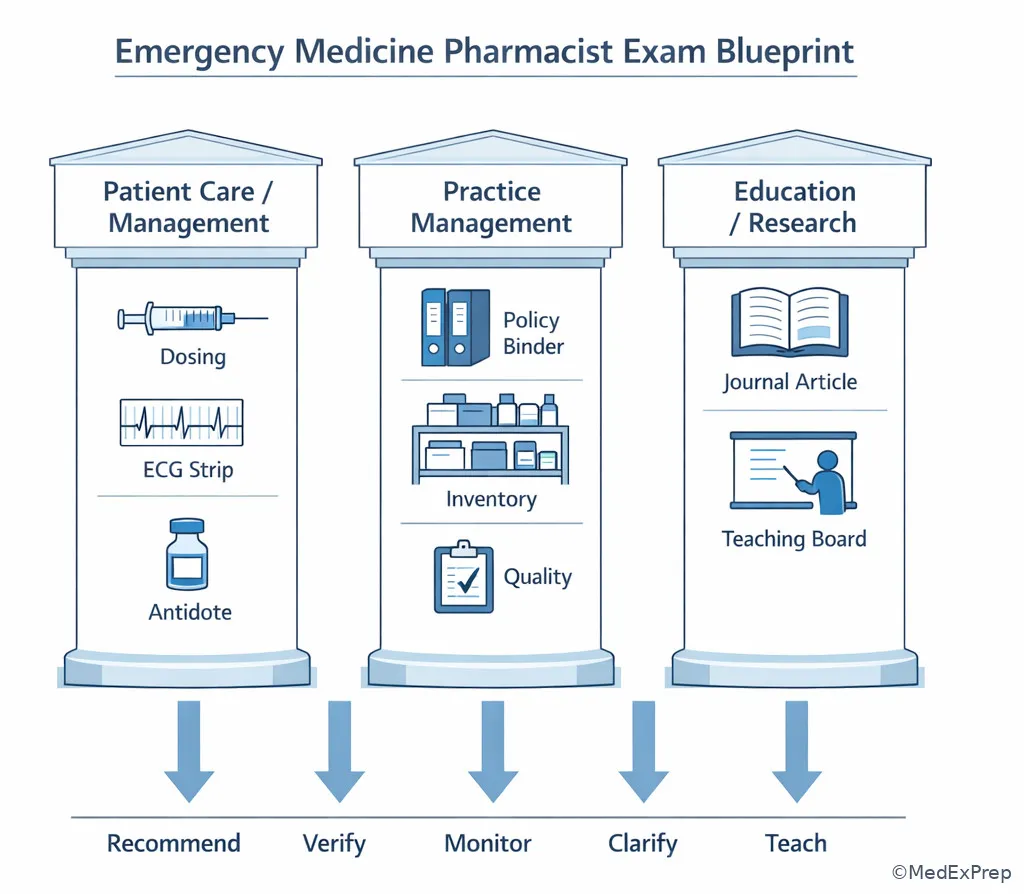
Blueprint domain dashboard sketch
Recall: This is the first topic in the sequence, so there is no prior lesson to review. In the upcoming topic Emergency Pharmacist Scope, we will tighten this framework by defining exactly which actions belong to the pharmacist and which must be escalated.

B. Worked example

A 67-year-old man with heart failure, stage 3 CKD, and atrial fibrillation presents with septic shock. The team asks the ED pharmacist to review an order set containing norepinephrine infusion, vancomycin loading dose, and stress-ulcer prophylaxis. A potassium of 3.2 mEq/L and a remote history of gout are also listed. The question asks which BCEMP domain is primarily being tested if the best answer focuses on recommending the safest initial vasoactive and anti-infective strategy.

Reasoning chain: Identify task: the stem is asking for the pharmacist’s medication recommendation in an acutely ill patient. Extract key facts: septic shock, urgent drug selection, dose/safety review, multiple comorbidities. Apply rule: urgent pharmacotherapy selection and verification fall under Patient Care/Management. Eliminate distractors: Practice Management would fit a drug shortage or standardization question; Education/Research would fit appraisal of sepsis data or staff teaching. Verify: the distracting potassium and gout history do not shift the domain. The governing feature is the medication-related bedside decision.

C. Exam trap

Common wrong answer: Practice Management. WHY IT IS TEMPTING: the stem mentions an order set and medication review, which sounds operational. The SINGLE CLUE that eliminates it: the core task is choosing and verifying urgent patient-specific pharmacotherapy at the bedside, which is Patient Care/Management.

D. Checkpoint

Question: A stem asks the ED pharmacist for the most appropriate next step after identifying an unsafe alteplase dose in a patient with acute ischemic stroke, including immediate clarification with the team and dose correction. Which blueprint domain is most directly being tested?

  1. Patient Care/Management — Tempting because it includes bedside action; correct because this is a time-sensitive medication verification and safety intervention for an individual patient.
  2. Practice Management — Tempting because medication safety systems belong there; wrong here because the task is patient-specific urgent dose correction, not system redesign.
  3. Education/Research — Tempting because stroke protocols rely on guideline knowledge; wrong because the stem is not asking for evidence appraisal or teaching.
  4. Inventory/Preparedness only — Tempting if you focus on drug availability; wrong because the issue is a live dose-verification decision, not stock management.
If you missed this: Review 1.1.1.1 Foundational domain map: what the blueprint is really organizing — focus on the rule that patient-specific urgent medication decisions map to Patient Care/Management.
Pharmacist Action: NOTICE: whether the stem is asking for a bedside medication decision, a systems fix, or evidence interpretation. SAY: “This is primarily a medication-related patient care issue” when clarifying the task with the team or yourself. MONITOR: for task words such as recommend, verify, monitor, clarify, and reconcile every time you read a new question. HOLD/CLARIFY/ESCALATE: if the answer choice requires physician-only procedural authority or diagnosis-only action.

1.1.1.2 Foundational weighting and study allocation: what deserves the most repetitions

A. Explanation

The next decision conflict is study breadth vs study proportion. BCEMP candidates must cover all domains, but not equally. The rule that resolves this is: allocate the most repetitions to Patient Care/Management while preserving deliberate review time for Practice Management and Education/Research. “Dominant exam weight” does not mean “the only content that matters.” It means most stems will still ask you to make or verify medication decisions in emergency care, so your prep must repeatedly rehearse acute drug selection, route, timing, adverse effect monitoring, reversal logic, renal/hepatic adjustments, transitions of care, and safety checks.

Practice Management and Education/Research still deserve explicit review because these domains often generate points through overlooked material: high-risk order verification, shortage contingencies, policy-driven safety constraints, patient/team counseling, and literature application. Candidates often underperform here because they study only disease states. WHY THIS IS TESTED: the exam rewards balanced professionals, not narrow memorization. Choose a study plan that mirrors weighting; reject a plan that ignores low-frequency domains completely. See Fig 3.

Fig 3. Weight-aware study flow
Exam takeaway: Heavier domains deserve more repetitions, but lower-weight domains still require explicit review blocks.
Map the blueprint
List domains and their likely stem types.

Assign repetition volume
Most practice goes to patient care; smaller protected blocks go to operations and evidence.

Use mixed review
Pair disease-state learning with safety, policy, and teaching tasks.

Audit blind spots
If you skip low-weight domains, you create easy point losses.

Fig 4. Study allocation decision map
Exam takeaway: Build your schedule around dominant patient care content without zeroing out practice management or evidence topics.
flowchart LR
A[Weekly study block] --> B[Patient Care / Management]
A --> C[Practice Management]
A --> D[Education / Research]
B --> B1[Acute pharmacotherapy]
B --> B2[Dosing and monitoring]
B --> B3[Toxicology and reversal]
C --> C1[Safety and policy]
C --> C2[Inventory and shortages]
C --> C3[Quality improvement]
D --> D1[Guidelines]
D --> D2[Evidence appraisal]
D --> D3[Patient and team teaching]

Use Fig 4 when building your review calendar.

B. Worked example

A PGY2 resident is six weeks from the exam and has completed 400 flashcards on vasopressors, anticoagulant reversal, and status epilepticus but has not reviewed medication safety, drug shortage response, or literature interpretation. She asks how to rebalance. She also mentions a distracting concern that she “probably won’t be asked much” about practice standards because the ED is mostly clinical.

Reasoning chain: Identify task: this is blueprint-based study allocation. Extract key facts: strong Patient Care/Management preparation, neglected Practice Management and Education/Research. Apply rule: dominant weight means more emphasis, not exclusive emphasis. Eliminate extremes: do not advise equal time to every domain; do not advise ignoring smaller domains. Verify: the best recommendation is to preserve her patient care-heavy plan while adding explicit scheduled blocks for operations, quality, medication safety, counseling, and evidence/guideline interpretation.

C. Exam trap

Common wrong answer: “Study only the highest-weight domain until exam day.” WHY IT IS TEMPTING: it sounds efficient and aligns with point maximization. The SINGLE CLUE that eliminates it: BCEMP still tests non-patient-care domains explicitly, and those questions are often easier to miss because candidates neglect them.

D. Checkpoint

Question: Which study strategy best reflects the BCEMP blueprint for a foundational learner?

  1. Spend nearly all time on disease-state pharmacotherapy and ignore operations until the final week — Tempting because Patient Care/Management is dominant; wrong because it creates avoidable blind spots in explicitly tested domains.
  2. Divide time equally across all domains regardless of weight — Tempting because it seems fair; wrong because it underrepresents the dominant patient care workload.
  3. Emphasize Patient Care/Management while scheduling recurring review blocks for Practice Management and Education/Research — Tempting because it sounds balanced; correct because it mirrors weighting without neglecting lower-frequency topics.
  4. Study only calculations first because math appears everywhere — Tempting because calculations feel concrete; wrong because the blueprint is broader than calculations.
If you missed this: Review 1.1.1.2 Foundational weighting and study allocation: what deserves the most repetitions — focus on the rule that dominant weight means more emphasis, not exclusive attention.
Quick Recall:

  • The dominant BCEMP domain is Patient Care/Management.
  • True or False: Lower-weight domains can be ignored safely. False.
  • Name the three broad buckets: Patient Care/Management, Practice Management, Education/Research.
Memory anchor: Think “Big-P, small-p, E” — Big Patient Care gets the most reps; small practice Management still gets protected review; Education/Research gets deliberate targeted sessions.
Pharmacist Action: NOTICE: whether your review plan overweights disease treatment while neglecting safety and evidence tasks. SAY: “I need proportional, not equal, coverage” when planning study blocks. MONITOR: missed-question patterns by domain every week. HOLD/CLARIFY/ESCALATE: if your practice set performance shows systematic weakness outside patient care, pause content expansion and remediate the neglected domain.

1.1.1.3 Application: translating broad blueprint wording into pharmacist subskills

A. Explanation

Now the decision conflict becomes general objective vs concrete action. Public blueprint language is often broad by design. On the exam, however, questions are answerable only when you convert the broad objective into one or more specific subskills. For example, a broad statement about caring for acutely ill patients can translate into subskills such as selecting the initial vasopressor, verifying a thrombolytic dose, identifying an antidote contraindication, recommending renal dose adjustment, detecting a harmful interaction, preparing a weight-based infusion, or planning monitoring after ED disposition. Practice Management wording can map to subskills such as standardizing concentrations, responding to shortages, reducing alert fatigue, or identifying look-alike/sound-alike risk. Education/Research can map to subskills such as choosing the guideline-concordant recommendation, counseling on naloxone use at discharge, or identifying the most practice-changing limitation in a study.

WHY THIS IS TESTED: stems rarely quote the blueprint. They operationalize it. The rule is: rewrite the broad objective as “What would the emergency pharmacist do next?” Choose answers that correspond to a real pharmacist behavior; reject answers that remain abstract or drift into physician-only territory. See Fig 5.

Fig 5. Broad objective to subskill flow
Exam takeaway: Convert abstract blueprint language into a specific pharmacist task before solving the stem.
Read the broad objective
Example: manage emergency pharmacotherapy safely.

Ask the pharmacist question
What would I recommend, verify, prepare, monitor, or clarify?

Generate subskills
Dose selection, interaction review, antidote choice, disposition counseling, etc.

Match the stem
Use the subskill that fits the exact task and timeline.

High-Yield Connection: This concept is tested alongside Question Framing Cues. Know both the blueprint domain and the exact task verb in the stem; they are frequently paired to make one answer choice look clinically correct but role-inappropriate.
Subskill translation worksheet illustration
Exam takeaway: A visual conversion from broad objective to pharmacist task reduces abstract blueprint wording to answerable actions.
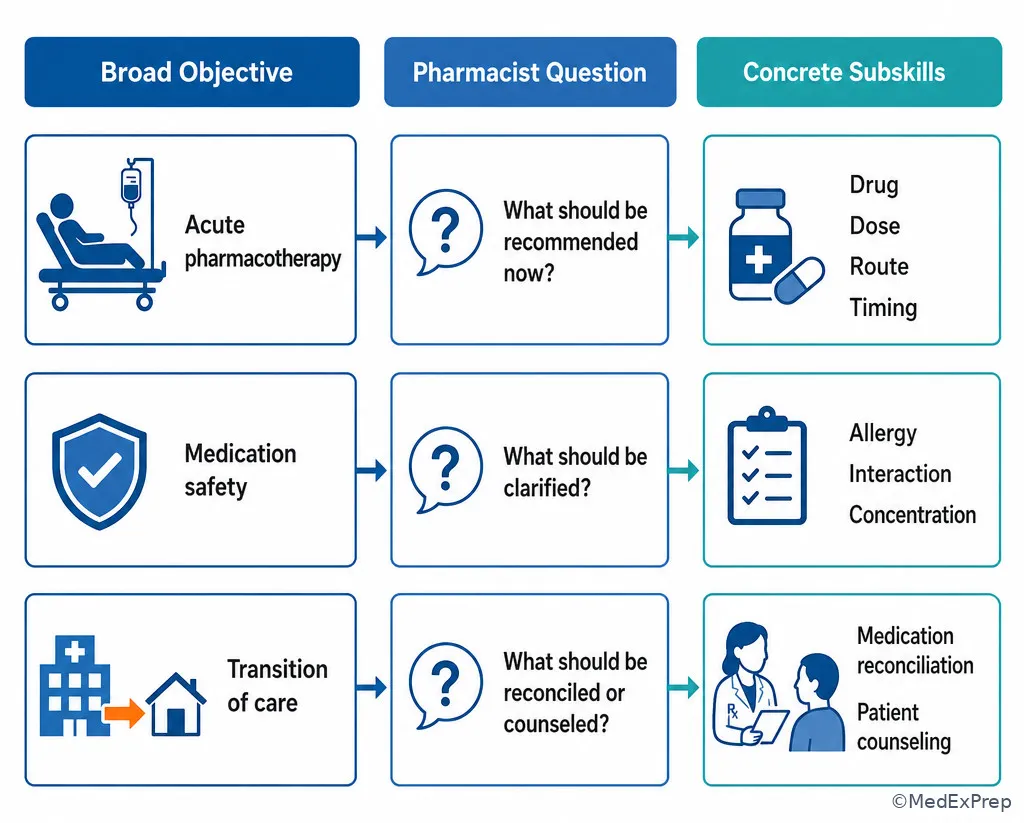
Subskill translation worksheet illustration

B. Worked example

A 32-year-old woman with epilepsy, obesity, and postpartum status presents after a generalized seizure. She is receiving levetiracetam 1500 mg IV, and the team asks the pharmacist to verify whether a fosphenytoin backup order is appropriate if seizures recur. The stem also includes a distracting mild AST elevation and notes that the patient forgot breakfast. The question asks which derived subskill is being tested under a broad patient care objective.

Reasoning chain: Identify task: this is not merely “neurologic emergency care”; it is verification of second-line antiseizure therapy appropriateness. Extract key facts: medication backup order, acute setting, patient-specific review, safety decision. Apply rule: convert broad objective to pharmacist subskill — recommend/verify medication choice and monitoring in a time-sensitive neurologic emergency. Eliminate distractors: counseling alone would fit discharge planning; literature appraisal is not asked; procedural seizure diagnosis is outside task. Verify: the distracting AST and missed meal do not change the core subskill.

C. Exam trap

Common wrong answer: “The question is testing seizure diagnosis.” WHY IT IS TEMPTING: the stem includes disease-specific details and recurrence risk. The SINGLE CLUE that eliminates it: the pharmacist is being asked to verify a medication order, so the tested subskill is pharmacotherapy selection/safety, not diagnosis.

D. Checkpoint

Question: A blueprint objective states “support care of acutely ill patients.” Which derived subskill is the best exam-ready translation for an ED pharmacist?

  1. Interpret all diagnostic imaging independently before recommending therapy — Tempting because it sounds comprehensive; wrong because it exceeds pharmacist scope.
  2. Select, dose, verify, and monitor emergency medications while escalating non-pharmacist decisions — Tempting because it is action-focused; correct because it translates the objective into real ED pharmacist tasks.
  3. Determine the final medical diagnosis and disposition without team input — Tempting because diagnosis guides therapy; wrong because the blueprint is pharmacist-centered.
  4. Memorize disease definitions without linking them to action — Tempting for foundational study; wrong because it does not produce testable pharmacist performance.
If you missed this: Review 1.1.1.3 Application: translating broad blueprint wording into pharmacist subskills — focus on the rule “What would the emergency pharmacist do next?”
Pharmacist Action: NOTICE: broad verbs like manage, support, assess, optimize, or monitor. SAY: “Operationally, this means I must verify the drug, dose, route, timing, interaction risk, and follow-up.” MONITOR: whether your interpretation remains concrete enough to eliminate distractors. HOLD/CLARIFY/ESCALATE: if the apparent “best answer” requires diagnosis-only authority or independent procedure performance.

1.1.1.4 Application: domain-task thinking to classify stems quickly

A. Explanation

At exam speed, you do not have time for lengthy reflection. The decision conflict is read every detail first vs classify early. The resolving rule is: classify the stem by domain-task before you process all the noise. Ask three questions in order: (1) What is the pharmacist being asked to do? (2) Is the problem patient-specific, system-based, or evidence/communication-based? (3) What single safety or scope rule decides between the top two options? This approach prevents common BCEMP errors, especially in stems loaded with comorbidities, one abnormal lab, and a tempting clue that points to a different but related topic.

Board-style stems often include details that are true but secondary. A potassium level, remote allergy, or chronic home medication may matter later, but not before you know the task category. WHY THIS IS TESTED: the exam rewards prioritization under pressure. Choose early classification because it reduces cognitive load; reject detail-first reading when it causes you to answer the wrong question. See Fig 6.

Fig 6. Fast stem classification algorithm
Exam takeaway: Identify the pharmacist task first, then sort patient-specific, systems, or evidence details around that task.
Find the verb
Recommend, verify, monitor, educate, prepare, reconcile, clarify.

Sort the task
Bedside drug issue, system issue, or evidence/teaching issue?

Spot the discriminator
One clue usually decides scope, timing, or safety.

Choose the role-appropriate answer
Take the best medication-related action and escalate the rest.

Emergency stem triage illustration
Exam takeaway: Visual triage of task verb, domain, and single discriminator helps you avoid noise-driven errors.
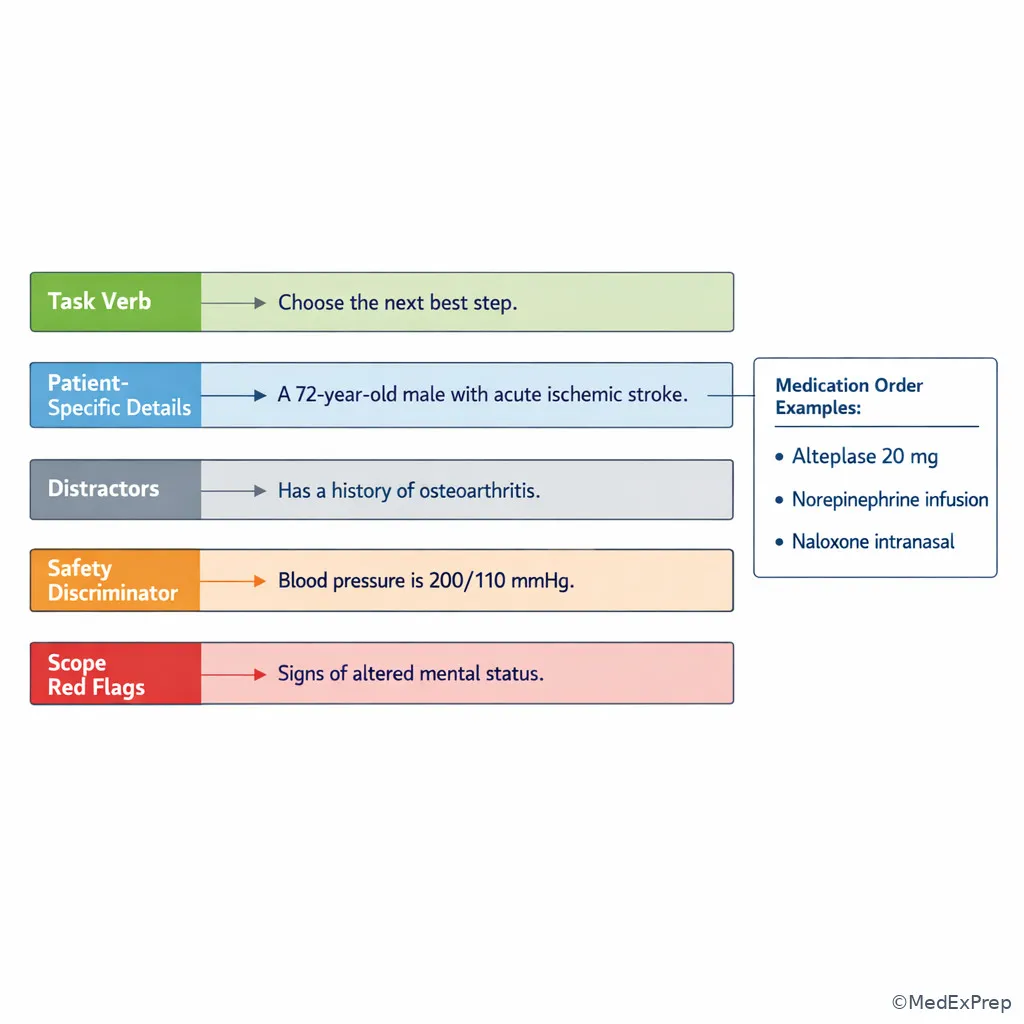
Emergency stem triage illustration
High-Yield Connection: This topic overlaps with Emergency Pharmacist Scope. A rapid stem classifier is most powerful when paired with clear scope boundaries; many BCEMP distractors are correct medical ideas but wrong pharmacist actions.

B. Worked example

A 74-year-old woman with COPD, hypertension, and chronic warfarin therapy presents after a fall with intracranial hemorrhage concern. The team is preparing imaging, and the pharmacist is asked to identify the most appropriate medication-related action immediately. Her INR is 3.4, serum sodium is 132 mEq/L, and she reports taking ibuprofen for arthritis. One option asks to recommend prothrombin complex concentrate and IV vitamin K; another asks to review the CT personally before advising reversal.

Reasoning chain: Identify task: immediate medication-related action. Extract key facts: warfarin-associated bleed concern, urgent reversal framing, pharmacist asked for medication support. Apply rule: classify as Patient Care/Management with a reversal/safety subskill. Eliminate distractors: reviewing CT personally is an out-of-scope signal; sodium and ibuprofen are distracting details. Verify: recommending evidence-based reversal and escalation to the treating team fits both domain and role.

C. Exam trap

Common wrong answer: “Read the CT before making any recommendation.” WHY IT IS TEMPTING: imaging confirmation sounds cautious and clinically thorough. The SINGLE CLUE that eliminates it: the pharmacist’s tested task is immediate medication-related support, not primary imaging interpretation.

D. Checkpoint

Question: Which first step best improves speed and accuracy on BCEMP stems?

  1. Memorize every lab value before deciding what the stem wants — Tempting because details feel protective; wrong because you may answer the wrong task.
  2. Find the pharmacist action verb and classify the domain-task before analyzing the noise — Tempting because it is efficient; correct because it aligns the question with the tested subskill.
  3. Choose the most aggressive intervention because emergency care is high acuity — Tempting in critical care contexts; wrong because scope and safety still control.
  4. Default to policy questions when order sets are mentioned — Tempting because order sets sound operational; wrong because many order-set stems are still patient-specific medication decisions.
If you missed this: Review 1.1.1.4 Application: domain-task thinking to classify stems quickly — focus on identifying the task verb before processing distracting details.
Quick Recall:

  • Fill in the blank: The first thing to identify in a stem is the task verb.
  • True or False: Mention of an order set always means Practice Management. False.
  • One-liner: If the answer requires primary imaging interpretation, think out of pharmacist scope.
Pharmacist Action: NOTICE: scope red flags such as “perform,” “diagnose,” “read the scan,” or “write the admission orders independently.” SAY: “My role is to recommend the best medication-related action and escalate non-pharmacist decisions.” MONITOR: whether the stem’s single discriminator is route, timing, contraindication, interaction, or authority. HOLD/CLARIFY/ESCALATE: when the answer choice crosses into physician-only procedure or diagnosis territory.

1.1.1.5 Integration: distinguishing patient care, practice management, and education/research in close-call stems

A. Explanation

The final foundational integration skill is handling close-call stems that contain features from multiple domains. A single question may mention a patient, a protocol, and a guideline citation. The rule that resolves the conflict is: ask what the answer must change right now. If the answer changes this patient’s drug therapy or safety check now, it is Patient Care/Management. If it changes the system, stock, workflow, standardization, or error-prevention process more than the current patient, it is Practice Management. If it changes understanding, interpretation, counseling, or evidence-based recommendation framing, it is Education/Research.

This distinction matters because distractors are often domain-shifted. A good operational fix may be true in general but wrong if the question asks what to do for the patient in front of you. Likewise, a bedside recommendation may be clinically sound but wrong if the stem asks for the best quality-improvement response to repeated dosing errors across multiple shifts. WHY THIS IS TESTED: BCEMP practice is interdisciplinary and systems-aware, so the exam expects you to separate immediate patient action from process redesign and educational response.

Concept flow: Close-call domain resolver
Name the outcome
What changes if you choose the right answer?

Patient, system, or understanding?
Current therapy, workflow/policy, or evidence/teaching.

Choose the matching domain
Then select the best action within that domain.

Patient-versus-system comparison illustration
Exam takeaway: Distinguish whether the answer changes the current patient, the department workflow, or the team's understanding.
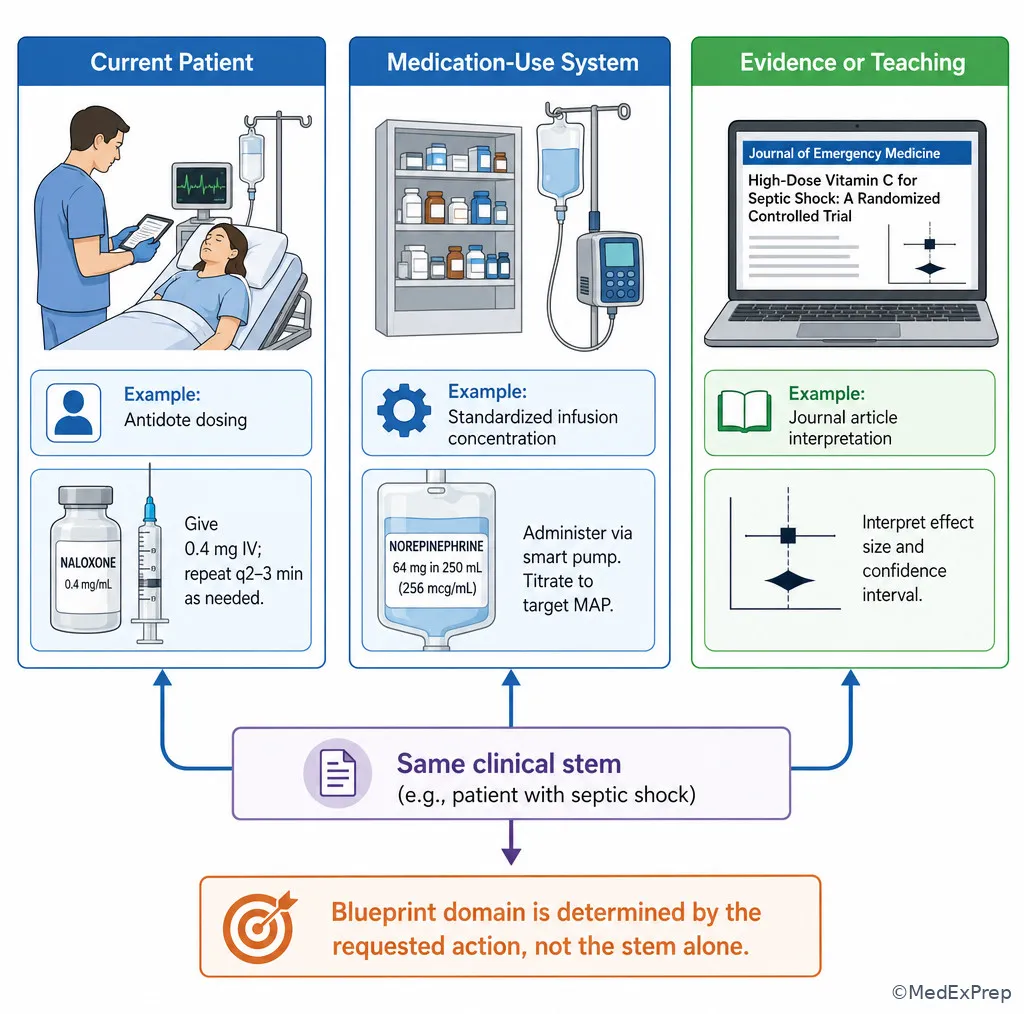
Patient-versus-system comparison illustration

B. Worked example

An ED has had three recent delays in administering four-factor PCC for warfarin-associated bleeding. A current patient with suspected intracranial hemorrhage arrives, and the pharmacist is asked two separate questions during the same case: first, what immediate reversal regimen to recommend; second, what department-level intervention would most reduce future delays. The stem adds distracting details about a mildly elevated lactate and a pending type and screen.

Reasoning chain: Identify task: there are actually two different tasks. Extract key facts: immediate bedside reversal for the current patient; recurring operational delay across multiple cases. Apply rule: the first maps to Patient Care/Management, the second to Practice Management. Eliminate distractors: a literature journal club on reversal data would be Education/Research and may be useful, but it is not the strongest process fix. Verify: one case can touch multiple domains, but each question still has one primary tested task.

C. Exam trap

Common wrong answer: choosing a system redesign answer for a bedside pharmacotherapy question. WHY IT IS TEMPTING: the process problem described in the stem is real and important. The SINGLE CLUE that eliminates it: if the question asks what to do now for the current patient, pick the patient-care answer first.

D. Checkpoint

Question: A stem asks which intervention would most reduce recurrent smart-pump programming errors with norepinephrine infusions across multiple ED shifts. Which blueprint domain is primary?

  1. Patient Care/Management — Tempting because norepinephrine is a bedside drug; wrong because the stem focuses on recurrent system-wide error prevention.
  2. Practice Management — Tempting because it emphasizes workflow, standardization, and medication safety; correct because the target is system redesign.
  3. Education/Research — Tempting because staff education may be part of the fix; wrong because the primary task is process improvement, not evidence interpretation.
  4. Transitions of care — Tempting if you think about handoffs; wrong because infusion programming errors are an operational safety issue here.
If you missed this: Review 1.1.1.5 Integration: distinguishing patient care, practice management, and education/research in close-call stems — focus on what the answer changes right now: patient, system, or understanding.
Pharmacist Action: NOTICE: whether the requested answer changes the current patient’s therapy, the departmental process, or the team’s interpretation of evidence. SAY: “This question is asking for the primary domain, not every domain involved in the case.” MONITOR: for words like recurrent, across shifts, policy, protocol, education, or journal data, which may shift the domain. HOLD/CLARIFY/ESCALATE: if you find yourself choosing a true statement that answers a different domain than the one asked.

Exam Traps & Differentiators

Common traps & distractors:

  • Most common wrong answer and why: picking a broadly true clinical statement instead of the specific pharmacist task. It is tempting because the statement is medically correct; it fails because it does not answer what the pharmacist should recommend, verify, prepare, monitor, or clarify.
  • Domain shift trap: choosing Practice Management because the stem mentions an order set or protocol. The eliminating clue is whether the question is about the current patient’s medication decision.
  • Scope trap: choosing an answer that asks the pharmacist to interpret imaging independently, perform a procedure, or make the final diagnosis. The eliminating clue is role language outside pharmacist scope.
  • Weight trap: ignoring smaller domains during preparation. The eliminating clue is that BCEMP explicitly includes operations, quality, education, and evidence use.
  • Noise trap: anchoring on a lab abnormality that is not the tested discriminator. The eliminating clue is the task verb, not the loudest detail.

Looks similar but isn't

If the stem focuses on... Think... Not usually... Discriminator
Immediate patient-specific drug choice, dose, route, or reversal Patient Care/Management Practice Management Current patient action
Repeated medication errors across shifts or system redesign Practice Management Patient Care/Management Workflow-level fix
Guideline interpretation, evidence quality, or staff/patient teaching Education/Research Pure bedside action Understanding/communication
Medication reconciliation at ED discharge or transition Patient Care/Management Only operations Patient-specific continuity
Drug shortage contingency planning Practice Management Education/Research Operational readiness
New study changes use of thrombolytics or reversal agents Education/Research Only policy Evidence application

If the stem says ..., think ...

  • “most appropriate medication-related action now” → think Patient Care/Management.
  • “across multiple recent cases” → think Practice Management.
  • “best way to educate/counsel/appraise” → think Education/Research.
  • “clarify unsafe order before dispensing/preparing” → think patient-specific safety task under Patient Care/Management.
  • “standardize concentrations / reduce recurring errors” → think Practice Management.
  • “apply guideline findings to the current recommendation” → think Education/Research feeding back into practice.
Recall: In the upcoming topic Question Framing Cues, you will practice separating urgent pharmacotherapy from distracting details like unrelated labs, remote histories, or non-decisive findings. The traps here are the blueprint-level version of that same skill.
Common confusable pair Why they blur together Single clue that separates them
Bedside order verification vs medication-use policy Both mention safety and orders One patient now vs recurring system fix
Guideline-based recommendation vs research appraisal Both involve literature Apply guidance now vs critique evidence quality
Counseling at discharge vs staff education program Both are teaching Individual patient vs department-level education
Scope-appropriate escalation vs independent diagnosis Both sound decisive Pharmacist supports medication decisions, not final diagnosis
Review connection: The traps above test blueprint classification under pharmacist scope. If any felt unfamiliar, revisit 1.1.1.4 Application: domain-task thinking to classify stems quickly before attempting the Self-check quiz.

Tables

Domain High-yield stem cues Likely answer type Close-call distractor
Patient Care/Management acute, immediate, dose, route, reversal, verify, monitor, contraindication Drug recommendation or safety intervention System policy answer
Practice Management recurrent errors, workflow, standardization, shortage, preparedness, policy Process redesign or risk reduction strategy Patient-specific bedside answer
Education/Research guideline, evidence, counsel, educate, appraise, study design Teaching point or evidence-based interpretation Operational fix answer
Broad blueprint wording Exam-ready pharmacist subskill Example from EM practice
Manage acutely ill patients Select and dose urgent therapy Choose norepinephrine initial strategy in septic shock
Ensure medication safety Detect contraindication or dose error Clarify incorrect alteplase dose before administration
Support transitions of care Reconcile and counsel high-risk discharge meds Naloxone and opioid discharge planning
Contribute to operations Standardize process to reduce error Smart-pump library update for vasopressors
Apply evidence Use guideline/study to support recommendation Select recommended antidote strategy based on current guidance
Educate patients and team Deliver focused medication teaching ED discharge counseling on anticoagulant resumption questions
Observed stem feature Correct interpretation Why learners miss it
Order set is mentioned May still be patient care if the action is patient-specific verification Order sets sound operational
Guideline is mentioned in bedside case Still may be patient care if used to support immediate therapy Guidelines trigger “research” reflex
Several recent cases are cited Likely practice management or quality improvement Clinical details distract from system focus
Question asks what to say to patient/team May be education if communication is the tested task Learners overfocus on disease facts
One tempting option requires independent procedural authority Likely wrong on pharmacist-scope grounds It sounds decisive and high acuity

Algorithm / Approach

Concept flow: BCEMP blueprint stem approach
Start with the verb
Find whether the pharmacist must recommend, verify, monitor, educate, reconcile, or clarify.

Classify the primary domain
Current patient action → Patient Care/Management; process/system fix → Practice Management; evidence/teaching → Education/Research.

Translate to subskill
Name the specific task: dose check, antidote choice, interaction review, counseling, policy fix, or evidence interpretation.

Screen for scope and safety
Reject answers requiring independent diagnosis, primary procedure performance, or non-pharmacist authority.

Choose the best medication-related action
Pick the answer that fits the domain, the pharmacist role, and the single discriminating clue.

Blueprint stem decision tree
Exam takeaway: The fastest reliable route is task verb → domain → subskill → scope check → best action.
flowchart TD
A[Read stem] --> B[Find task verb]
B --> C{Primary target?}
C --> D[Current patient]
C --> E[System or workflow]
C --> F[Evidence or teaching]
D --> G[Patient Care / Management]
E --> H[Practice Management]
F --> I[Education / Research]
G --> J[Translate to drug subskill]
H --> J
I --> J
J --> K{Within pharmacist scope?}
K -->|Yes| L[Choose best action]
K -->|No| M[Reject option]

Rapid Review

  • Patient Care/Management → current-patient medication decision beats protocol language.
  • Practice Management → repeated error across cases points to system redesign.
  • Education/Research → communication or evidence interpretation is the discriminator.
  • Order set mention → not enough alone to label Practice Management.
  • Guideline mention → may still support a bedside patient-care answer.
  • Out-of-scope option → often a strong distractor because it sounds decisive.
  • Broad objective → rewrite as recommend/verify/prepare/monitor/clarify.
  • Dominant weight → study more, not exclusively, from that domain.
  • Close-call stems → ask what the answer changes: patient, system, or understanding.
  • Noise detail → ignore until after task classification.
  • Discharge counseling → usually patient care unless the stem asks about education program design.
  • Quality-improvement language → think Practice Management even if drugs are named.
  • Primary imaging/procedure language → reject as pharmacist answer unless the role is explicitly collaborative and medication-focused.

Self-check quiz

1. A 58-year-old man with septic shock, diabetes, and CKD has norepinephrine 8 mg in 250 mL ordered and broad-spectrum antibiotics pending. The team asks the ED pharmacist for the most appropriate medication-related action now. Which blueprint domain is primary?

  1. Patient Care/Management
  2. Practice Management
  3. Education/Research
  4. Inventory/Preparedness

2. An ED pharmacist reviews several cases with repeated delays in stocking intranasal naloxone kits for discharge after opioid overdose. A patient with COPD and OUD is being discharged on buprenorphine/naloxone, but the question asks which domain is tested by fixing the naloxone distribution workflow across shifts. Which is the best answer?

  1. Patient Care/Management
  2. Practice Management
  3. Education/Research
  4. Toxicology only

3. A 71-year-old woman with atrial fibrillation, hypertension, and prior stroke presents with suspected ischemic stroke. Alteplase 90 mg IV is ordered for a body weight of 72 kg. Serum glucose is 152 mg/dL, and she also takes sertraline. As the ED pharmacist, what is the most appropriate first action for this stem classification exercise?

  1. Classify it as Education/Research because alteplase use depends on guidelines
  2. Classify it as Practice Management because a dose-verification issue involves medication safety
  3. Classify it as Patient Care/Management because the immediate task is patient-specific dose clarification
  4. Classify it as operations because the product requires preparation workflow

4. A 45-year-old man with alcohol use disorder and cirrhosis presents after acetaminophen ingestion. NAC 150 mg/kg IV loading is started, and the toxicology fellow asks the pharmacist to summarize the guideline-supported role of acetaminophen nomogram timing for the team. The question asks which blueprint domain is most directly emphasized by that request. Which is the best answer?

  1. Patient Care/Management
  2. Practice Management
  3. Education/Research
  4. Inventory/Preparedness

5. A 29-year-old postpartum woman with migraine and asthma is in the ED observation unit after anaphylaxis. The pharmacist is asked to create a counseling plan for epinephrine auto-injector use at discharge while also reconciling newly prescribed medications. The stem asks specifically about the counseling task. Which blueprint domain is primary?

  1. Practice Management
  2. Education/Research
  3. Patient Care/Management
  4. Operations only

6. During a norepinephrine shortage, a 63-year-old patient with septic shock, obesity, and HFrEF is receiving vasopressor support. The pharmacist is asked in one question to recommend the best immediate vasoactive alternative for this patient, and in a separate question to develop the department’s shortage-response standardization plan. Which statement best distinguishes the primary domains being tested?

  1. Both questions are Practice Management because shortages are operational by definition
  2. The first is Patient Care/Management and the second is Practice Management
  3. The first is Education/Research and the second is Patient Care/Management
  4. Both questions are Patient Care/Management because both involve drugs used in shock

7. A 76-year-old man with warfarin therapy, CKD, and recent head trauma is in the CT scanner. The pharmacist is asked for the most appropriate immediate medication-related recommendation if intracranial hemorrhage is confirmed. One answer choice says to prepare PCC dosing guidance and vitamin K recommendations for the team; another says to personally interpret the scan first because reversal should wait for radiology details. Which principle most reliably eliminates the wrong option?

  1. Any imaging-related stem belongs to Education/Research
  2. Pharmacists should avoid all reversal recommendations until a final diagnosis is documented
  3. Scope matters: recommending medication reversal is within role, but primary imaging interpretation is not
  4. Warfarin reversal is primarily an inventory issue

8. A 34-year-old man with OUD, hepatitis C, and homelessness is treated for opioid overdose with naloxone 0.4 mg IV followed by 2 mg intranasal take-home supply. The pharmacist is asked which action best represents a derived subskill under a broad blueprint objective for transitions and emergency patient care. Which is the best answer?

  1. Provide patient-specific overdose education, verify naloxone dispensing, and reconcile discharge medications
  2. Independently decide final discharge diagnosis and social disposition
  3. Perform the respiratory assessment and administer all bedside doses personally
  4. Interpret toxicology mass spectrometry as the final diagnostic authority before counseling

Answer key

1. Answer: A — Patient Care/Management

A. Patient Care/Management: Tempting because bedside shock therapy, drug concentration, and antibiotic timing are classic acute care issues; correct because the PK/PD and clinical focus is immediate patient-specific medication recommendation and verification. The single stem clue is “most appropriate medication-related action now.” This aligns with guideline-driven bedside pharmacotherapy support in emergency care. Sources: ASHP emergency medicine pharmacy practice principles; DiPiro Pharmacotherapy.

B. Practice Management: Tempting because infusion preparation and safe use can involve systems. Incorrect here because no recurring workflow, standardization, or policy problem is being asked. The single eliminating fact is that the stem centers on the patient in front of you. Sources: ASHP; AHFS Drug Information.

C. Education/Research: Tempting because sepsis therapy uses guideline knowledge. Incorrect because the task is not evidence appraisal or teaching; it is action selection. The discriminating clue is bedside urgency. Sources: DiPiro; ACCP/critical care guidance.

D. Inventory/Preparedness: Tempting because vasopressors require stocking and preparation. Incorrect because no stock shortage or preparedness issue is described. The discriminating clue is direct patient care. Sources: ASHP; Clinical Pharmacology.

If you missed this: Review 1.1.1.1 Foundational domain map: what the blueprint is really organizing — focus on the discriminator that current-patient medication decisions map to Patient Care/Management.

2. Answer: B — Practice Management

A. Patient Care/Management: Tempting because naloxone and discharge medications are patient-specific topics. Incorrect because the question explicitly asks about fixing the workflow across shifts, which is a system intervention. The single clue is “across shifts.” Sources: ASHP medication safety and transitions principles.

B. Practice Management: Tempting because it fits operational naloxone kit distribution; correct because the task targets medication-use process, stock flow, and implementation reliability rather than one patient’s regimen. The discriminating clue is recurrent distribution failure. Sources: ASHP; AHFS.

C. Education/Research: Tempting because naloxone discharge teaching matters. Incorrect because counseling an individual patient is not the requested task. The single clue is workflow redesign. Sources: ASHP naloxone counseling resources; FDA labeling.

D. Toxicology only: Tempting because overdose is the underlying clinical topic. Incorrect because “toxicology” is a content area, not the primary blueprint domain asked here. The single clue is systems-level distribution process. Sources: DiPiro; ASHP.

If you missed this: Review 1.1.1.5 Integration: distinguishing patient care, practice management, and education/research in close-call stems — focus on what the answer changes right now: patient vs system.

3. Answer: C — classify as Patient Care/Management

A. Education/Research: Tempting because alteplase use is guideline-bound. Incorrect because the primary pharmacological issue is dose verification for this specific patient, not appraisal of the guideline evidence. The key clue is an unsafe ordered dose relative to body weight. Sources: FDA labeling for alteplase; stroke guidelines.

B. Practice Management: Tempting because medication safety is often associated with systems. Incorrect because the PK/PD decision is patient-specific dose clarification in real time. The single fact that eliminates it is the live bedside order. Sources: FDA labeling; ASHP medication-use safety.

C. Patient Care/Management: Tempting because it is action-oriented; correct because the pharmacist must verify dose appropriateness and immediately communicate correction. The stem clue is the body-weight-linked alteplase order for a current patient. Sources: FDA labeling; stroke guideline documents.

D. Operations: Tempting because preparation workflow exists for alteplase. Incorrect because preparation is secondary to the dose-safety issue. The single clue is that the unsafe dose must be clarified before product workflow matters. Sources: FDA labeling; AHFS.

If you missed this: Review 1.1.1.4 Application: domain-task thinking to classify stems quickly — focus on finding the task verb before being distracted by guideline language or preparation details.

4. Answer: C — Education/Research

A. Patient Care/Management: Tempting because NAC dosing is an active bedside therapy. Incorrect for this specific question because the asked task is to summarize the guideline-supported role of nomogram timing for the team. The single clue is the request to explain evidence/guidance. Sources: FDA labeling; toxicology guidance; AHFS.

B. Practice Management: Tempting because team communication can involve workflow. Incorrect because no system redesign or policy intervention is requested. The discriminating clue is interpretation of guideline support, not process optimization. Sources: ASHP; Clinical Pharmacology.

C. Education/Research: Tempting because it explicitly involves guidance interpretation; correct because the pharmacist is teaching the team how evidence and nomogram timing should inform use. The key clue is “summarize the guideline-supported role.” Sources: toxicology guidelines; DiPiro.

D. Inventory/Preparedness: Tempting if you think about stocking NAC formulations. Incorrect because the stem is not about supply or preparedness. The clue is educational interpretation. Sources: AHFS; FDA labeling.

If you missed this: Review 1.1.1.5 Integration: distinguishing patient care, practice management, and education/research in close-call stems — focus on the discriminator “Does the answer change understanding rather than therapy or workflow?”

5. Answer: B — Education/Research

A. Practice Management: Tempting because discharge processes can be standardized. Incorrect because the stem specifically asks about the counseling task for the individual patient. The single clue is patient teaching. Sources: FDA epinephrine auto-injector labeling; ASHP patient education principles.

B. Education/Research: Tempting because it centers on counseling; correct because the primary tested action is medication education, even though reconciliation is also present in the case. The discriminating clue is that the question asks specifically about the counseling task. Sources: FDA labeling; AHFS.

C. Patient Care/Management: Tempting because reconciliation at discharge is patient care. Incorrect for this question because the stem narrows the asked task to counseling, which is the education-focused component. The single clue is “asks specifically about the counseling task.” Sources: ASHP transitions guidance.

D. Operations only: Tempting because discharge workflows are operational. Incorrect because there is no system-level redesign focus. The clue is individual communication. Sources: ASHP.

If you missed this: Review 1.1.1.5 Integration: distinguishing patient care, practice management, and education/research in close-call stems — focus on the rule that the asked task, not the whole case, determines the primary domain.

6. Answer: B — first Patient Care/Management, second Practice Management

A. Both Practice Management: Tempting because the shortage creates an operational backdrop. Incorrect because the first question still asks for the best immediate vasoactive choice for one patient, which is bedside pharmacotherapy. The single clue is “immediate ... for this patient.” Sources: ASHP shortage management; DiPiro vasopressor guidance.

B. First Patient Care/Management, second Practice Management: Tempting because it preserves both truths; correct because the first is a patient-specific drug recommendation and the second is a department-level shortage-response strategy. The discriminating clue is one current patient vs departmental standardization. Sources: ASHP; ACCP/critical care references.

C. First Education/Research, second Patient Care/Management: Tempting if you think alternative vasopressor selection is evidence-based. Incorrect because evidence informs the recommendation but does not change the primary domain, and the second clearly addresses system planning. The clue is operational standardization in the second question. Sources: DiPiro; ASHP.

D. Both Patient Care/Management: Tempting because both involve shock medications. Incorrect because the second asks for a systems response to shortage. The single eliminating clue is “department’s shortage-response standardization plan.” Sources: ASHP shortage guidance.

If you missed this: Review 1.1.1.5 Integration: distinguishing patient care, practice management, and education/research in close-call stems — focus on separating current-patient action from department-level process design.

7. Answer: C — scope matters

A. Any imaging-related stem belongs to Education/Research: Tempting because imaging interpretation relies on knowledge. Incorrect because the presence of imaging in the case does not determine the blueprint domain. The single clue is that the pharmacist is asked for an immediate medication-related recommendation. Sources: ASHP emergency medicine practice statements.

B. Avoid all reversal recommendations until final diagnosis is documented: Tempting because it sounds conservative and safety-minded. Incorrect because pharmacists routinely support evidence-based reversal planning when clinically indicated and requested by the team. The discriminating clue is the prompt for medication-related recommendation contingent on hemorrhage confirmation. Sources: reversal guidance; AHFS; DiPiro.

C. Scope matters: recommending reversal is within role, but primary imaging interpretation is not: Tempting because it aligns the task and role; correct because the single clinical fact that eliminates the distractor is pharmacist scope, not radiology expertise. PK/PD reasoning supports PCC/vitamin K planning as a medication action. Sources: ASHP; reversal guidelines; FDA/label-based references.

D. Warfarin reversal is primarily an inventory issue: Tempting because PCC availability matters. Incorrect because the acute problem is patient care; inventory is secondary unless the stem asks about stock policy. The clue is the immediate bedside context. Sources: ASHP; DiPiro.

If you missed this: Review 1.1.1.4 Application: domain-task thinking to classify stems quickly — focus on rejecting out-of-scope answer choices even when they sound clinically thorough.

8. Answer: A — provide education, verify naloxone, and reconcile discharge meds

A. Provide patient-specific overdose education, verify naloxone dispensing, and reconcile discharge medications: Tempting because it bundles several pharmacist actions; correct because it translates a broad transitions/patient-care objective into concrete ED pharmacist subskills. The discriminating clue is that all actions remain medication-related and patient-specific. Sources: ASHP transitions-of-care principles; FDA naloxone labeling.

B. Independently decide final discharge diagnosis and social disposition: Tempting because discharge planning feels comprehensive. Incorrect because final diagnosis and disposition authority are not pharmacist-only tasks. The single eliminating fact is scope. Sources: ASHP practice statements.

C. Perform the respiratory assessment and administer all bedside doses personally: Tempting because overdose care is urgent. Incorrect because the task as written extends into bedside clinical execution outside routine pharmacist-scope framing for this exam. The clue is performing non-pharmacist care tasks rather than recommending/verifying. Sources: exam scope guardrails; ASHP.

D. Interpret toxicology mass spectrometry as the final diagnostic authority before counseling: Tempting because confirmatory data sounds definitive. Incorrect because counseling and medication planning do not require the pharmacist to act as final diagnostic authority. The discriminating clue is scope and task mismatch. Sources: ASHP; DiPiro.
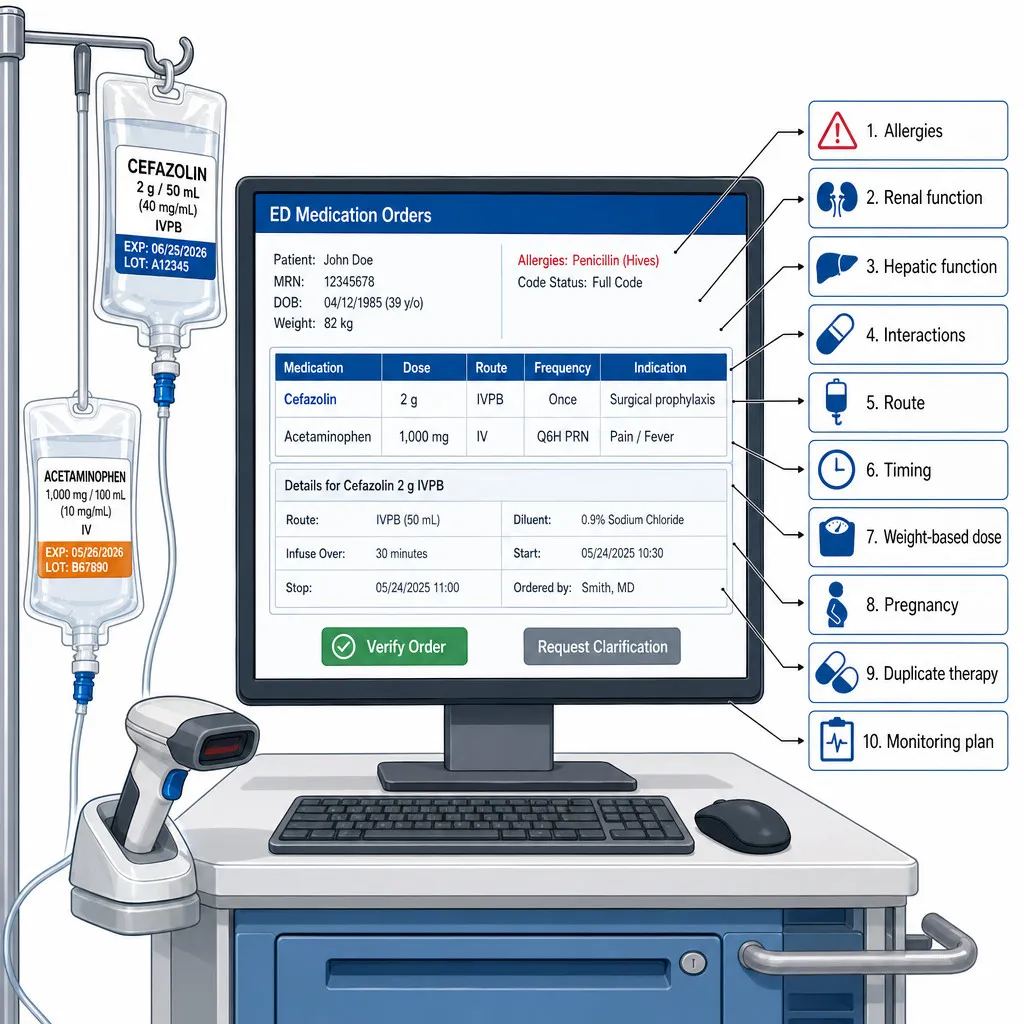
If you missed this: Review 1.1.1.3 Application: translating broad blueprint wording into pharmacist subskills — focus on rewriting broad objectives as concrete recommend/verify/monitor/reconcile/counsel actions.

References

  • American Society of Health-System Pharmacists. ASHP Guidelines on Emergency Medicine Pharmacist Services.
  • DiPiro, Joseph T., et al. Pharmacotherapy: A Pathophysiologic Approach. McGraw-Hill.
  • AHFS Drug Information. American Society of Health-System Pharmacists.
  • Lexicomp Online. Wolters Kluwer Clinical Drug Information.
  • Clinical Pharmacology. Elsevier.
  • Board of Pharmacy Specialties. BCEMP candidate-facing exam scope and framework materials.

Last reviewed: April 23, 2026

Lesson 2

Emergency Pharmacist Scope

Emergency Pharmacist Scope

Topic: 1.1.2

Course position: 2 of 81

Difficulty: Foundational

What you’ll learn

  • Define the medication-related boundaries of the BCEMP emergency pharmacist role in board-style scenarios.
  • Choose whether the best pharmacist action is to recommend, verify, prepare, monitor, clarify, or escalate.
  • Reject answer choices that drift into physician-only procedural or diagnosis-only responsibilities.
  • Apply learner-safe decision-making when protocols, formularies, or local workflows vary.
  • Recognize how scope framing changes what counts as the “most appropriate next step” on the exam.

Blueprint mapping

  • DOMAIN: Patient Care/Management - medication-related assessment in acute care - pharmacist emergency response support
  • DOMAIN: Patient Care/Management - therapeutic planning - agent, dose, route, timing, and monitoring recommendation
  • DOMAIN: Practice Management - medication-use safety, verification, preparation oversight, and escalation pathways
  • DOMAIN: Education/Research - communication of evidence-based medication recommendations to the interprofessional team
  • Explicit subskill: Distinguish in-scope medication judgment from out-of-scope procedural or diagnosis-only actions

Estimated time: 45-60 minutes

Prereqs: BCEMP Blueprint Domains

Key outputs: You should be able to identify the exact pharmacist task in a stem, choose the safest medication-related action, and eliminate tempting but out-of-role options.

Why it matters

  • BCEMP questions often hide the real task behind diagnostic noise; the exam rewards pharmacist judgment, not generic medical management.
  • Many wrong answers are clinically reasonable for someone on the team, but not the best pharmacist action.
  • In emergency care, time-sensitive medication actions often hinge on role clarity: verify now, recommend now, prepare now, or escalate now.
  • Scope errors are safety errors in practice and exam errors on test day.

Key Terms & Must-Know Facts

Key terms

  • Recommend: Advise an evidence-based medication action to the treating team.
  • Verify: Confirm order appropriateness, dose, route, timing, patient factors, and safety.
  • Prepare: Support urgent medication preparation or compounding according to policy.
  • Monitor: Track efficacy, toxicity, hemodynamics, labs, and follow-up parameters.
  • Clarify: Pause an unsafe or incomplete order until critical details are resolved.
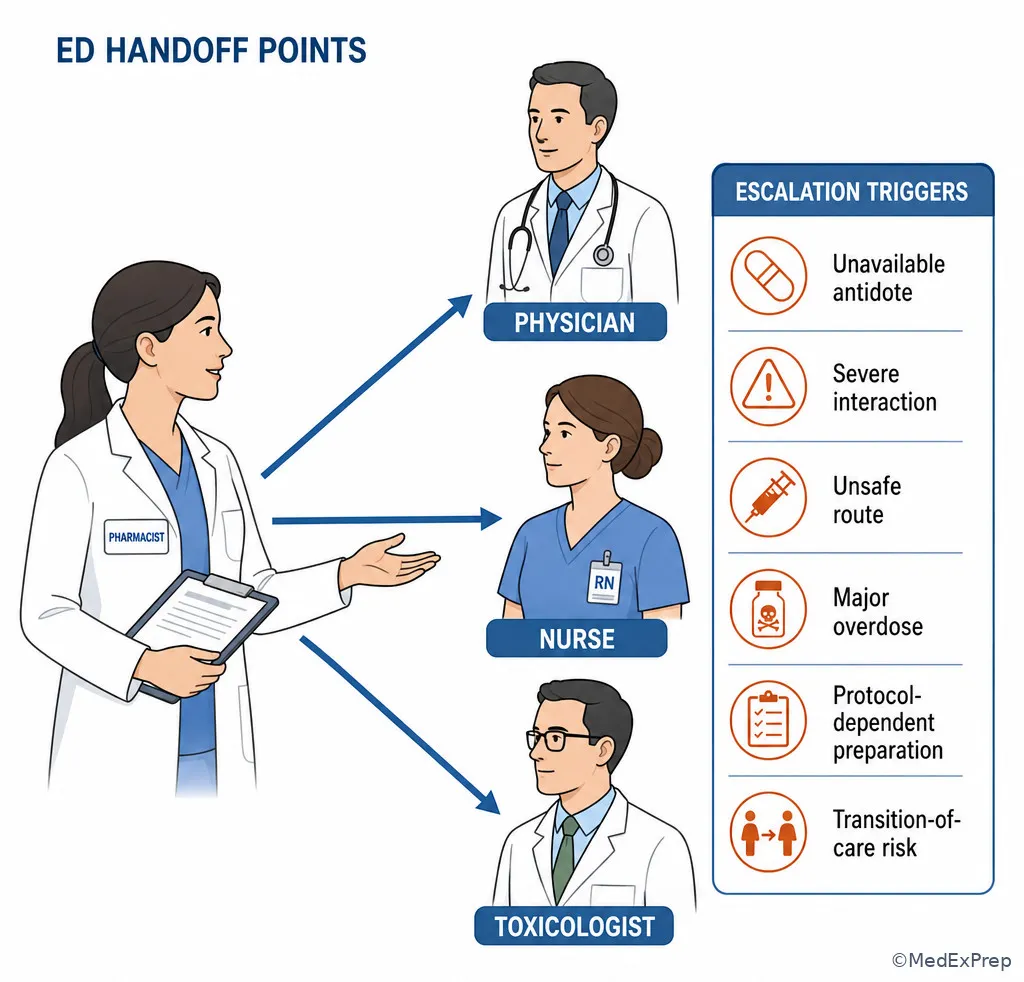
  • Escalate: Notify the appropriate clinician when a risk exceeds pharmacist-only action.
  • Medication reconciliation: Identify current, omitted, duplicated, or conflicting therapies.
  • Transitions of care: Medication planning across ED arrival, observation, admission, transfer, or discharge.
  • Learner-safe guidance: State widely accepted principles when local protocols vary.
  • Out-of-role signal: Stem wording that asks for physician-only procedural or diagnosis-only action.
  • Time-to-treatment task: Medication action where delay changes outcome.
  • Medication-use safety hazard: Interaction, allergy, contraindication, duplication, preparation error, or wrong dose/route.

Must-know facts

  • The BCEMP lens is medication-centered, even when the clinical scenario is broad.
  • The best answer often names what the pharmacist should recommend, verify, monitor, or clarify.
  • Procedural performance is usually out of scope unless the question explicitly grants protocol authority.
  • Do not answer as the emergency physician when the task can be framed as medication support.
  • When protocols vary, use guideline-based principles and note that local protocols vary.
  • A strong pharmacist answer includes safety screening, monitoring, and escalation triggers.
  • “Best next step” may be clarification rather than immediate dispensing or recommending.
  • Medication history gaps, renal function, pregnancy, allergies, and interactions can convert a routine order into a safety problem.
  • On exam stems, a diagnosis may be given; your job is often the medication implication of that diagnosis.
Fig 1. Scope filter for BCEMP stems
Exam takeaway: Use this sequence to convert a broad ED case into the specific pharmacist action being tested.
flowchart TD
A[Read the stem] --> B{What is the pharmacist task?}
B -->|Recommend| C[Choose drug dose route timing]
B -->|Verify| D[Check appropriateness allergies interactions organ function]
B -->|Prepare| E[Confirm concentration compatibility urgency]
B -->|Monitor| F[Define efficacy toxicity follow-up]
B -->|Clarify or escalate| G[Identify missing data or out-of-scope issue]
C --> H[Answer with safest medication-related action]
D --> H
E --> H
F --> H
G --> H
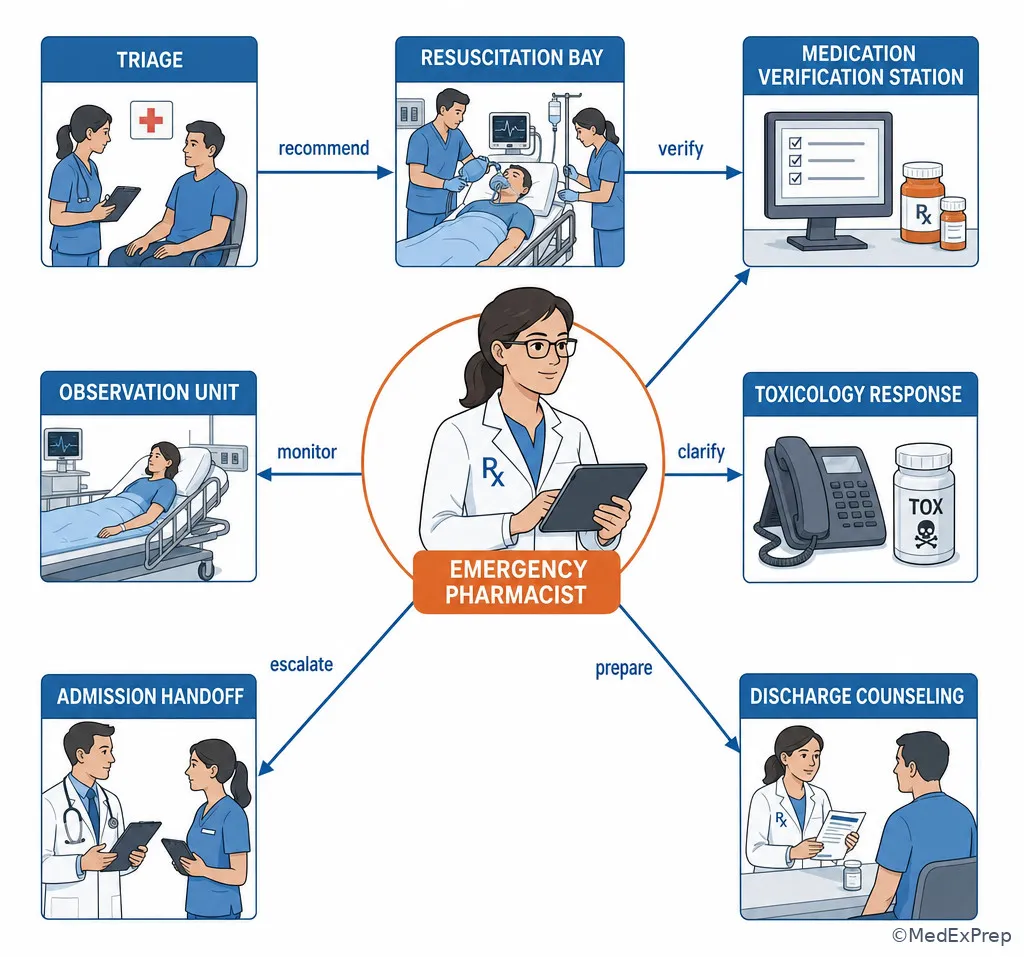
Emergency pharmacist role map in the ED
Exam takeaway: Visualize the pharmacist at key ED interfaces where medication decisions, verification, and escalation occur.
Emergency pharmacist role map in the ED

Core content

Recall: In BCEMP Blueprint Domains, we covered that Patient Care/Management dominates the exam. Here, we build on that by translating broad blueprint wording into concrete pharmacist actions in ED scenarios.
High-Yield Connection: This concept is tested alongside Question Framing Cues. Know both the scope boundary and the stem trigger words that identify whether the task is dose selection, route verification, contraindication screening, or urgent clarification.

1.1.2.1 Foundational role boundary: medication-centered, not diagnosis-centered

A. Explanation

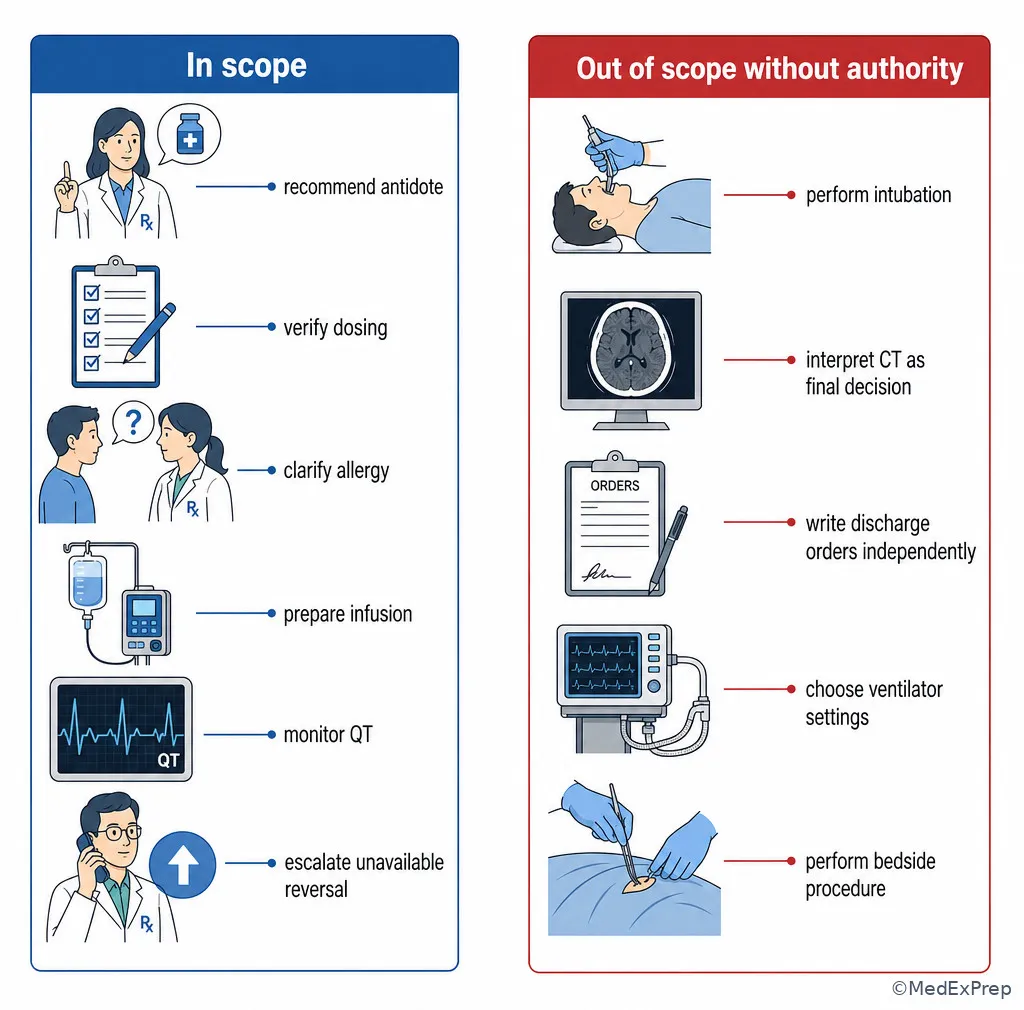
The first decision conflict in this topic is simple but heavily tested: should you answer as a general clinician managing the whole patient, or as an emergency pharmacist making the best medication-related contribution? The correct frame is the second one. The single rule that resolves most scope questions is this: if the task can be expressed as choosing, checking, preparing, monitoring, or escalating medication therapy, it belongs in your answer; if it requires independent diagnosis-only reasoning or procedural performance, reject it unless explicit protocol authority is provided. WHY THIS IS TESTED: exam writers often place a true medication task inside a dramatic ED scenario so that candidates drift toward physician-only actions.

Choose a pharmacist-centered answer when the stem asks what should be recommended, verified, prepared, monitored, or clarified. Reject answers that ask you to intubate, independently interpret imaging as the primary decision-maker, perform a bedside procedure, write independent admission or discharge orders without stated authority, or make a diagnosis-only call that does not lead to a medication implication. A pharmacist can recognize the need for urgent intubation support, anticoagulant reversal, antidote selection, or seizure therapy escalation; the pharmacist should not be framed as the operator performing the airway or procedure. See Fig 1.

Fig 2. In-scope versus out-of-scope role split
Exam takeaway: Pick the option that keeps the pharmacist anchored to medication judgment, safety, and communication.
Identify the action verb
Look for recommend, verify, prepare, monitor, clarify, or escalate.

Role test
If the action is medication-related, keep it. If it is procedure-only or diagnosis-only, reject it.

Final answer
State the best medication contribution plus safety and escalation needs.

Memory anchor: RVPM-CE = Recommend, Verify, Prepare, Monitor, Clarify, Escalate. If an answer fits one of these, it is usually in the pharmacist lane.
Pharmacist Action: NOTICE: verbs that imply medication judgment versus procedure performance. SAY: “My recommendation is the safest medication-related next step based on available data.” MONITOR: immediate toxicity or efficacy parameters tied to the medication decision, reassessed as clinically needed. HOLD/CLARIFY/ESCALATE: hold when the order lacks a critical safety element or when the requested action is out of pharmacist scope.

B. Worked example

A 67-year-old man with atrial fibrillation on apixaban 5 mg twice daily, CKD stage 3, and hypertension presents after a fall with worsening confusion. CT is pending. The team asks for urgent medication input while neurosurgery is being paged. Labs show serum creatinine 1.9 mg/dL and INR 1.3. A distracting clue in the stem mentions a remote penicillin allergy. The pharmacist is asked for the most appropriate next step.

Reasoning chain: Identify the task: this is not “read the CT and diagnose the bleed.” It is a medication-support question in an unstable trauma/neuro context. Extract key facts: apixaban exposure, possible intracranial hemorrhage, renal dysfunction, urgent time-sensitive decision. Apply the rule: anchor to a medication-related responsibility. The pharmacist should recommend anticoagulant reversal strategy, verify last dose timing if possible, prepare or facilitate reversal product access per guideline and local protocol, and communicate monitoring needs. Eliminate distractors: independent neurosurgical decision-making is out of scope; ordering imaging independently is not the pharmacist task; focusing on the penicillin allergy is noise. Verify: because local protocols vary, learner-safe wording is to recommend guideline-based reversal and escalate urgently to the treating team.

C. Exam trap

Common wrong answer: “Interpret the CT and decide whether the patient requires emergent surgery.” WHY IT IS TEMPTING: the clinical situation is dramatic, so the candidate shifts into total-patient management. SINGLE CLUE: the stem asks for pharmacist input on an anticoagulated patient, which makes reversal recommendation and medication safety the tested action.

D. Checkpoint

Question: A 59-year-old woman with epilepsy, alcohol use disorder, and cirrhosis arrives actively seizing after missing levetiracetam. The physician is at bedside preparing the airway plan. Which pharmacist-centered action is most appropriate?

  1. Perform rapid sequence intubation because seizure control requires airway management.
  2. Recommend evidence-based antiseizure medications, verify benzodiazepine dosing and route, and monitor for respiratory depression.
  3. Make the final diagnosis of nonconvulsive status epilepticus before any medications are given.
  4. Choose the ventilator settings most appropriate for post-intubation management.
  • A: Tempting because airway matters in status epilepticus; wrong because performing RSI is an operator task, not the pharmacist role.
  • B: Tempting because it feels narrower than total resuscitation; right because it anchors to medication selection, dose verification, route, and monitoring.
  • C: Tempting because diagnosis guides treatment; wrong because the pharmacist is not asked to make a diagnosis-only determination before medication support.
  • D: Tempting because sedation and ventilation interact; wrong because choosing ventilator settings is not the pharmacist task in this stem.
If you missed this: Review 1.1.2.1 Foundational role boundary: medication-centered, not diagnosis-centered — focus on the verb test that separates medication judgment from procedure-only actions.

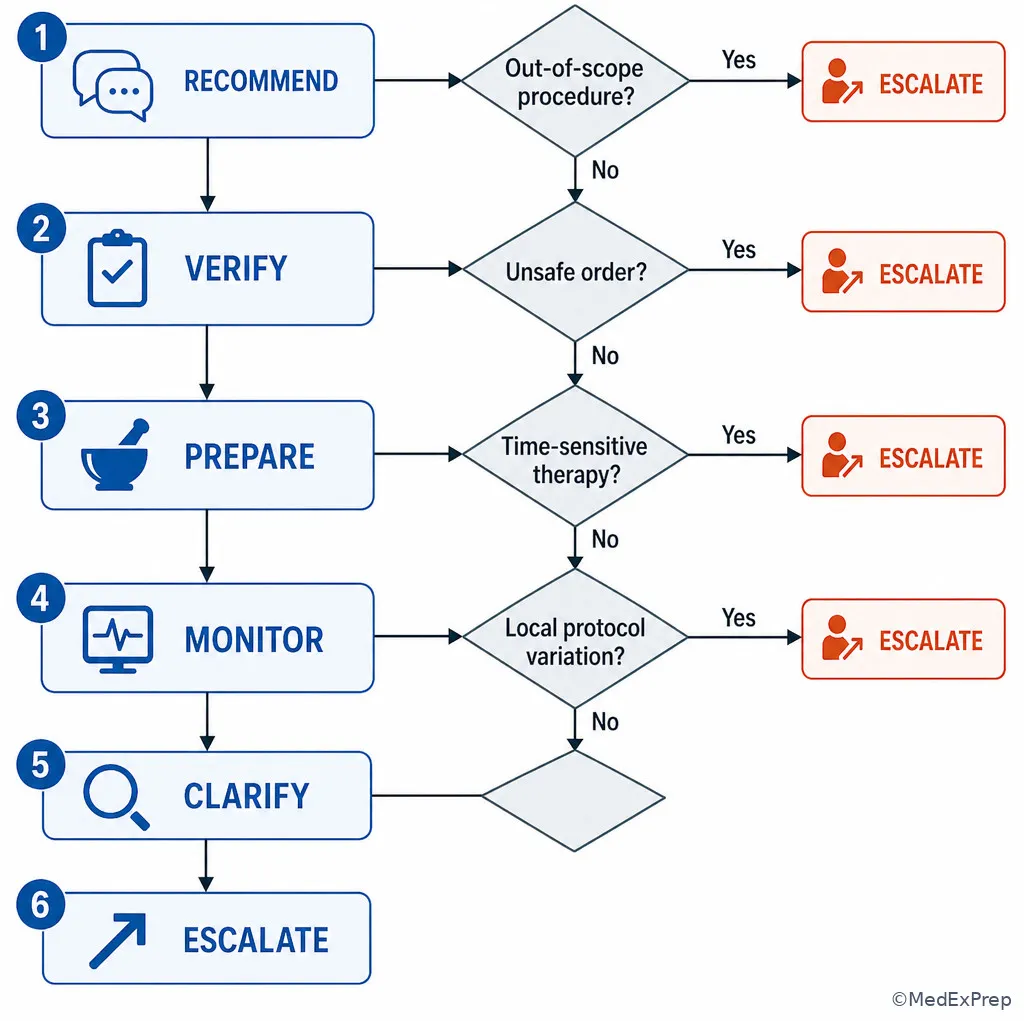
1.1.2.2 The pharmacist action ladder: recommend, verify, prepare, monitor, clarify, escalate

A. Explanation

After you confirm that the stem is in scope, the next decision conflict is choosing which pharmacist action the question really wants. Several answers may be medication-related, but only one matches the urgency and information available. The single resolving rule is: choose the action that removes the most immediate medication-related risk. In a complete, appropriate order, you may monitor. In an incomplete or unsafe order, you clarify. In a time-sensitive evidence gap, you recommend. In an emergent product need, you prepare or coordinate access. In a risk beyond your authority, you escalate. WHY THIS IS TESTED: the exam distinguishes passive knowledge from operational judgment under time pressure.

Think of these actions as a ladder rather than isolated verbs. For example, a septic shock stem may require all of the following in practice: recommend empiric antimicrobials, verify dose and renal considerations, prepare or facilitate rapid availability, monitor timing and adverse effects, clarify missing allergy history if critical, and escalate if delay or contraindication threatens outcome. The exam, however, usually asks for the one best immediate action. The winner is the action tied to the most pressing medication problem. See Fig 2.

Fig 3. Pharmacist action ladder in urgent care
Exam takeaway: The best answer is the action that removes the highest-priority medication risk with the data currently available.
Is there a medication need?
If therapy is missing or suboptimal, recommend the best option.

Is the order unsafe or incomplete?
If yes, clarify or hold. If no, proceed to verification and preparation support.

Close the loop
Monitor response and escalate when risk exceeds pharmacist-only action.

A useful choose-versus-reject frame: choose clarify over dispense when the dose is unsafe, choose recommend over observe when delay worsens outcomes, choose escalate over silently correct when the clinical consequence is major, and choose monitor over repeat dosing when the order is already appropriate and the next issue is reassessment.

Pharmacist Action: NOTICE: whether the immediate problem is missing therapy, unsafe therapy, unavailable therapy, or unmonitored therapy. SAY: “The highest-priority pharmacist action is to [recommend/verify/clarify/etc.] because this removes the immediate medication risk.” MONITOR: onset, adverse effects, dose timing, and required labs based on the therapy. HOLD/CLARIFY/ESCALATE: hold if key safety data are absent; escalate if delay or harm is likely.

B. Worked example

A 74-year-old woman with heart failure, diabetes, and chronic kidney disease presents with fever, hypotension, and suspected pneumonia. Cefepime 2 g IV every 8 hours is ordered immediately. Her serum creatinine returns at 3.2 mg/dL, estimated creatinine clearance is markedly reduced, and family reports an anaphylactic reaction to cefepime years ago, though triage documented “cephalosporin intolerance” without detail. Lactate is elevated; a mildly elevated AST distracts from the real issue. What is the best pharmacist action?

Reasoning chain: Identify task: pharmacist scope in a sepsis medication decision. Extract key facts: time-sensitive antibiotic need, possible severe beta-lactam allergy, likely renal dose issue, hemodynamic instability. Apply rule: select the action that removes the highest immediate medication risk. Clarify the allergy immediately because anaphylaxis would invalidate the current order, recommend an appropriate alternative regimen, verify renal adjustment for the replacement, and escalate urgency because delays in effective antimicrobials worsen outcomes. Eliminate distractors: simply monitoring is too passive; dispensing the current cefepime order is unsafe; debating the source of infection without acting on antimicrobials is not the pharmacist’s best role. Verify with learner-safe language: use guideline principles and local antibiogram/formulary if available.

C. Exam trap

Common wrong answer: “Renally adjust cefepime and dispense it now.” WHY IT IS TEMPTING: renal dose adjustment is a classic pharmacist task. SINGLE CLUE: the history suggests prior anaphylaxis to cefepime, so allergy clarification and alternative recommendation outrank simple renal adjustment.

D. Checkpoint

Question: A 68-year-old man with COPD, atrial fibrillation on amiodarone, and CKD is ordered levofloxacin 750 mg IV for severe CAP. Baseline QTc is prolonged, potassium is 3.1 mEq/L, and magnesium is low. Which pharmacist action is most appropriate first?

  1. Verify the order as written because levofloxacin is guideline-concordant for pneumonia.
  2. Clarify the safety risk, recommend an alternative or corrective plan, and address the modifiable QT/electrolyte issue before routine verification.
  3. Prepare the infusion immediately because time to antibiotics is the only priority.
  4. Monitor the patient after the first dose because adverse effects can be managed if they occur.
  • A: Tempting because the indication is plausible; wrong because the interaction and electrolyte risk create an immediate medication safety issue.
  • B: Tempting because it delays antibiotics; right because it addresses the highest-priority medication risk without ignoring the need for prompt therapy.
  • C: Tempting because severe CAP is time-sensitive; wrong because product preparation should not bypass a major preventable safety problem.
  • D: Tempting because monitoring is always needed; wrong because post-dose monitoring does not fix a known pre-dose hazard.
If you missed this: Review 1.1.2.2 The pharmacist action ladder: recommend, verify, prepare, monitor, clarify, escalate — focus on choosing the action that removes the immediate medication-related risk.
Quick Recall:

  • The best pharmacist answer usually starts with one of these verbs: recommend, verify, prepare, monitor, clarify, or escalate.
  • True or False: A medication order can be time-sensitive and still require clarification before verification. True.
  • Name the two factors that most often convert “verify” into “clarify.” Missing critical information and immediate safety risk.

1.1.2.3 Application in board-style stems: finding the true pharmacist task amid noise

A. Explanation

Foundational scope knowledge becomes useful only when you can spot the tested task in a noisy stem. The decision conflict here is between following the emotionally loudest detail and following the medication-relevant detail. The single rule that resolves this is: ask which fact changes drug choice, dose, route, timing, monitoring, or safety. THAT is the board-relevant signal. WHY THIS IS TESTED: BCEMP-style questions add comorbidities, abnormal labs, and procedural context to force prioritization.

Noise is not random. Common distractors include a lab that matters clinically but not to the immediate medication decision, a remote history that sounds important but does not alter therapy, or a procedure mention that tempts you into out-of-scope action. The best pharmacist response names the task precisely: “recommend reversal,” “verify weight-based dose,” “clarify last anticoagulant dose,” “monitor for hypotension after sedation,” or “escalate because the route ordered is unsafe.” See Fig 3. Forward-looking note: this skill directly supports the upcoming topic Acuity and Prioritization, where you will rank medication tasks by time-to-treatment.

Fig 4. Stem signal-versus-noise triage
Exam takeaway: Identify the single fact that changes the medication plan and let that fact drive the answer.
flowchart LR
A[Full stem] --> B[Medication facts]
A --> C[Clinical noise]
B --> D{Does it change drug dose route timing or monitoring?}
C --> E[Background only]
D -->|Yes| F[Use for answer selection]
D -->|No| E
F --> G[Best pharmacist action]
E --> G2[Do not let noise drive the answer]

Use a repeatable internal checklist: identify task, extract key facts, determine immediate threats, apply the governing medication rule, eliminate alternatives, verify safety and disposition implications. If a stem says “most appropriate next step” and gives you a drug order, you are often being tested on verification or clarification. If the stem says a medication has not yet been started in a time-critical syndrome, recommendation or preparation is more likely. If the stem gives a correct therapy and asks what matters next, monitoring usually wins.

High-Yield Connection: This concept is tested alongside Acuity and Prioritization. Know both which task is yours and which task must happen first when multiple medication issues are present.
Pharmacist Action: NOTICE: the one stem detail that changes a medication decision. SAY: “The medication-relevant discriminator is ___, so the best action is ___.” MONITOR: whichever parameter would confirm benefit or detect harm from that specific drug decision. HOLD/CLARIFY/ESCALATE: escalate if unresolved noise actually conceals a time-sensitive medication danger.

B. Worked example

A 32-year-old pregnant woman at 28 weeks with asthma and opioid use disorder is brought in after being found somnolent. Respiratory rate is 6/min, oxygen saturation is 84%, pupils are pinpoint, and EMS administered no medications en route. Her glucose is 58 mg/dL, which is a tempting distractor. Home medications include buprenorphine/naloxone and albuterol. The team asks what the pharmacist should recommend first.

Reasoning chain: Identify task: immediate medication recommendation in a toxicology-respiratory emergency. Extract key facts: severe respiratory depression, likely opioid toxidrome, pregnancy matters but does not change the need to reverse life-threatening hypoventilation, hypoglycemia is present but does not best explain pinpoint pupils plus bradypnea. Apply the rule: choose the fact that changes medication action most urgently. Recommend naloxone dosing and titration strategy, support preparation, and monitor for recurrent sedation or withdrawal. Eliminate distractors: discussing chronic OUD maintenance strategy is premature; independently managing airway procedure details is out of role; focusing first on buprenorphine continuation ignores the acute threat. Verify: communicate the need for repeat dosing or infusion if recurrent toxicity develops.

C. Exam trap

Common wrong answer: “Recommend dextrose first because glucose is 58 mg/dL.” WHY IT IS TEMPTING: hypoglycemia is an emergency and is a familiar protocol trigger. SINGLE CLUE: the triad of severe bradypnea, pinpoint pupils, and opioid exposure points to naloxone as the medication-specific priority in this stem.

D. Checkpoint

Question: A 46-year-old man with cirrhosis, obesity, and chronic pain is receiving ketamine for severe agitation in the ED. After the dose, he becomes hypertensive and tachycardic but remains oxygenating well. Which pharmacist task is most appropriate?

  1. Read the head CT to determine whether intracranial pathology caused the agitation.
  2. Monitor for expected adverse effects, reassess the need for additional sedatives, and communicate medication-related safety parameters.
  3. Complete the physical restraints order independently because agitation treatment is ongoing.
  4. Choose the exact bedside procedural approach for immediate airway intervention.
  • A: Tempting because the cause of agitation matters; wrong because imaging interpretation is not the tested medication role.
  • B: Tempting because it may feel less active; right because the medication has already been given and the key pharmacist role is monitoring and medication-related reassessment.
  • C: Tempting because control of agitation includes restraints; wrong because independent ordering authority is not assumed here.
  • D: Tempting because sedation can affect airway; wrong because procedural airway choices are not the pharmacist action in this scenario.
If you missed this: Review 1.1.2.3 Application in board-style stems: finding the true pharmacist task amid noise — focus on the single stem fact that changes drug choice, dose, route, timing, or monitoring.

1.1.2.4 Integration: when local protocols vary and when escalation is required

A. Explanation

The last major conflict is what to do when the “right” medication answer depends on institutional practice. The exam does not expect you to invent a local policy. The single rule is: use broadly accepted guideline-based principles, then state that local protocols vary when operational details differ. WHY THIS IS TESTED: emergency medicine pharmacy involves antidote stocking, sedation pathways, RSI adjunct preferences, formulary substitutions, and compounding workflows that differ across institutions.

Examples include which reversal agent is stocked, who may mix bedside infusions, which broad-spectrum beta-lactam is first-line locally, or the exact sedation protocol during behavioral emergencies. In these situations, choose the answer that reflects the universal principle: recommend the evidence-based class or strategy, verify contraindications and patient modifiers, and escalate or coordinate with the team for institution-specific execution. Reject answers that pretend hidden local knowledge. Also know when escalation is mandatory: significant medication error risk, unavailable antidote, procedural need outside scope, severe hemodynamic instability affecting drug choice, or a disagreement requiring urgent physician/toxicology input. See Fig 4.

Fig 5. Protocol variation and escalation pathway
Exam takeaway: When details vary locally, answer with the universal medication principle and name the need to confirm protocol-specific execution.
Find the universal rule
Choose the evidence-based medication strategy that applies across institutions.

Does local protocol affect execution?
If yes, confirm with institution-specific policy or formulary. If no, proceed with guideline-based recommendation.

Escalate when needed
Notify the appropriate clinician when harm risk, procedural need, or antidote access exceeds pharmacist-only action.

A good BCEMP answer sounds like this: “Recommend guideline-concordant therapy, verify contraindications and dosing, and confirm protocol-specific preparation or access per local policy.” That phrasing is safer than overclaiming a nonexistent institutional rule. It also reflects the real emergency pharmacist role: evidence translation plus medication-use operations plus safety escalation.

Memory anchor: GUIDE = Guideline principle first, Unknown local detail does not change the core therapy, Institution may vary, Declare need to confirm protocol, Escalate if harm risk is immediate.
Pharmacist Action: NOTICE: whether the uncertainty is clinical or merely operational. SAY: “The evidence-based medication strategy is ___; local protocols vary, so confirm product access/preparation workflow with your institution.” MONITOR: implementation delay, adverse effects, and response after the therapy is started. HOLD/CLARIFY/ESCALATE: escalate immediately for unavailable antidotes, severe medication errors, or any procedural need outside pharmacist scope.

B. Worked example

A 61-year-old man with obesity, type 2 diabetes, and coronary artery disease presents after ingesting an unknown quantity of sustained-release verapamil. He is hypotensive and bradycardic. The ED has variable access to high-dose insulin protocols overnight; the charge nurse asks which medication strategy the pharmacist should recommend while toxicology is being paged. A mildly elevated lipase is included in the stem but is distracting.

Reasoning chain: Identify task: pharmacist recommendation in a time-sensitive overdose. Extract key facts: likely calcium channel blocker toxicity, shock physiology, protocol-sensitive antidote logistics, toxicology consultation needed. Apply the rule: answer with the universal principle rather than invent local workflow. Recommend evidence-based CCB overdose support, verify dosing and dextrose/potassium monitoring if high-dose insulin is used, identify available agents and preparations, and escalate to toxicology and the treating team for protocol execution. Eliminate distractors: “follow your hospital policy” alone is incomplete because it lacks the universal medication principle; independently managing vasopressor titration at the bedside without framing it as recommendation is too broad; focusing on lipase is noise. Verify: local protocols vary, but the medication-related role does not.

C. Exam trap

Common wrong answer: “Choose whichever antidote your institution usually uses, without further clarification.” WHY IT IS TEMPTING: candidates know local practice often drives implementation. SINGLE CLUE: the exam expects a guideline-based principle first, then acknowledgment that operational details may vary by protocol.

D. Checkpoint

Question: An ED physician asks whether the pharmacist should independently write discharge anticoagulation orders for a low-risk PE because “you know the meds best.” No collaborative practice authority is described. What is the most appropriate pharmacist action?

  1. Write the discharge prescription independently because medication selection is within pharmacy knowledge.
  2. Recommend the evidence-based anticoagulant plan, verify contraindications and transitions-of-care issues, and escalate that prescribing requires the authorized clinician.
  3. Decline all involvement because discharge planning is outside emergency pharmacy scope.
  4. Delay anticoagulation discussion until the patient reaches outpatient follow-up.
  • A: Tempting because the pharmacist is medication expert; wrong because independent prescribing authority is not granted in the stem.
  • B: Tempting because it may seem less efficient; right because it preserves the pharmacist’s medication role while respecting authority boundaries.
  • C: Tempting because it avoids scope violation; wrong because transitions-of-care medication planning is absolutely within scope.
  • D: Tempting because outpatient follow-up matters; wrong because the immediate ED transition medication plan is the relevant issue now.
If you missed this: Review 1.1.2.4 Integration: when local protocols vary and when escalation is required — focus on using guideline principles without inventing authority or institutional rules.
Quick Recall:

  • True or False: “Local protocols vary” means no exam answer can be preferred. False.
  • The correct sequence is usually guideline principle first, then protocol-specific confirmation.
  • Name 3 triggers for escalation: unavailable therapy, major safety hazard, procedural need outside scope.
Medication verification workstation with emergency safety checks
Exam takeaway: The pharmacist’s role often centers on rapid order review for allergies, renal function, interactions, route, and timing.
Medication verification workstation with emergency safety checks
ED handoff with pharmacist escalation points
Exam takeaway: Escalation is part of pharmacist scope when medication risk exceeds clarification or routine verification.
ED handoff with pharmacist escalation points

Exam Traps & Differentiators

Common traps & distractors:

  • Most common wrong answer: choosing the physician-only action because it feels more decisive. Why: dramatic ED stems make total-patient management seem like the “bigger” answer. Fix: ask which action is specifically medication-related.
  • Looks similar but isn’t: verify versus clarify. Verification confirms a safe order; clarification interrupts an unsafe or incomplete order.
  • Looks similar but isn’t: recommend versus prepare. Recommendation chooses therapy; preparation supports implementation after the strategy is selected.
  • Looks similar but isn’t: monitor versus repeat dose. Monitoring is correct only when the current therapy is appropriate and the next issue is reassessment.
  • Cross-topic confusion: in the upcoming Acuity and Prioritization lesson, some stems will include multiple correct pharmacist tasks; there the tested skill is ranking them. Here, the tested skill is recognizing which tasks are yours at all.

If the stem says “The physician is preparing for intubation,” think medication support, induction/paralytic verification, post-intubation sedation planning, not airway performance.

If the stem says “CT is pending,” think medication implication of the likely syndrome, not independent imaging interpretation.

If the stem says “The order is already written,” think verify versus clarify before dispensing.

If the stem says “Best next step” in a time-critical syndrome with no therapy yet, think recommend or facilitate urgent medication action.

If the stem says “Local policy may differ,” think universal guideline principle plus protocol confirmation.

If the stem says “The team asks the pharmacist for input,” think a pharmacist-specific contribution, not a generic management plan.

Task verb in stem Best pharmacist lane Common wrong pivot Discriminator
Recommend Select agent, dose, route, timing Discuss broad diagnosis only The stem asks for actionable medication guidance
Verify Check safety, appropriateness, organ function, interactions Assume the order is fine because indication fits An order already exists and must be screened
Prepare Support product access, concentration, compatibility, readiness Skip safety review because urgency is high The therapy choice is known but operational support is needed
Monitor Track response, toxicity, follow-up Redose or change therapy too early Current therapy is already appropriate
Clarify Resolve missing or unsafe information Verify and send anyway A critical safety element is absent or contradictory
Escalate Communicate urgent risk beyond pharmacist-only action Quietly document without notifying team Delay or harm risk is immediate
Looks similar Actually means Choose when Reject when
Verify Approve after safety review Order is complete and safe Allergy, interaction, or dose problem exists
Clarify Pause and resolve risk Critical detail missing or unsafe The order is already clearly appropriate
Recommend Choose the therapy strategy No therapy yet or current therapy is wrong The question is really about monitoring after a correct dose
Monitor Follow effect and harm Medication plan is already correct The initial selection still has not been made
Scenario type Pharmacist role Out-of-scope temptation Single clue that eliminates it
Pending airway Drug selection, dose verification, post-intubation sedation planning Perform RSI Pharmacist input is requested on medications
Possible intracranial bleed on anticoagulant Recommend reversal, verify exposure history, coordinate product access Decide surgery or interpret CT as final authority The testable issue is anticoagulant reversal
Sepsis with antibiotic order Verify allergy, dose, timing, spectrum, renal adjustment Diagnose the infection source only A medication order is present and safety-sensitive
Discharge anticoagulation planning Recommend regimen, identify interactions, counsel transitions issues Write prescription without authority No prescribing authority is stated
Toxidrome/antidote Recommend antidote strategy, prepare access, monitor response Manage all bedside procedures The medication implication is the central pharmacist task
Choose-versus-reject comparison map
Exam takeaway: Competitive answer choices often differ by only one role boundary, so test each option against scope before choosing.
flowchart TD
A[Answer choice] --> B{Medication-related?}
B -->|Yes| C{Needs safety clarification first?}
B -->|No| D[Reject as out-of-scope]
C -->|Yes| E[Clarify or escalate]
C -->|No| F{Therapy missing or wrong?}
F -->|Yes| G[Recommend]
F -->|No| H[Verify monitor prepare as appropriate]
Comparison panel of in-scope and out-of-scope ED actions
Exam takeaway: Distinguish pharmacist medication decisions from physician-only procedural or diagnosis-only actions at a glance.
Comparison panel of in-scope and out-of-scope ED actions
Review connection: The traps above test role framing and action selection. If any felt unfamiliar, revisit 1.1.2.2 The pharmacist action ladder: recommend, verify, prepare, monitor, clarify, escalate before attempting the Self-check quiz.

Algorithm / Approach

Fig 6. Board-style approach to scope questions
Exam takeaway: Use this algorithm to convert a broad emergency stem into the single best pharmacist-centered action.
Start with the verb
Ask what the pharmacist is being asked to do: recommend, verify, prepare, monitor, clarify, or escalate.

Role boundary test
If the action is procedure-only or diagnosis-only, reject it unless explicit authority is stated.

Find the medication discriminator
Pick the single fact that changes drug choice, dose, route, timing, or monitoring.

Urgency check
Choose the pharmacist action that removes the highest-priority medication risk right now.

Protocol variation check
Use guideline principles first; if local details differ, say to confirm with institutional protocol.

Close the answer
State the action, safety concern, monitoring plan, and escalation trigger.

Key rule: The best BCEMP answer is rarely the broadest answer. It is the narrowest answer that safely solves the immediate medication problem.
Decision algorithm poster for emergency pharmacist actions
Exam takeaway: A visual decision ladder helps you separate recommend, verify, clarify, and escalate under time pressure.
Decision algorithm poster for emergency pharmacist actions

Rapid Review

  • Medication-centered role → answer with drug-related action, not total-patient management.
  • Procedure mention → support medication plan; do not become the operator.
  • Order already written → think verify versus clarify before anything else.
  • Missing critical safety fact → clarify beats verify.
  • Untreated time-sensitive syndrome → recommend beats passive monitoring.
  • Correct therapy already started → monitor beats re-choosing the drug.
  • Protocol-dependent logistics → universal guideline principle first, local confirmation second.
  • No prescribing authority stated → recommend regimen; do not independently prescribe.
  • Imaging pending → focus on medication implications, not primary image interpretation.
  • Noise lab in stem → ignore unless it changes dose, route, timing, monitoring, or safety.
  • Allergy plus appropriate drug → allergy clarification outranks routine dose adjustment.
  • Severe interaction risk → clarification or alternative recommendation beats automatic verification.
  • Unavailable antidote → escalate immediately; do not stop at documentation.
  • Transitions of care → still in scope when the task is medication planning or reconciliation.

Self-check quiz

1. A 63-year-old man with heart failure and CKD is ordered vancomycin 1.5 g IV in the ED. The physician asks the pharmacist to “take a look before we send it.” Which action best matches the pharmacist task?

  1. Verify the dose, infusion plan, and patient-specific safety factors.
  2. Perform the central line placement needed for long-term therapy.
  3. Make the final diagnosis of endocarditis before therapy begins.
  4. Write the admission orders independently because antibiotics are needed.

2. A 56-year-old woman with atrial fibrillation on rivaroxaban, obesity, and hypertension presents with head trauma. CT is pending. Which pharmacist-centered action is most appropriate?

  1. Recommend/prepare evidence-based reversal support and verify anticoagulant exposure details.
  2. Interpret the CT scan and determine whether surgery is indicated.
  3. Choose the neurosurgical operative approach.
  4. Delay all medication input until the formal radiology read is complete.

3. A 71-year-old woman with COPD, CKD, and chronic amiodarone therapy is ordered levofloxacin 750 mg IV once in the ED for pneumonia. QTc is 520 ms, potassium is 3.0 mEq/L, and magnesium is 1.5 mg/dL. Which is the most appropriate pharmacist action?

  1. Verify levofloxacin because prompt antibiotics are needed.
  2. Clarify the order, address the QT/electrolyte risk, and recommend a safer plan.
  3. Prepare the infusion immediately and reassess after administration.
  4. Document the risk but take no further action unless torsades occurs.

4. A 29-year-old pregnant woman with opioid use disorder and asthma is brought in with RR 5/min after suspected fentanyl exposure. Home medications include buprenorphine/naloxone 8 mg/2 mg SL twice daily and albuterol PRN. Glucose is 61 mg/dL. Which recommendation is most appropriate first?

  1. Recommend naloxone titration and monitoring for recurrent respiratory depression.
  2. Recommend immediate continuation of her home buprenorphine/naloxone dose.
  3. Recommend only dextrose because glucose is abnormal.
  4. Choose the procedural airway technique to be used if intubation is needed.

5. A 76-year-old man with diabetes, CKD, and a documented prior cefepime anaphylaxis is ordered cefepime 2 g IV every 8 hours for septic shock. Which pharmacist action is most appropriate?

  1. Renally adjust cefepime and verify the order.
  2. Clarify the allergy immediately and recommend an alternative empiric regimen.
  3. Prepare the current cefepime dose because sepsis timing outweighs allergy concerns.
  4. Wait for culture results before intervening.

6. A 60-year-old man with verapamil overdose, obesity, and CAD is hypotensive and bradycardic. Overnight staff are unsure whether the ED high-dose insulin protocol can be activated without toxicology callback. Which pharmacist response is most appropriate?

  1. Recommend the guideline-based CCB overdose strategy, verify monitoring/logistics, and confirm protocol-specific execution with the institution while escalating to toxicology.
  2. Choose whichever antidote your hospital usually uses and send it without further clarification.
  3. Refuse to participate until the toxicologist gives the complete plan.
  4. Independently titrate vasopressors and bedside procedures because the patient is unstable.

7. A 65-year-old woman with low-risk PE, metastatic breast cancer, and normal renal function is preparing for ED discharge. The physician asks the pharmacist to independently write the apixaban prescription because the department is busy. No collaborative practice authority is described. Which is the best medication-related action?

  1. Write the prescription because anticoagulant selection is within pharmacy expertise.
  2. Recommend the anticoagulant regimen, verify interactions and education points, and escalate that prescribing requires the authorized clinician.
  3. Decline involvement because all discharge work is outside emergency pharmacy scope.
  4. Delay anticoagulation planning until outpatient oncology follow-up.

8. A 48-year-old man with alcohol use disorder, cirrhosis, and epilepsy is actively seizing despite an initial benzodiazepine dose. The physician is preparing for airway support. The pharmacist is asked for the “best next step.” Which answer is most appropriate?

  1. Perform rapid sequence intubation because seizures can threaten the airway.
  2. Recommend next-line antiseizure pharmacotherapy, verify dosing/route, and monitor for respiratory and hemodynamic effects.
  3. Choose ventilator settings for the post-intubation phase.
  4. Delay medication recommendations until EEG confirms seizure subtype.

Answer key

1. Correct answer: A

A. Verify the dose, infusion plan, and patient-specific safety factors. Tempting because it sounds routine; correct because the stem explicitly asks the pharmacist to review an existing IV antibiotic order, which makes verification the primary task. The single discriminator is that an order already exists and the physician asks for a safety check, not independent diagnosis or procedure performance. This fits medication-use safety principles described in emergency pharmacy practice and tertiary drug information references such as Lexicomp and AHFS Drug Information.

B. Perform the central line placement needed for long-term therapy. Tempting because serious infections may require vascular access; incorrect because central line placement is a procedural task outside standard pharmacist scope. The single clue is that the question asks what medication-related action the pharmacist should take regarding a vancomycin order. Scope guardrails and emergency pharmacy role expectations reject operator tasks.

C. Make the final diagnosis of endocarditis before therapy begins. Tempting because antibiotic choice depends on diagnosis; incorrect because the question focuses on reviewing an ordered medication, not making the final diagnostic determination. The single clue is the specific request to “take a look before we send it,” which points to verification. Drug references and emergency pharmacy practice support pharmacist assessment of drug appropriateness without converting that role into diagnosis-only decision making.

D. Write the admission orders independently because antibiotics are needed. Tempting because timely therapy and continuity of care matter; incorrect because no independent order-writing authority is stated. The single discriminator is absent collaborative practice authority. Emergency pharmacy scope includes recommendations and transitions input, not assumed independent admission ordering.

If you missed this: Review 1.1.2.2 The pharmacist action ladder: recommend, verify, prepare, monitor, clarify, escalate — focus on recognizing that an existing order usually triggers verify versus clarify.

2. Correct answer: A

A. Recommend/prepare evidence-based reversal support and verify anticoagulant exposure details. Tempting because CT is pending and action may feel premature; correct because the pharmacist’s role in a head trauma patient on rivaroxaban is to support urgent anticoagulant reversal planning, exposure history verification, and product readiness. The single clue is rivaroxaban exposure plus head trauma, which creates a medication-specific risk even before final imaging. Guideline-based reversal principles and major drug information resources support this pharmacist-centered response.

B. Interpret the CT scan and determine whether surgery is indicated. Tempting because imaging drives neurosurgical decisions; incorrect because primary CT interpretation and surgical indication are not the pharmacist task. The single clue is that the question asks for a pharmacist-centered action. Scope-based answer selection eliminates diagnosis/procedure ownership.

C. Choose the neurosurgical operative approach. Tempting because urgency can make decisive actions look attractive; incorrect because operative planning is entirely outside pharmacist scope. The single discriminator is the medication-related anticoagulant exposure in the stem.

D. Delay all medication input until the formal radiology read is complete. Tempting because definitive findings matter; incorrect because delaying medication-related preparedness in a potentially bleeding anticoagulated patient misses the urgent pharmacist contribution. The single clue is the time-sensitive bleeding risk associated with rivaroxaban.

If you missed this: Review 1.1.2.1 Foundational role boundary: medication-centered, not diagnosis-centered — focus on anticoagulant reversal support as the pharmacist task when imaging or surgery decisions are pending.

3. Correct answer: B

A. Verify levofloxacin because prompt antibiotics are needed. Tempting because timely pneumonia treatment is guideline-supported; incorrect for this specific scenario because the patient has multiple torsades risk factors: chronic amiodarone exposure, prolonged QTc, hypokalemia, and hypomagnesemia. The single clue is the combination of QT-prolonging drug plus marked electrolyte abnormalities. Lexicomp, Clinical Pharmacology, and drug labeling support avoiding or carefully reconsidering additive QT risk.

B. Clarify the order, address the QT/electrolyte risk, and recommend a safer plan. Tempting because it may seem to delay antibiotics; correct because clarification is required when a plausible order carries a major preventable safety hazard. PK/PD rationale: additive repolarization risk from levofloxacin and amiodarone plus low potassium/magnesium increases torsades risk. The single discriminator is not pneumonia severity alone, but the modifiable medication risk profile. This is consistent with medication safety guidance in major references and emergency pharmacy practice.

C. Prepare the infusion immediately and reassess after administration. Tempting because severe infection makes timing important; incorrect because preparation does not outrank clarification when the known pre-dose risk is serious and potentially avoidable. The single clue is that the hazard exists before the first dose.

D. Document the risk but take no further action unless torsades occurs. Tempting because monitoring is always part of care; incorrect because passive documentation fails to address a high-risk drug-interaction and electrolyte problem. The single discriminator is that a safer action is possible before harm occurs.

If you missed this: Review 1.1.2.2 The pharmacist action ladder: recommend, verify, prepare, monitor, clarify, escalate — focus on why known pre-dose safety hazards convert verification into clarification.

4. Correct answer: A

A. Recommend naloxone titration and monitoring for recurrent respiratory depression. Tempting because pregnancy and buprenorphine history add complexity; correct because the immediate medication-related threat is life-threatening opioid-associated hypoventilation. PD rationale: naloxone reverses opioid receptor-mediated respiratory depression; titration helps restore ventilation while limiting severe withdrawal. The single stem clue is RR 5/min with suspected fentanyl exposure. Toxicology references, drug labeling, and emergency care guidance support immediate naloxone-based management.

B. Recommend immediate continuation of her home buprenorphine/naloxone dose. Tempting because opioid use disorder maintenance matters and buprenorphine is a real medication consideration; incorrect because chronic maintenance strategy does not address the acute respiratory emergency. The single clue eliminating it is severe bradypnea now.

C. Recommend only dextrose because glucose is abnormal. Tempting because glucose of 61 mg/dL is low and dextrose is a standard emergency medication; incorrect because the stronger medication discriminator is opioid toxidrome with life-threatening respiratory depression. The single clue is pinpoint pupils plus profound hypoventilation. Dextrose may still be considered, but it is not the best first pharmacist recommendation here.

D. Choose the procedural airway technique to be used if intubation is needed. Tempting because airway deterioration is possible; incorrect because airway technique selection is not the pharmacist role. The single discriminator is that the pharmacist is being asked for medication recommendation, not procedure execution.

If you missed this: Review 1.1.2.3 Application in board-style stems: finding the true pharmacist task amid noise — focus on identifying the single fact that most changes urgent medication action.

5. Correct answer: B

A. Renally adjust cefepime and verify the order. Tempting because renal adjustment is a classic pharmacist function and CKD is present; incorrect because the documented prior cefepime anaphylaxis is the higher-priority medication discriminator. The single clue is severe allergy history, which supersedes ordinary dose adjustment. Drug information references and allergy safety practice support avoiding re-exposure pending clarification and alternative selection.

B. Clarify the allergy immediately and recommend an alternative empiric regimen. Tempting because it adds complexity during septic shock; correct because clarification and alternative recommendation address the immediate safety threat while still preserving timely antimicrobial therapy. PK/PD and clinical rationale: effective empiric therapy should be prompt, but not with a drug likely to trigger anaphylaxis. The single discriminator is the specific cefepime anaphylaxis history. AHFS, Lexicomp, and emergency antimicrobial stewardship principles support this action.

C. Prepare the current cefepime dose because sepsis timing outweighs allergy concerns. Tempting because delayed antibiotics worsen outcomes; incorrect because time sensitivity does not justify proceeding with a likely contraindicated drug when alternatives exist. The single clue is not generic beta-lactam intolerance but explicit cefepime anaphylaxis.

D. Wait for culture results before intervening. Tempting because cultures refine therapy; incorrect because septic shock requires immediate empiric treatment, and the pharmacist must intervene on the unsafe current choice now. The single discriminator is shock-level urgency.

If you missed this: Review 1.1.2.2 The pharmacist action ladder: recommend, verify, prepare, monitor, clarify, escalate — focus on why allergy clarification outranks routine renal dose adjustment when both are present.

6. Correct answer: A

A. Recommend the guideline-based CCB overdose strategy, verify monitoring/logistics, and confirm protocol-specific execution with the institution while escalating to toxicology. Tempting because it sounds more nuanced than test items sometimes do; correct because it captures the exact integration skill this lesson tests: apply the universal medication principle first, then acknowledge operational variation and escalate appropriately. PK/PD rationale: therapies such as high-dose insulin require intensive glucose and potassium monitoring and protocol-specific execution, but the pharmacist can still recommend the strategy and coordinate safe implementation. Toxicology references, poison center guidance, and standard drug information resources support this approach.

B. Choose whichever antidote your hospital usually uses and send it without further clarification. Tempting because local practice often shapes implementation; incorrect because it invents a local rule and bypasses critical protocol confirmation. The single clue is staff uncertainty about protocol activation. That uncertainty requires confirmation, not assumption.

C. Refuse to participate until the toxicologist gives the complete plan. Tempting because specialist input is appropriate; incorrect because the pharmacist’s role includes evidence-based interim medication recommendations and logistics support during urgent care. The single discriminator is ongoing hypotension and bradycardia, which make passivity unsafe.

D. Independently titrate vasopressors and bedside procedures because the patient is unstable. Tempting because the patient is critically ill and vasoactive support may be needed; incorrect because the answer shifts into broad independent management and bedside procedural control rather than pharmacist recommendation and support. The single clue is that the task is a pharmacist response, not a physician/operator role.

If you missed this: Review 1.1.2.4 Integration: when local protocols vary and when escalation is required — focus on guideline principle first, protocol-specific confirmation second.

7. Correct answer: B

A. Write the prescription because anticoagulant selection is within pharmacy expertise. Tempting because pharmacists are medication experts and DOAC dosing is a medication issue; incorrect because no collaborative practice or prescribing authority is stated. The single clue is explicit absence of such authority. Scope-based exam reasoning rejects independent prescribing assumptions even when the medication plan itself is familiar. Lexicomp and guideline references can inform the recommendation, but not grant authority.

B. Recommend the anticoagulant regimen, verify interactions and education points, and escalate that prescribing requires the authorized clinician. Tempting because it may seem administratively slower; correct because it preserves the pharmacist’s full medication value: regimen recommendation, safety screening, education, and transitions-of-care support while respecting authorization boundaries. The single discriminator is that discharge prescribing authority is not described. This aligns with emergency pharmacy transitions-of-care responsibilities.

C. Decline involvement because all discharge work is outside emergency pharmacy scope. Tempting because avoiding overreach feels safe; incorrect because ED transitions of care, reconciliation, patient education, and medication planning are absolutely within BCEMP-relevant scope. The single clue is that the task is medication-related discharge planning, not independent discharge disposition.

D. Delay anticoagulation planning until outpatient oncology follow-up. Tempting because cancer may affect long-term agent choice; incorrect because the immediate ED transition medication plan is still required for a patient preparing for discharge. The single discriminator is imminent discharge from the ED.

If you missed this: Review 1.1.2.4 Integration: when local protocols vary and when escalation is required — focus on transitions-of-care medication planning versus independent prescribing authority.

8. Correct answer: B

A. Perform rapid sequence intubation because seizures can threaten the airway. Tempting because status epilepticus commonly intersects with airway protection; incorrect because performing RSI is an operator procedure, not the pharmacist role. The single clue is that the physician is already preparing for airway support, while the pharmacist is asked for the best next step. Emergency pharmacy scope favors medication recommendation and verification.

B. Recommend next-line antiseizure pharmacotherapy, verify dosing/route, and monitor for respiratory and hemodynamic effects. Tempting because it may feel less comprehensive than airway management; correct because ongoing seizure activity after initial benzodiazepine therapy makes next-line medication support the central pharmacist task. PK/PD rationale: antiseizure therapy selection, dose, route, and adverse-effect monitoring directly affect seizure termination and safety. The single discriminator is persistent seizures despite initial medication. Drug references and status epilepticus guidance support pharmacist involvement here.

C. Choose ventilator settings for the post-intubation phase. Tempting because sedation, seizures, and ventilation are linked; incorrect because ventilator-setting selection is not a pharmacist-centered answer in this scenario. The single clue is medication-focused pharmacist consultation during active seizure treatment.

D. Delay medication recommendations until EEG confirms seizure subtype. Tempting because definitive classification is academically appealing; incorrect because active convulsive seizure management is time-sensitive and should not wait for EEG confirmation. The single discriminator is ongoing active seizure despite first-line therapy.

If you missed this: Review 1.1.2.1 Foundational role boundary: medication-centered, not diagnosis-centered — focus on how airway context does not convert the pharmacist into the procedural operator.

References

  • Lexicomp Online. Wolters Kluwer, current access.
  • AHFS Drug Information. American Society of Health-System Pharmacists, current edition.
  • DiPiro, Joseph T., et al. Pharmacotherapy: A Pathophysiologic Approach. McGraw-Hill, current edition.
  • American College of Clinical Pharmacy and American Society of Health-System Pharmacists. Emergency medicine and clinical pharmacy practice guidance documents, current access.
  • U.S. Food and Drug Administration. Approved Drug Labeling, current access.

Last reviewed: April 23, 2026

Keep reading, free

Enter your email to read lesson 2 now.

Free. We may also email you about our programs. No spam, and you can ask us to remove your email at any time.

Liked it?

BCEMP Prep Course (BCEMP) has 82 lessons.

BPSPrep
Programs
For organizations
ContactLog inGet a free guide