

BPSPrep

Free lesson

Age-Related PK Changes

The first lesson of BCGP Prep Course (BCGP), free to read.

Age-Related PK Changes

Course: BCGP Prep Course (BCGP)

Topic: 1.1.1

Level: Foundational

Estimated time: 55–75 minutes

What you'll learn

  • GERIATRIC CARE DOMAIN: Patient Assessment and Individualized Care of Older Adults -> Physiologic aging interpretation: Distinguish normal age-related pharmacokinetic changes from disease-related changes.
  • GERIATRIC CARE DOMAIN: Calculations and Applied Dosing -> Renal dosing foundations: Choose the correct renal function estimate for medication dosing in older adults.
  • GERIATRIC CARE DOMAIN: Medication Safety, Adverse Effects, and Monitoring -> PK-linked toxicity prevention: Predict which drugs become higher risk when absorption, distribution, metabolism, or excretion changes with aging.
  • GERIATRIC CARE DOMAIN: Comprehensive Medication Review, Optimization, and Deprescribing -> Dose simplification and risk reduction: Recommend dose adjustment, monitoring, or deprescribing logic based on age-related PK vulnerability.
  • GERIATRIC CARE DOMAIN: Transitions of Care and Medication-Use Systems -> Reconciliation risk detection: Identify medication profiles that require clarification during transitions because standard doses may become unsafe in older adults.

Blueprint mapping

  • Patient Assessment and Individualized Care of Older Adults → Physiologic aging principles → age-related changes in absorption, distribution, metabolism, and elimination
  • Calculations and Applied Dosing → Renal dosing → selecting the correct equation and interpreting low serum creatinine carefully
  • Medication Safety, Adverse Effects, and Monitoring → ADE prevention → identifying PK-driven accumulation and toxicity risk
  • Comprehensive Medication Review, Optimization, and Deprescribing → regimen adjustment → matching dose and monitoring to altered organ reserve

Prereqs: Introductory physiology/pharmacokinetics concepts; upcoming continuity topics: Age-Related PD Changes Pathophysiology In Older Adults

Key outputs: You should be able to choose when to keep a usual dose, start lower, extend an interval, calculate renal dosing conservatively, and identify when a “normal” lab value is misleading in an older adult.

Why it matters

  • Many board questions hide the real issue inside a standard adult regimen that becomes unsafe because the older adult clears or distributes the drug differently.
  • Age-related PK changes often interact with frailty, low body weight, dehydration, heart failure, and polypharmacy, making toxicity more likely even before symptoms are obvious.
  • The safest pharmacist recommendation is often not “stop the drug,” but “clarify the renal estimate, lower the dose, extend the interval, and monitor the right parameter.”
  • PK and PD are tested together: this lesson gives the concentration side; the next lesson adds tissue sensitivity and homeostatic vulnerability.

Key Terms & Must-Know Facts

Key terms

  • Bioavailability: Fraction of administered dose reaching systemic circulation.
  • First-pass metabolism: Presystemic hepatic or gut metabolism before systemic entry.
  • Volume of distribution (Vd): Apparent extent of drug distribution outside plasma.
  • Clearance (CL): Volume of plasma cleared of drug per unit time.
  • Half-life: Time for concentration to fall by 50%; depends on both Vd and CL.
  • Lipophilic drug: Drug distributing more into fat tissue.
  • Hydrophilic drug: Drug staying more in plasma/extracellular water.
  • Phase I metabolism: Oxidation, reduction, hydrolysis; often CYP-mediated.
  • Phase II metabolism: Conjugation such as glucuronidation.
  • Creatinine clearance (CrCl): Estimate used traditionally for drug dosing.
  • Serum creatinine trap: “Normal” creatinine can mask reduced kidney function in low-muscle-mass older adults.
  • Loading dose: Dose based mainly on Vd.
  • Maintenance dose: Dose based mainly on clearance.

Must-know facts

  • Absorption changes with aging are usually less clinically important than distribution, metabolism, and excretion changes.
  • Older adults generally have less total body water and more body fat.
  • Lipophilic drugs often have longer half-lives in older adults.
  • Hydrophilic drugs may reach higher peak concentrations at standard doses.
  • Hepatic blood flow and liver mass tend to decrease with age.
  • Phase I metabolism is more affected by aging than Phase II metabolism.
  • Renal elimination declines with age even when serum creatinine appears normal.
  • For many drugs, CrCl using Cockcroft-Gault remains the dosing standard because drug studies and labeling are commonly tied to it.
  • A longer half-life does not always mean the loading dose should change; it often means the maintenance strategy should change.
  • The exam tests whether you can separate aging effect from acute illness effect such as dehydration or AKI.

Core content

1.1.1.1 Foundational PK framework: what changes, what does not

A. Explanation

The first exam decision conflict is this: when an older adult has a medication problem, should you blame absorption, or should you focus on distribution, metabolism, and excretion? The correct choice is usually to reject absorption as the main culprit unless the stem gives a specific reason such as achlorhydria affecting a pH-dependent drug, enteral feed interaction, constipation/ileus, malabsorption, or administration error. Aging alone produces variable absorption changes, but the biggest clinically actionable shifts are usually reduced renal clearance, altered body composition, and reduced hepatic blood flow.

WHY THIS IS TESTED: exam stems often include many age-related physiologic facts, but only one explains why a usual dose becomes unsafe. The tested pattern is choosing the PK domain that actually changes the concentration-time curve in a meaningful way.

Use a simple hierarchy. First ask: does the drug depend on kidney clearance? If yes, renal change often dominates. If not, ask whether the drug is lipophilic or hydrophilic, then whether hepatic oxidative metabolism is important. Maintenance dosing tracks clearance; loading dose tracks distribution. So if the issue is a higher peak with an aminoglycoside, think reduced total body water and altered Vd. If the issue is prolonged sedation with diazepam, think increased fat stores and longer half-life. If the issue is accumulation of digoxin or gabapentin, think reduced renal elimination.

Key rule: In older adults, the highest-yield PK defaults are: absorption usually modestly changed, distribution predictably changed, hepatic Phase I often reduced, and renal elimination commonly reduced.

Recall: In the upcoming topic Age-Related PD Changes, we will add the second layer: even when concentration changes are small, tissue sensitivity to sedatives, anticoagulants, and anticholinergics may still be increased.

Fig 1. Aging PK triage map
Exam takeaway: Start with renal clearance, then body composition, then hepatic metabolism because those changes usually explain standard-dose toxicity in older adults.
flowchart TD
A[Older adult with possible drug toxicity] --> B{Which PK domain best explains it?}
B --> C[Renal elimination reduced]
B --> D[Distribution altered by less water and more fat]
B --> E[Hepatic Phase I metabolism reduced]
B --> F[Absorption change only if stem gives specific clue]
C --> G[Lower dose or extend interval]
D --> H[Hydrophilic higher peak or lipophilic prolonged effect]
E --> I[Watch high extraction and oxidized drugs]
F --> J[Check administration, pH, feeds, GI disease]
Concept flow: Choosing the relevant PK domain
Start with the drug
Identify whether it is renally cleared, hepatically metabolized, lipophilic, or hydrophilic.

Main conflict
If kidney-dependent, prioritize renal dosing; otherwise look at Vd and hepatic metabolism.

Interpret the pattern
Higher peak suggests less water; prolonged effect suggests more fat or lower clearance.

Act safely
Recommend dose reduction, interval extension, or closer monitoring rather than assuming standard adult dosing fits.

B. Worked example

An 84-year-old woman in assisted living is reviewed after increased morning confusion. Her medications include diazepam 5 mg by mouth nightly, metoprolol succinate 50 mg daily, calcium carbonate 500 mg three times daily, and omeprazole 20 mg daily. She has osteoarthritis and chronic constipation. Serum creatinine is 0.8 mg/dL, BP 126/68 mm Hg, and there is a note that she sometimes takes her medications with yogurt. The team asks which age-related PK change best explains the prolonged sedation.

Identify task: choose the most likely PK change producing toxicity. Extract key facts: lipophilic benzodiazepine, nightly dosing, morning carryover, no clear renal injury signal, distracting clue is calcium/omeprazole/yogurt suggesting absorption interactions. Apply rule: diazepam is highly lipophilic; increased body fat increases Vd and prolongs half-life. Eliminate distractors: reduced gastric acidity can alter absorption of some drugs, but not the best explanation for next-day sedation with diazepam. “Normal” serum creatinine is irrelevant here because diazepam toxicity is not mainly from renal accumulation. Verify: safest pharmacist recommendation is to flag the long-acting benzodiazepine and suggest taper/alternative rather than focusing on food administration.

C. Exam trap

Common wrong answer: reduced absorption due to increased gastric pH.

Why it is tempting: stems often include proton pump inhibitors, calcium products, or food timing, making learners chase a familiar drug-absorption interaction.

Single clue that eliminates it: the problem is prolonged effect from a lipophilic sedative, which points to increased fat distribution and longer half-life, not failed absorption.

D. Checkpoint

Question: Which age-related PK change most often explains why standard adult maintenance doses become unsafe in older adults?

  1. Marked loss of oral absorption for most medications
  2. Reduced renal clearance despite apparently normal serum creatinine
  3. Universal increase in Phase II hepatic conjugation
  4. Consistent increase in first-pass metabolism for all high-extraction drugs

Answer: B

  • A: Tempting because GI physiology changes with age, but most drugs are still adequately absorbed; absorption alone is not the main high-yield explanation.
  • B: Correct because age-related decline in kidney function is common and clinically important for maintenance dosing and toxicity prevention.
  • C: Tempting if you remember Phase II is often preserved, but it is not universally increased.
  • D: Tempting if you associate aging with liver changes, but first-pass metabolism does not consistently increase; if anything, reduced blood flow may increase bioavailability for some high-extraction drugs.
If you missed this: Review 1.1.1.1 Foundational PK framework: what changes, what does not — focus on the rule that absorption is usually a weaker aging effect than renal clearance, distribution, and hepatic Phase I metabolism.

Pharmacist Action: NOTICE: standard adult doses of renally cleared, sedating, or narrow-therapeutic-index drugs in very old adults. SAY: “This regimen may be safe in younger adults but may accumulate differently here.” MONITOR: adverse effects, renal function, and timing of symptoms after dose changes; frequency depends on drug and instability. HOLD/CLARIFY/ESCALATE: clarify when toxicity appears after a new start, dose increase, dehydration, or transition of care.

1.1.1.2 Distribution changes: less water, more fat, different peaks and half-lives

A. Explanation

The decision conflict here is whether to adjust because a drug is hydrophilic or because it is lipophilic. The single rule that resolves it is body composition: older adults generally have reduced total body water and lean body mass plus increased body fat percentage. Hydrophilic drugs have a smaller Vd, so a standard dose can yield a higher plasma concentration. Lipophilic drugs have a larger Vd, so they redistribute into fat and may have a longer terminal half-life with prolonged effects.

WHY THIS IS TESTED: board stems often ask why one older adult gets a higher peak concentration while another gets prolonged sedation. The tested pattern is matching drug physicochemical behavior to age-related body composition.

High-yield examples: aminoglycosides, ethanol, and lithium are relatively hydrophilic; diazepam is classically lipophilic. Digoxin also deserves special care because reduced lean body mass can reduce Vd, increasing serum concentration sensitivity, though kidney function is also crucial. This means loading doses and initial dose selection may change for hydrophilic drugs, while interval or maintenance strategy often changes for lipophilic drugs with long half-lives. The exam may also combine low body weight or cachexia with aging, which strengthens the hydrophilic concentration effect further.

Do not overgeneralize: not every lipophilic drug must be avoided, and not every hydrophilic drug needs a lower dose. The question is whether the observed toxicity pattern fits a Vd problem. Fast toxicity after a standard loading dose suggests smaller Vd for a water-soluble drug. Slow accumulation with persistent sedation suggests larger fat distribution and delayed elimination.

Memory anchor: Water shrinks, Fat spreads. Hydrophilic drugs hit harder; lipophilic drugs last longer.

Fig 2. Body composition shift and drug distribution
Exam takeaway: Less total body water raises concentrations of hydrophilic drugs, while more body fat prolongs effects of lipophilic drugs.
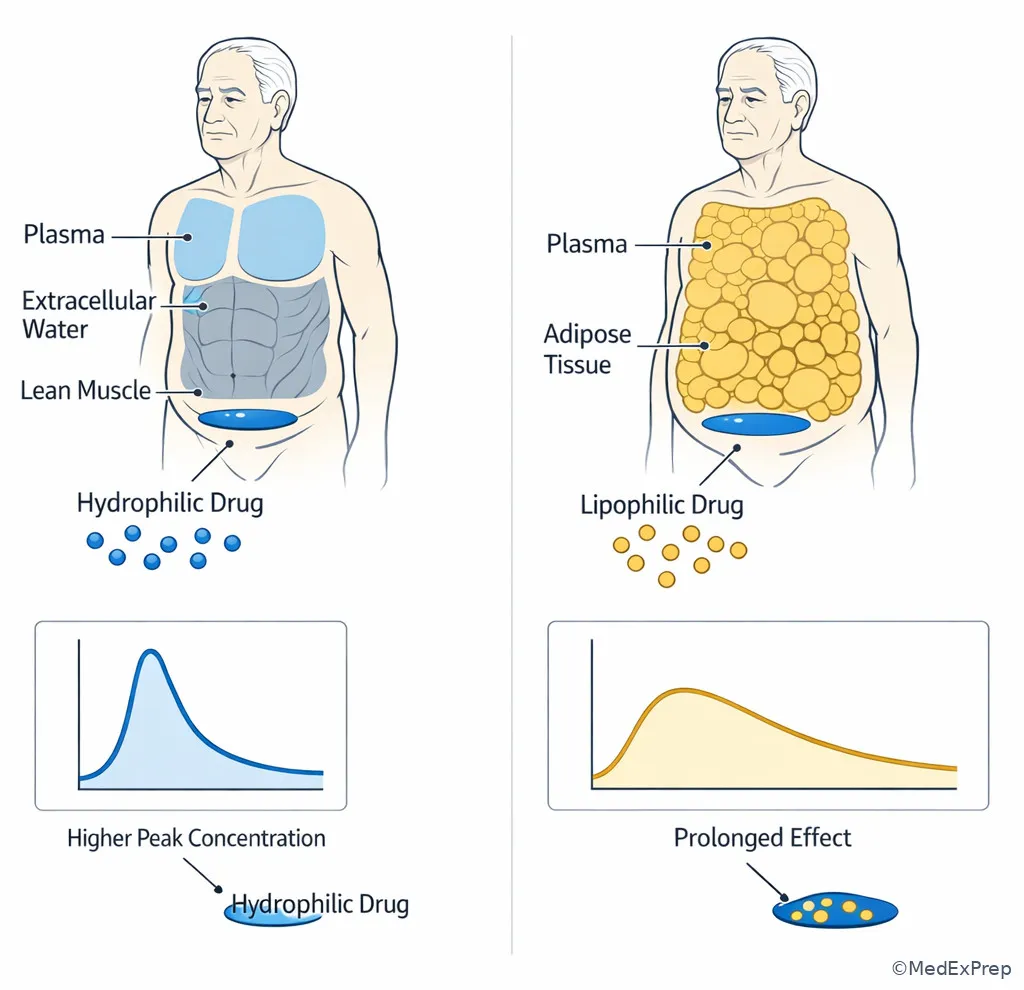
Fig 2. Body composition shift and drug distribution
Concept flow: Interpreting distribution-based toxicity
Classify the drug
Decide whether the agent behaves mainly as hydrophilic or lipophilic.

Choose the pattern
Hydrophilic drugs cause higher early concentrations; lipophilic drugs cause prolonged duration.

Translate to dosing
Consider lower initial doses for hydrophilic drugs and slower titration or avoidance of long-acting lipophilic agents.

Monitor the right signal
Watch for early peak-related toxicity versus delayed persistent effects.

B. Worked example

A 79-year-old man in a skilled nursing facility receives gentamicin 5 mg/kg IV as part of a facility protocol pending prescriber review for gram-negative bacteremia. He has frailty, heart failure, and chronic kidney disease; weight is 54 kg. He also takes furosemide 40 mg daily and sertraline 50 mg daily. The nurse notes dizziness after the first dose. Serum creatinine is 1.0 mg/dL, which is close to his baseline. The pharmacist is asked which age-related PK principle should guide the immediate dosing review.

Identify task: choose the governing PK change. Extract key facts: hydrophilic drug, low body weight, frailty, older adult, possible higher concentration after initial dose. Ototoxic loop diuretic is a distracting but relevant risk amplifier, not the core PK principle. Apply rule: reduced total body water and lean mass can shrink Vd for hydrophilic drugs, increasing peak concentration. Eliminate distractors: increased body fat explains lipophilic drug prolongation, not aminoglycoside early peak concerns. Reduced gastric acidity is irrelevant because the drug is IV. Verify: this patient also needs renal assessment and careful serum-level strategy, but the first-dose concentration problem is distribution-based.

C. Exam trap

Common wrong answer: increased body fat causing gentamicin accumulation.

Why it is tempting: learners memorize “older adults have more fat” and overapply it to every medication.

Single clue that eliminates it: gentamicin is a hydrophilic IV drug; the more relevant issue is smaller water compartment and higher concentration, not fat sequestration.

D. Checkpoint

Question: Which drug is most likely to have a prolonged half-life in an older adult primarily because of increased body fat?

  1. Diazepam
  2. Gentamicin
  3. Lithium
  4. Atenolol

Answer: A

  • A: Correct because diazepam is lipophilic and distributes into fat, prolonging its effect.
  • B: Tempting because gentamicin toxicity is common in older adults, but its major issue is hydrophilic distribution and renal clearance, not fat-related prolongation.
  • C: Tempting because lithium is narrow therapeutic index, but it is not the classic fat-distribution example.
  • D: Tempting because atenolol can accumulate in kidney impairment, but prolonged half-life from increased body fat is not the main mechanism.
If you missed this: Review 1.1.1.2 Distribution changes: less water, more fat, different peaks and half-lives — focus on the discriminator hydrophilic higher peak versus lipophilic prolonged effect.
Quick Recall:

  • The smaller compartment in many older adults is total body water.
  • True or False: Increased body fat usually shortens diazepam half-life. False.
  • Name the pattern: hydrophilic drug + standard dose + frail low-weight older adult = higher concentration.

Pharmacist Action: NOTICE: low body weight, frailty, cachexia, and hydrophilic or highly lipophilic drugs. SAY: “The standard dose may not distribute the same way in this patient.” MONITOR: peak-related toxicity for hydrophilic agents and prolonged sedation or delayed toxicity for lipophilic agents; follow drug-specific levels if indicated. HOLD/CLARIFY/ESCALATE: clarify loading dose choices when the patient is frail, underweight, or develops toxicity after the first few doses.

1.1.1.3 Hepatic metabolism: reduced blood flow, reduced Phase I, preserved Phase II

A. Explanation

The exam conflict here is whether aging reduces all hepatic metabolism equally. Reject that oversimplification. The single rule is that hepatic blood flow and liver mass tend to decline with age, and Phase I oxidative metabolism is more affected than Phase II conjugation. This matters most for drugs with significant first-pass extraction or reliance on oxidative clearance. As a result, some drugs may have increased bioavailability or reduced clearance, especially when hepatic extraction and blood flow are important.

WHY THIS IS TESTED: the stem may ask why an older adult has greater effect from an oral dose or why a sedative lasts longer even without kidney failure. The testable pattern is choosing reduced Phase I metabolism or reduced hepatic blood flow rather than assuming global liver failure.

Examples matter. Diazepam is a classic Phase I example and can have prolonged effects. Lorazepam, oxazepam, and temazepam are often favored when a benzodiazepine is unavoidable because they rely more on conjugation. This does not make them harmless in older adults; it just explains why some short-acting conjugated agents are pharmacokinetically preferable to long-acting oxidized ones. Similarly, high-extraction drugs may show higher oral bioavailability if first-pass extraction falls. On the exam, you are not expected to turn every liver-metabolized drug into a memorization list. You are expected to recognize the pattern: Phase I is more vulnerable than Phase II.

Key rule: “LOT” benzodiazepines (lorazepam, oxazepam, temazepam) are remembered as conjugation-favored options; the PK reason is relative preservation of Phase II metabolism compared with Phase I oxidation.

High-Yield Connection: This concept is tested alongside Age-Related PD Changes. Know both the PK reason some benzodiazepines last longer and the PD reason all benzodiazepines still raise delirium and falls risk in older adults.

Fig 3. Hepatic aging decision map
Exam takeaway: Prefer the pattern “Phase I down more than Phase II” when the stem asks why a hepatically cleared drug has prolonged effects in an older adult.
flowchart LR
A[Aging liver changes] --> B[Reduced liver mass]
A --> C[Reduced hepatic blood flow]
A --> D[Phase I oxidation reduced more]
A --> E[Phase II conjugation relatively preserved]
D --> F[Longer effect for oxidized drugs]
C --> G[Higher bioavailability for some high-extraction drugs]
E --> H[Conjugated options may be PK-preferred]
Hepatic metabolism in aging
Exam takeaway: Reduced hepatic blood flow and reduced oxidative metabolism explain why some orally administered drugs have greater exposure in older adults.
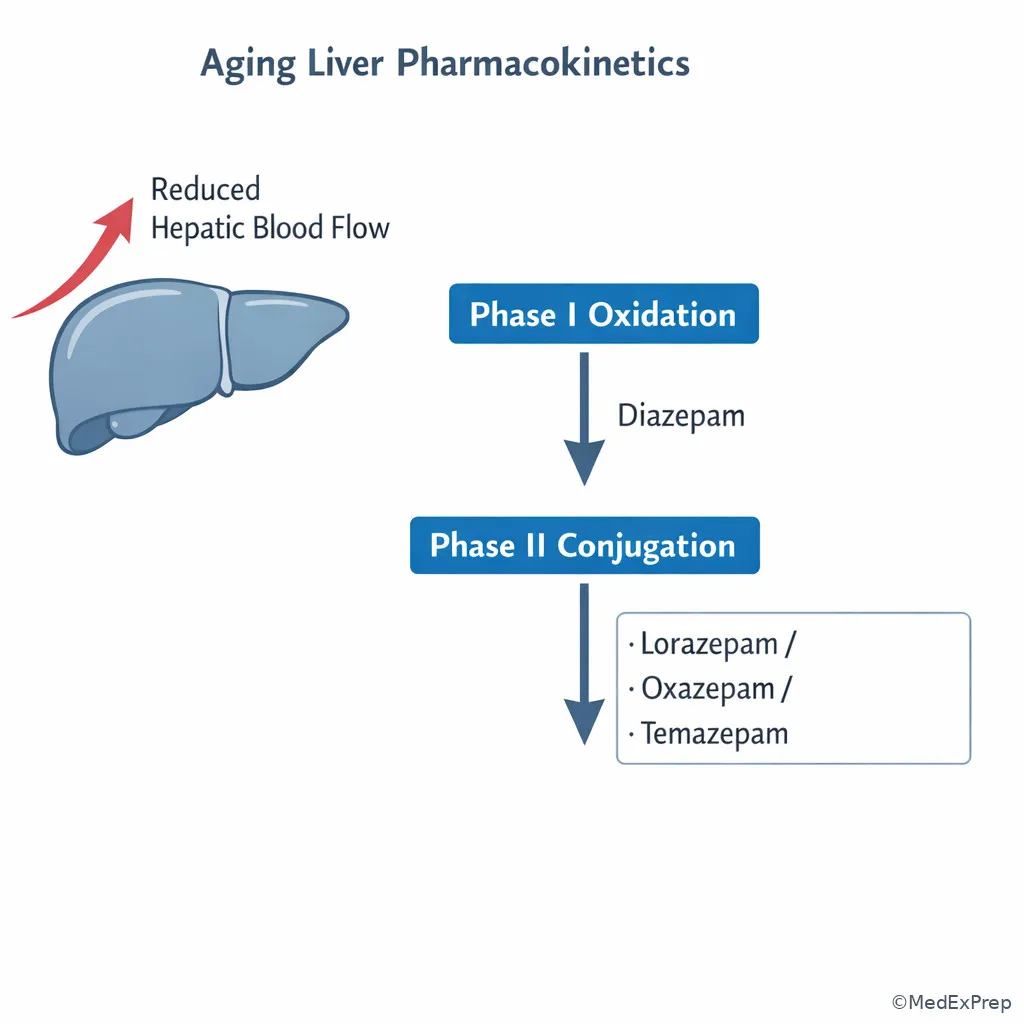
Hepatic metabolism in aging
Concept flow: Using hepatic metabolism clues in a stem
Spot a hepatically cleared drug
Look for oxidized sedatives or high first-pass agents.

Resolve the conflict
If the stem contrasts Phase I and Phase II, choose reduced Phase I as the more age-sensitive pathway.

Predict exposure
Expect reduced clearance or increased bioavailability depending on the drug.

Recommend safely
Start lower, choose safer alternatives, and monitor sedation, confusion, or hypotension.

B. Worked example

An 81-year-old woman in primary care is taking diazepam 2 mg by mouth twice daily as needed for muscle spasm after a hospitalization. Comorbidities include osteoporosis, chronic insomnia, and mild heart failure. She reports daytime grogginess and one near-fall. Serum creatinine is 0.7 mg/dL, AST/ALT are normal, and she asks whether “her liver tests being normal” means the dose is fine. A tempting clue is that she also takes omeprazole, which may suggest an interaction-focused answer.

Identify task: determine the age-related PK principle behind prolonged effect. Extract key facts: oxidatively metabolized long-acting benzodiazepine, older adult, grogginess and near-fall, normal transaminases. Apply rule: age-related hepatic blood flow reduction and reduced Phase I metabolism can prolong diazepam effect even when routine liver tests are normal. Eliminate distractors: a normal AST/ALT does not rule out reduced functional clearance with aging. Omeprazole may interact with some agents, but the core tested principle is physiologic aging of hepatic metabolism. Verify: recommend deprescribing discussion or alternative therapy with safer risk profile, not reassurance based on liver tests.

C. Exam trap

Common wrong answer: normal liver enzymes mean hepatic handling is preserved.

Why it is tempting: learners confuse injury markers with functional drug-metabolism capacity.

Single clue that eliminates it: the stem tests age-related clearance and blood flow, not hepatocellular damage.

D. Checkpoint

Question: Which statement best supports selecting lorazepam over diazepam when a benzodiazepine cannot be avoided in an older adult?

  1. Lorazepam is not associated with falls in older adults
  2. Lorazepam has no hepatic metabolism
  3. Lorazepam relies more on conjugation, which is relatively preserved with aging
  4. Diazepam is safer because its lipophilicity prevents accumulation

Answer: C

  • A: Tempting because lorazepam is often viewed as safer, but all benzodiazepines still increase fall and cognitive risk.
  • B: Tempting because “LOT” is a famous memory aid, but lorazepam is hepatically handled; it is not free of hepatic metabolism.
  • C: Correct because conjugation is relatively preserved compared with oxidative metabolism in aging.
  • D: Tempting if you misremember lipophilicity as protective, but lipophilicity contributes to diazepam’s prolonged half-life in older adults.
If you missed this: Review 1.1.1.3 Hepatic metabolism: reduced blood flow, reduced Phase I, preserved Phase II — focus on the discriminator Phase I declines more than Phase II with aging.

Pharmacist Action: NOTICE: long-acting oxidatively metabolized sedatives and high-extraction oral drugs. SAY: “Normal liver enzymes do not guarantee normal drug clearance in an older adult.” MONITOR: sedation, falls, confusion, and cumulative adverse effects after starts or dose changes. HOLD/CLARIFY/ESCALATE: escalate when persistent sedation, recurrent falls, or poor functional recovery occurs after adding a long-acting hepatically cleared drug.

1.1.1.4 Renal elimination: the serum creatinine trap and dosing decisions

A. Explanation

This is the highest-yield section for the BCGP exam. The decision conflict is whether a “normal” serum creatinine means kidney function is adequate for dosing. The single rule that resolves it is that serum creatinine reflects both filtration and muscle mass. Older adults often have reduced muscle mass, so serum creatinine can look normal even when true filtration is reduced. For medication dosing, the exam usually expects you to think in terms of estimated creatinine clearance using Cockcroft-Gault, because many drug labels and studies use it.

WHY THIS IS TESTED: many wrong answers occur because learners equate SCr 0.8 mg/dL with “normal kidneys.” The testable pattern is recognizing hidden renal impairment in a small, frail, older adult.

Key consequence: maintenance dosing of renally cleared drugs may need a lower dose, longer interval, or both. High-yield examples include digoxin, DOACs, gabapentin, pregabalin, metformin, aminoglycosides, and many antimicrobials. Also distinguish chronic age-related decline from acute kidney injury. Aging lowers reserve; dehydration, diuretics, infection, ACE inhibitors, NSAIDs, or contrast can push the patient into a more dangerous range quickly. The exam may ask what requires immediate clarification: it is often a newly started renally cleared drug at a standard dose in a frail older adult with low body weight and “normal” SCr.

Do not automatically round low serum creatinine values upward without a specific local protocol; that practice can misestimate function and is not universally recommended. Use an evidence-based approach and the dosing method tied to the drug reference or label.

Common pitfall: eGFR reported by the lab may be useful clinically, but when the question asks about drug dosing, default to the dosing standard used by the reference for that medication, commonly Cockcroft-Gault CrCl.

High-Yield Connection: This concept overlaps strongly with the later topic Cockcroft-Gault And Renal Dosing. Here you learn the aging principle; later you will execute the calculation and compare dose-adjustment cutoffs in board-style stems.

Fig 4. Renal dosing decision pathway
Exam takeaway: In a frail older adult, a normal serum creatinine does not rule out the need for renal dose adjustment.
flowchart TD
A[Older adult on renally cleared drug] --> B[Check age, weight, baseline SCr, hydration]
B --> C{Is SCr deceptively normal?}
C --> D[Yes: low muscle mass may mask reduced function]
C --> E[No: still estimate dosing function]
D --> F[Use Cockcroft-Gault or drug-specific dosing standard]
E --> F
F --> G{Drug has renal cutoff?}
G --> H[Adjust dose or interval]
G --> I[Monitor and reassess if no adjustment needed]
Fig 5. Serum creatinine trap in frailty
Exam takeaway: Low muscle mass can make serum creatinine appear reassuring even when drug-clearing kidney function is reduced.
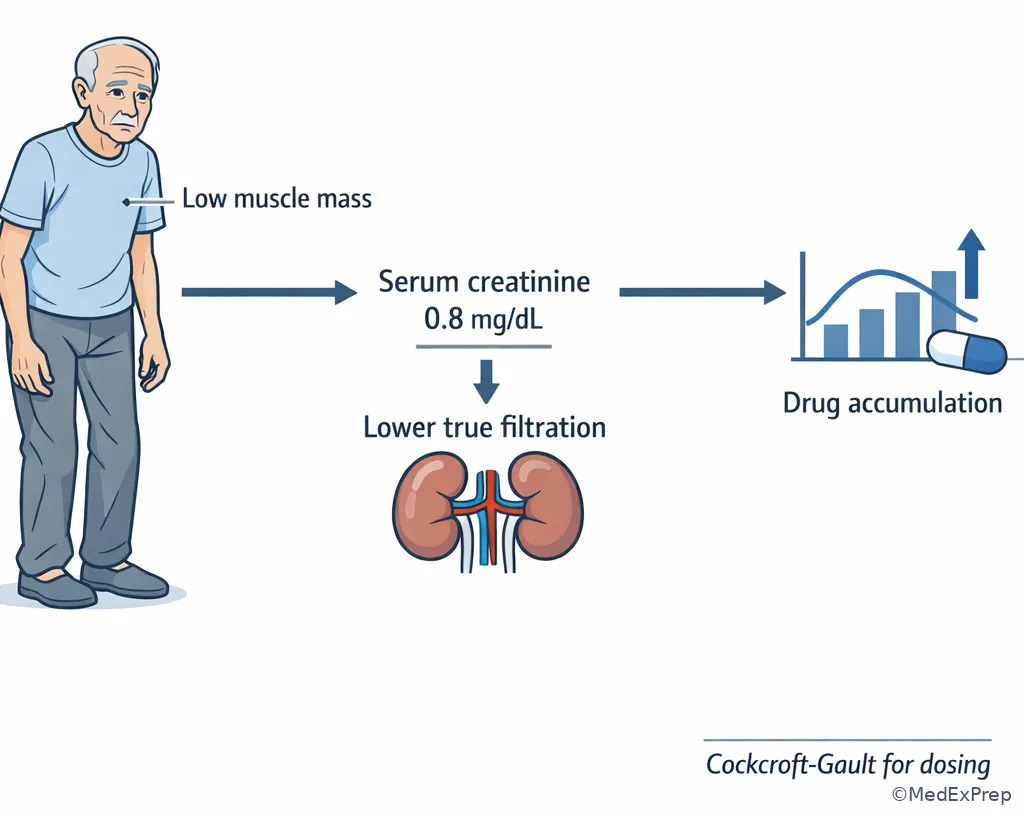
Fig 5. Serum creatinine trap in frailty
Concept flow: Renal dosing review in an older adult
Confirm the medication
Ask whether the drug or its active metabolite is primarily renally eliminated.

Reject the trap
Do not accept a normal serum creatinine at face value in a frail or low-weight older adult.

Estimate dosing function
Use Cockcroft-Gault or the drug-reference method tied to dosing recommendations.

Adjust and monitor
Recommend lower dose or longer interval and follow efficacy plus toxicity after the change.

B. Worked example

An 88-year-old woman is discharged from the hospital to home with apixaban 5 mg by mouth twice daily for atrial fibrillation, gabapentin 300 mg by mouth three times daily for neuropathy, and lisinopril 10 mg daily. She weighs 47 kg, has hypertension and mild cognitive impairment, and uses a walker. Serum creatinine today is 0.8 mg/dL; last week she had poor oral intake after influenza. The pharmacist performing discharge reconciliation is asked what requires immediate clarification.

Identify task: prioritize the PK risk needing pharmacist action. Extract key facts: very old age, low body weight, frailty signal, renally relevant medications, apparently normal SCr, recent dehydration as distracting acute factor. Apply rule: SCr may overestimate kidney function; renally relevant regimens require dose review using the appropriate dosing standard. Eliminate distractors: lisinopril may need monitoring, but the most urgent clarification is whether apixaban and gabapentin doses fit current renal function and patient-specific criteria. Verify: recommend CrCl-based dose review, confirm weight and age criteria, reassess renal function after discharge, and monitor bleeding/sedation.

C. Exam trap

Common wrong answer: keep the regimen because serum creatinine is normal.

Why it is tempting: the number looks reassuring and exam takers may anchor on the laboratory reference range.

Single clue that eliminates it: 88 years old and 47 kg strongly suggest low muscle mass, so the creatinine may not reflect true drug-clearing function.

D. Checkpoint

Question: A frail 86-year-old woman weighing 45 kg has serum creatinine 0.7 mg/dL and is prescribed a standard dose of a renally eliminated medication. What is the most appropriate pharmacist recommendation?

  1. Assume renal function is normal because serum creatinine is below 1 mg/dL
  2. Estimate CrCl using the dosing-standard method and assess whether dose or interval adjustment is needed
  3. Ignore kidney function and reduce the dose only because of age
  4. Increase the dose because low serum creatinine suggests augmented clearance

Answer: B

  • A: Tempting because reference ranges can falsely reassure, but low muscle mass can mask renal impairment.
  • B: Correct because dosing should be tied to an appropriate estimate of renal function, commonly Cockcroft-Gault for drug dosing.
  • C: Tempting because “start low” is common in geriatrics, but dosing should be individualized rather than reduced solely by chronological age.
  • D: Tempting only if one misunderstands the creatinine trap; low SCr in frailty does not imply augmented clearance.
If you missed this: Review 1.1.1.4 Renal elimination: the serum creatinine trap and dosing decisions — focus on the discriminator that low muscle mass can hide reduced renal function.
Quick Recall:

  • The dosing equation most often expected on older board-style renal dosing items is Cockcroft-Gault CrCl.
  • True or False: A serum creatinine of 0.8 mg/dL always excludes significant renal dose adjustment. False.
  • The most dangerous assumption in a frail older adult is that a normal creatinine equals normal clearance.

Pharmacist Action: NOTICE: frailty, low body weight, dehydration, heart failure, and renally cleared drugs. SAY: “This creatinine may look normal, but the dosing estimate may still be low.” MONITOR: renal function trend, efficacy endpoints, and concentration-linked toxicities; recheck after acute illness or regimen changes. HOLD/CLARIFY/ESCALATE: clarify standard doses of DOACs, digoxin, gabapentin/pregabalin, antimicrobials, and other renally cleared agents at transitions of care.

1.1.1.5 Integration: translating PK changes into safer geriatric medication decisions

A. Explanation

The final conflict is practical: when a board stem shows possible PK risk, should you recommend a lower dose, a longer interval, an alternative medication, or more monitoring? The single rule is to match the intervention to the PK problem. If the drug has a smaller Vd in aging and the issue is high peak concentration, consider a lower initial or loading dose. If the issue is reduced clearance and longer half-life, adjust the maintenance dose, extend the interval, or both. If the problem is persistent toxicity from a long-acting or high-risk drug, selecting an alternative may be safer than “micro-adjusting” the same agent.

WHY THIS IS TESTED: the exam is not satisfied with recognizing the PK change; it asks whether you can make a pharmacist-level recommendation that is safe, specific, and within scope.

Use a structured approach. First, identify whether the harm is concentration-related, duration-related, or interaction-amplified. Second, assess whether the drug is high value, replaceable, or inappropriate for geriatric use. Third, choose the narrowest effective intervention: adjust dose, adjust interval, slow titration, recommend a safer alternative, or deprescribe. Fourth, define monitoring tied to the expected toxicity. For example, with gabapentin accumulation, monitor sedation, dizziness, gait instability, and renal trend. With digoxin, monitor symptoms, heart rate, renal function, and if appropriate levels. With long-acting benzodiazepines, monitor confusion, falls, and withdrawal risk if tapering.

Memory anchor: \(PK = Peak\), Keep, Kidney. Peak problem → think Vd/initial dose. Keep lingering too long → think half-life/maintenance. Kidney drug → check CrCl before trusting the dose.

Recall: In the upcoming topic Pathophysiology In Older Adults, symptoms may be atypical and overlap with drug effects. Here, we build on that by asking whether the symptom is disease progression or PK-driven accumulation.

Fig 6. PK-based medication action algorithm
Exam takeaway: Match the intervention to the PK problem—lower dose for high peak, extend interval for slow clearance, or switch drugs when the risk profile remains unfavorable.
flowchart TD
A[Possible PK-related adverse effect] --> B{What pattern fits best?}
B --> C[Early high concentration]
B --> D[Delayed accumulation or prolonged effect]
B --> E[Hidden renal impairment]
C --> F[Lower initial or loading dose]
D --> G[Lower maintenance dose or extend interval]
E --> H[Recalculate dosing function and adjust]
F --> I{Drug still appropriate?}
G --> I
H --> I
I --> J[If not, recommend safer alternative or deprescribing]
J --> K[Set monitoring for efficacy, toxicity, withdrawal]
PK-based monitoring checklist
Exam takeaway: Tie monitoring to the predicted PK problem instead of ordering generic follow-up.
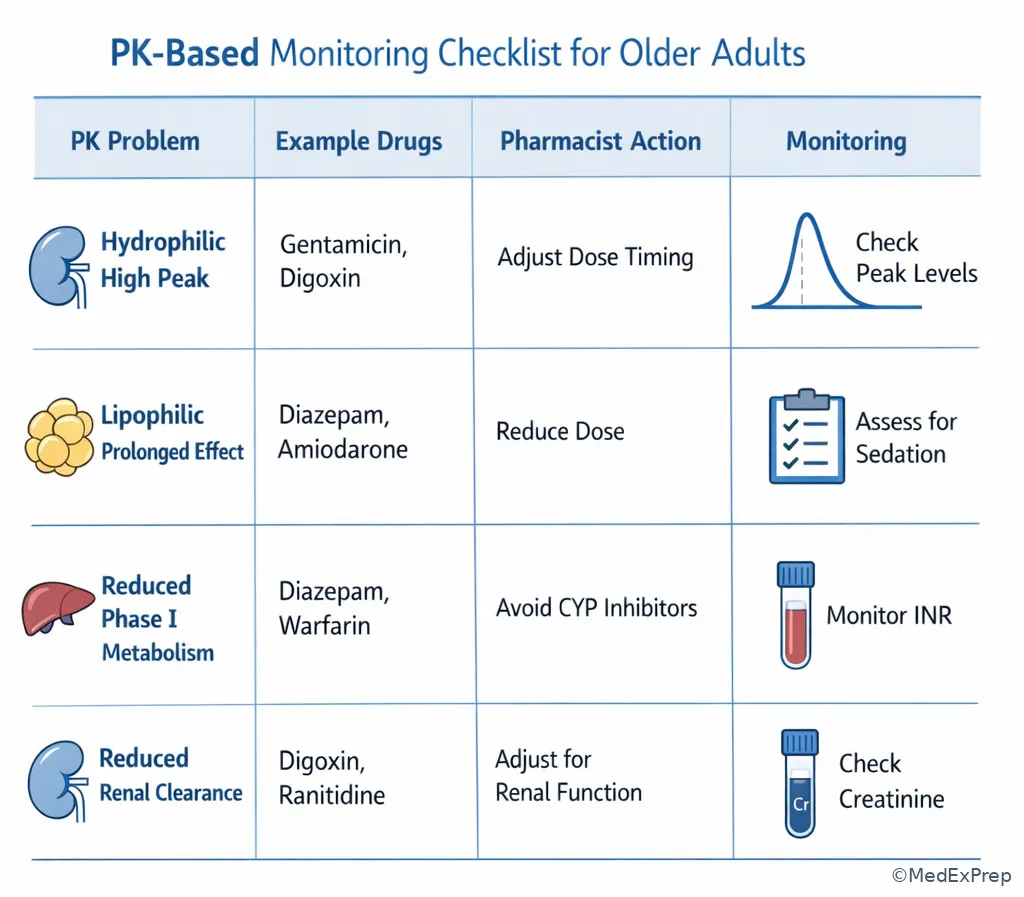
PK-based monitoring checklist
Concept flow: From PK clue to pharmacist recommendation
Define the toxicity pattern
Decide whether the issue is an early peak, slow clearance, or hidden renal impairment.

Choose the intervention
Lower initial dose for Vd problems; lower maintenance dose or extend interval for clearance problems.

Reassess appropriateness
If the drug remains high risk in geriatrics, recommend an alternative or deprescribing plan.

Monitor with intent
Track a parameter linked to the expected harm: sedation, falls, level, renal trend, or bleeding.

B. Worked example

An 83-year-old man in long-term care has chronic neuropathic pain, stage 3b CKD, diabetes, and a recent fall. His MAR shows gabapentin 600 mg by mouth three times daily, trazodone 50 mg nightly, and hydrocodone/acetaminophen 5/325 mg every 6 hours as needed. He is more somnolent after supper but requests that pain therapy not be stopped completely. A recent sodium of 132 mEq/L is mildly low and may distract toward trazodone as the sole issue.

Identify task: recommend the safest pharmacist action. Extract key facts: renally cleared gabapentin at a potentially excessive dose for CKD, fall, somnolence, competing sedatives. Apply rule: clearance problem means maintenance dose or interval should be adjusted to renal function; if toxicity persists, deprescribe or switch strategy. Eliminate distractors: trazodone contributes to sedation, but the signature PK issue is gabapentin accumulation in reduced renal function. Simply adding monitoring without a dose recommendation is too passive. Verify: recommend renal dose reassessment, dose reduction or interval change per reference, sedation/fall monitoring, and communication with the prescriber/team.

C. Exam trap

Common wrong answer: lower every medication equally because “older adults need lower doses.”

Why it is tempting: it sounds geriatric-friendly and cautious.

Single clue that eliminates it: safe recommendations are drug-specific and mechanism-specific; the best answer matches the adjustment to the PK driver, not age alone.

D. Checkpoint

Question: Which recommendation best fits an older adult with toxicity from a renally cleared maintenance medication and hidden renal impairment?

  1. Increase the loading dose to overcome age-related absorption changes
  2. Lower the maintenance dose or extend the interval based on the drug’s renal dosing guidance
  3. Keep the current dose and monitor only because serum creatinine is normal
  4. Switch automatically to another drug in the same class at an equivalent standard dose without reassessing renal handling

Answer: B

  • A: Tempting if one wrongly assumes poor absorption drives most geriatric toxicity, but the issue is impaired clearance.
  • B: Correct because maintenance dosing must match reduced renal elimination.
  • C: Tempting because “monitoring” feels safe, but it ignores the need for an active dosing correction.
  • D: Tempting if the class is familiar, but an equivalent standard dose may recreate the same PK problem.
If you missed this: Review 1.1.1.5 Integration: translating PK changes into safer geriatric medication decisions — focus on matching the intervention to the PK problem: initial dose for Vd, maintenance/interval for clearance.

Pharmacist Action: NOTICE: whether the problem is peak-related, duration-related, or kidney-related. SAY: “The dose strategy should match the pharmacokinetic reason for harm.” MONITOR: one efficacy endpoint and one toxicity endpoint after every recommendation. HOLD/CLARIFY/ESCALATE: escalate persistent toxicity, recurrent falls, delirium, or any regimen where the drug remains inappropriate even after adjustment.

Exam Traps & Differentiators

Common traps & distractors: The most common wrong answer is to overfocus on absorption changes. That is tempting because GI changes are easy to remember and many stems include food, antacids, or PPIs. The better discriminator is the toxicity pattern: higher peak with hydrophilic drugs, prolonged effect with lipophilic drugs, prolonged exposure with reduced Phase I metabolism, and accumulation with reduced renal clearance.

See Fig 1 for the triage map that helps you sort these mechanisms quickly. See Fig 4 and Fig 5 when the stem is trying to lure you into trusting a normal serum creatinine. See Fig 2 and Fig 3 when you need to separate distribution from hepatic metabolism. For the action step after identifying the PK problem, See Fig 6.

Stem clue Think Reject
Frail older adult, low weight, SCr 0.7–0.9 mg/dL, renally cleared drug Hidden renal impairment; estimate CrCl for dosing “Renal function is normal because creatinine is normal”
Long-acting benzodiazepine with daytime sedation Lipophilic distribution + reduced Phase I metabolism General absorption problem
Hydrophilic IV drug causes early toxicity after standard dose Smaller Vd due to less total body water Increased body fat as main explanation
Question compares diazepam with lorazepam Phase I reduced more than Phase II All benzodiazepines are PK-equivalent
High-extraction oral drug has greater effect in aging Reduced first-pass extraction from lower hepatic blood flow Universal increase in metabolism
Looks similar But isn't Single discriminator
Age-related renal decline Acute kidney injury Trend, recent illness, dehydration, or nephrotoxin exposure
Distribution-driven high peak Clearance-driven accumulation Early first doses versus delayed persistence over time
Normal liver enzymes Normal hepatic drug clearance AST/ALT do not directly prove preserved metabolic capacity
Age-related absorption change Administration problem Enteral feeds, chelation, dysphagia, or formulation mismatch suggest the latter
PK toxicity PD sensitivity Concentration/dosing pattern versus exaggerated effect at usual concentration
  • If the stem says “normal serum creatinine” in a frail 85-year-old → think hidden renal impairment until proven otherwise.
  • If the stem says “daytime grogginess on diazepam” → think prolonged half-life from lipophilic distribution and reduced Phase I metabolism.
  • If the stem says “toxicity after first IV dose of a hydrophilic drug” → think smaller water compartment and higher concentration.
  • If the stem says “why prefer lorazepam to diazepam” → think relative preservation of conjugation.
  • If the stem says “what needs clarification at discharge” with a renally cleared drug → think dose verification, monitoring plan, and recent renal trend.
Review connection: The traps above test the distinction between aging-related concentration change and misleading laboratory reassurance. If any felt unfamiliar, revisit 1.1.1.4 Renal elimination: the serum creatinine trap and dosing decisions before attempting the Self-check quiz.

Tables

PK domain Typical age-related change Drug consequence Pharmacist response
Absorption Variable; usually modest effect Usually not the main cause of toxicity unless specific stem clue Check formulation, food, pH, feeds, administration timing
Distribution: water Decreased total body water Higher concentrations of hydrophilic drugs Consider lower initial dose; monitor peak-related toxicity
Distribution: fat Increased body fat percentage Longer half-life of lipophilic drugs Avoid long-acting sedatives when possible; slow titration
Hepatic metabolism Reduced liver mass and blood flow; Phase I down more than Phase II Reduced clearance or higher bioavailability for some drugs Favor safer alternatives; monitor cumulative CNS effects
Renal excretion Declines with age; masked by low muscle mass Accumulation of renally cleared drugs Use dosing-standard renal estimate; adjust dose/interval
Comparison Hydrophilic pattern Lipophilic pattern Best example
Body compartment affected Reduced body water Increased body fat —
Main PK effect Smaller Vd, higher concentration Larger Vd, longer half-life —
Typical exam presentation Early toxicity after standard dose Persistent sedation or delayed washout —
Representative drugs Gentamicin, lithium Diazepam See Fig 2
Preferred action Reassess initial dose and concentration risk Avoid long-acting agents or reduce ongoing exposure Drug-specific monitoring
Differential / classification issue Most likely mechanism Best discriminating clue High-yield drug examples
Standard oral dose gives stronger-than-expected effect Reduced first-pass extraction or lower clearance High-extraction or oxidatively metabolized drug Some sedatives, certain cardiovascular agents
First few doses cause unexpectedly high serum exposure Reduced Vd for hydrophilic drug IV or water-soluble agent, frailty/low weight Gentamicin, lithium
Days to weeks of worsening somnolence Long half-life from lipophilic distribution and/or low clearance Persistent next-day carryover Diazepam
Toxicity despite normal SCr Overestimated renal function from low muscle mass Advanced age, low body weight, frailty Gabapentin, digoxin, DOACs
Safer benzodiazepine choice question Phase II conjugation relatively preserved Lorazepam/oxazepam/temazepam comparison Lorazepam, oxazepam, temazepam
Drug / class Main PK aging concern Common exam harm What to monitor
Diazepam Lipophilic distribution + reduced Phase I clearance Daytime sedation, falls, confusion Sedation, gait, cognition
Gabapentin Renal accumulation Somnolence, dizziness, falls Renal function, sedation, balance
Digoxin Renal clearance; altered Vd sensitivity Bradycardia, GI or CNS toxicity HR, renal function, symptoms, level when appropriate
Aminoglycosides Hydrophilic concentration + renal elimination Nephrotoxicity, ototoxicity Drug levels, renal trend, hearing/balance symptoms
DOACs Renal cutoff sensitivity Bleeding or under/overdosing CrCl, weight, bleeding, adherence

Algorithm / Approach

Concept flow: Practical pharmacist approach to age-related PK risk
Define the medication context
List drug, dose, route, frequency, start date, and whether toxicity appeared early or after accumulation.

Choose the PK domain
Hydrophilic peak? Lipophilic persistence? Phase I reduction? Renal accumulation? Absorption only if specific clue.

Match intervention to mechanism
Lower initial dose for Vd issues; lower maintenance dose or extend interval for clearance issues; switch if the drug remains poor-value.

Account for geriatric amplifiers
Frailty, low weight, dehydration, heart failure, polypharmacy, and recent care transitions raise risk further.

Monitor and document
Communicate the rationale, specify what to track, and set a follow-up interval tied to the expected adverse effect.

Rapid Review

  • Absorption in aging → usually weaker exam answer than renal clearance or distribution.
  • Hydrophilic drug in frailty → smaller Vd, higher concentration.
  • Lipophilic sedative in aging → longer half-life, prolonged carryover.
  • Diazepam vs lorazepam → Phase I sensitivity versus relative Phase II preservation.
  • Normal SCr in low-muscle-mass elder → does not equal normal drug clearance.
  • Maintenance dose problem → think clearance first.
  • Loading dose problem → think Vd first.
  • High-extraction oral drug stronger than expected → think reduced hepatic blood flow and less first-pass extraction.
  • Renally cleared CNS drug plus falls → dose review beats passive observation.
  • Frail low-weight older adult → do not trust reference ranges without context.
  • Normal AST/ALT → does not prove normal hepatic drug metabolism.
  • Early toxicity after IV hydrophilic drug → distribution clue, not absorption clue.
  • Chronic sedation after long-acting benzodiazepine → distribution plus metabolism clue, not merely insomnia severity.
  • Transition-of-care reconciliation → verify renal dosing before continuing hospital-start regimens.

Self-check quiz

1. A 77-year-old woman in ambulatory care takes diazepam 5 mg by mouth nightly, temazepam 15 mg nightly as needed, lorazepam 0.5 mg twice daily as needed, and oxazepam 10 mg three times daily as needed listed from prior encounters. The pharmacist is asked which agent is most likely to have a prolonged half-life in aging primarily because of increased body fat distribution. What is the most appropriate answer?

  1. Diazepam
  2. Lorazepam
  3. Oxazepam
  4. Temazepam

2. A 84-year-old man weighing 48 kg is prescribed gabapentin 300 mg by mouth three times daily, pregabalin 75 mg twice daily, levetiracetam 500 mg twice daily, and metformin 500 mg twice daily appears on his medication list. Serum creatinine is 0.8 mg/dL. Which principle most requires immediate clarification before assuming the renal dose is safe?

  1. Low serum creatinine proves normal renal clearance in older adults
  2. Cockcroft-Gault or the drug-specific dosing estimate should be reviewed because low muscle mass may mask reduced kidney function
  3. Renal function is irrelevant if the patient is asymptomatic
  4. Only eGFR matters for every medication without exception

3. A 82-year-old frail woman in long-term care with CKD and neuropathy is taking gabapentin 600 mg by mouth three times daily, acetaminophen 650 mg three times daily, and sertraline 50 mg daily. She has new dizziness and two near-falls; serum creatinine is 0.9 mg/dL, weight 44 kg, and staff report poor oral intake last week. Which is the most appropriate pharmacist recommendation?

  1. Continue gabapentin at the same dose because serum creatinine is normal
  2. Recommend renal-function-based reassessment of gabapentin with dose reduction or interval extension and monitor sedation/falls
  3. Increase gabapentin to 800 mg three times daily because symptoms suggest uncontrolled neuropathy
  4. Switch to pregabalin at an equivalent standard dose without reassessing kidney function

4. A 79-year-old man in a health system receives gentamicin 5 mg/kg IV once for suspected bacteremia under protocol. He weighs 52 kg and has frailty, heart failure, and CKD. After the first dose he develops dizziness. Which age-related PK change best explains why a standard first dose may produce a higher concentration?

  1. Increased body fat leading to larger Vd for a hydrophilic drug
  2. Reduced total body water leading to smaller Vd for a hydrophilic drug
  3. Increased first-pass metabolism
  4. Improved renal clearance from low serum creatinine

5. A 81-year-old woman with insomnia, osteoarthritis, and prior fall is taking diazepam 2 mg by mouth twice daily as needed after a recent hospitalization. She reports next-day sedation. AST and ALT are normal; serum creatinine is 0.7 mg/dL. Which explanation best supports a pharmacist recommendation to clarify ongoing diazepam use?

  1. Normal liver enzymes exclude age-related changes in drug handling
  2. Phase I metabolism and hepatic blood flow can be reduced with aging, prolonging diazepam exposure
  3. Older adults absorb all oral benzodiazepines poorly, so the patient is likely overusing it
  4. Diazepam is preferred over lorazepam because lipophilic drugs clear faster in aging

6. An 87-year-old man in assisted living with atrial fibrillation, CKD, diabetes, and recent dehydration after viral illness is discharged on apixaban 5 mg by mouth twice daily, gabapentin 300 mg three times daily, and furosemide 40 mg daily. Weight is 49 kg; serum creatinine is 1.0 mg/dL. Which pharmacist action is most appropriate at transition of care?

  1. Accept all doses because serum creatinine is within a common adult reference range
  2. Clarify renal and patient-specific dosing criteria, especially for renally sensitive agents, before assuming standard doses are appropriate
  3. Hold all medications until a nephrologist independently rewrites the regimen
  4. Recommend switching all renally cleared agents to hepatically cleared alternatives immediately

7. A 85-year-old woman with chronic anxiety, mild cognitive impairment, constipation, and two falls is taking diazepam 5 mg by mouth nightly. A prescriber asks which alternative is pharmacokinetically preferable if a benzodiazepine must temporarily continue. Which is the best recommendation?

  1. Clonazepam 0.5 mg nightly because it is long acting and smoother
  2. Lorazepam 0.5 mg nightly because conjugation is relatively preserved compared with oxidation
  3. Chlordiazepoxide 10 mg nightly because its metabolites are less active in aging
  4. Diazepam 2 mg twice daily because dividing the dose overcomes the long half-life problem

8. A 83-year-old frail man with CKD, heart failure, neuropathy, and chronic insomnia is taking gabapentin 600 mg by mouth three times daily, diazepam 2 mg nightly, and metoprolol succinate 25 mg daily. He is somnolent in the morning and unsteady after breakfast. Which pharmacist interpretation best integrates the likely age-related PK contributors?

  1. Gabapentin accumulation from reduced renal clearance plus diazepam prolongation from lipophilic distribution and reduced Phase I metabolism
  2. Gabapentin toxicity from increased first-pass metabolism plus diazepam accumulation from reduced body water
  3. Metoprolol accumulation explains all symptoms because beta-blockers are always the main PK driver of morning sedation
  4. Age-related absorption failure is the most likely shared explanation for both drugs

Answer key

1. Correct answer: A — Diazepam.

  • A. Diazepam: Tempting because it is the classic long-acting benzodiazepine you are trained to flag, and that surface logic is correct here. It is correct because diazepam is highly lipophilic, distributes into increased body fat, and also relies on oxidative metabolism, producing prolonged effect in older adults; this is consistent with standard geriatric pharmacotherapy references and Beers-oriented safety teaching (Lexicomp; DiPiro; 2023 AGS Beers Criteria).
  • B. Lorazepam: Tempting because it is still a benzodiazepine and still causes sedation. It is incorrect for this specific question because although lorazepam remains risky from a PD and safety standpoint, it is not the prototypical answer for prolonged half-life from increased fat distribution; the discriminating clue is the wording “primarily because of increased body fat distribution” (Lexicomp; DiPiro).
  • C. Oxazepam: Tempting because it belongs to the same class and appears in comparisons with diazepam. It is incorrect because oxazepam relies more on conjugation and is not the classic lipophilic prolonged-half-life answer in aging; the single clue is the question asking for the best body-fat example (Lexicomp; AHFS).
  • D. Temazepam: Tempting because it is also used for sleep and may seem likely to cause carryover. It is incorrect because the strongest pharmacokinetic teaching point remains diazepam, not temazepam, for increased fat distribution and prolonged half-life in older adults (Lexicomp; DiPiro).
If you missed this: Review 1.1.1.2 Distribution changes: less water, more fat, different peaks and half-lives — focus on the discriminator lipophilic drugs last longer because of increased body fat.

2. Correct answer: B — Cockcroft-Gault or the drug-specific dosing estimate should be reviewed because low muscle mass may mask reduced kidney function.

  • A: Tempting because clinicians often glance at whether SCr is above or below 1 mg/dL. It is incorrect because serum creatinine alone can be misleading in low-muscle-mass older adults; the discriminating clue is 84 years old and 48 kg (Lexicomp; FDA labeling conventions for many renal-dose drugs; DiPiro).
  • B: Tempting because it sounds more work-intensive, but it is correct because medication dosing should use the dosing-standard renal estimate, commonly Cockcroft-Gault, especially in frail older adults where SCr may overestimate function (Lexicomp; Clinical Pharmacology; DiPiro).
  • C: Tempting because the patient is not yet symptomatic. It is incorrect because renal dose problems are often detected before toxicity becomes obvious; the single clue is the presence of renally relevant drugs in a frail patient (Lexicomp; AHFS).
  • D: Tempting because eGFR appears on lab reports and is clinically useful. It is incorrect because the exam asks for a drug-dosing principle, and many dosing references remain tied to Cockcroft-Gault or drug-specific labeling rather than a universal eGFR rule (FDA labeling; Lexicomp).
If you missed this: Review 1.1.1.4 Renal elimination: the serum creatinine trap and dosing decisions — focus on the discriminator that low muscle mass can make serum creatinine falsely reassuring.

3. Correct answer: B — Recommend renal-function-based reassessment of gabapentin with dose reduction or interval extension and monitor sedation/falls.

  • A: Tempting because serum creatinine appears normal and continuing the medication avoids undertreating pain. It is incorrect because 44 kg frailty and CKD make hidden renal impairment likely, and gabapentin is renally cleared; the discriminating clue is dizziness with near-falls plus low body weight (Lexicomp; AHFS).
  • B: Tempting because it is more conservative and targeted, and it is correct because gabapentin exposure rises as renal clearance falls; the proper pharmacist action is to reassess the dose using renal guidance and monitor sedation and falls risk (Lexicomp; FDA labeling; DiPiro).
  • C: Tempting because neuropathy can remain undertreated and clinicians may chase symptom control. It is incorrect because the immediate problem is possible accumulation toxicity, not treatment failure; the single clue is new dizziness and near-falls (Lexicomp).
  • D: Tempting because pregabalin is a closely related alternative and keeping class effect may seem reasonable. It is incorrect because pregabalin is also renally cleared, so switching without renal reassessment recreates the same PK risk; the discriminator is same therapeutic neighborhood but same renal dependence (Lexicomp; Clinical Pharmacology).
If you missed this: Review 1.1.1.5 Integration: translating PK changes into safer geriatric medication decisions — focus on the rule that clearance problems require maintenance dose or interval adjustment, not passive monitoring.

4. Correct answer: B — Reduced total body water leading to smaller Vd for a hydrophilic drug.

  • A: Tempting because increased body fat is a famous aging change. It is incorrect because gentamicin is hydrophilic, so fat expansion is not the main determinant; the discriminating clue is the hydrophilic IV drug context (Lexicomp; DiPiro).
  • B: Tempting because it fits the body-composition model, and it is correct because reduced total body water can reduce Vd and raise concentration after a standard dose of a hydrophilic drug such as gentamicin (Lexicomp; AHFS).
  • C: Tempting if you remember hepatic metabolism facts generally. It is incorrect because first-pass metabolism is irrelevant for an IV aminoglycoside; the key clue is route of administration (Lexicomp).
  • D: Tempting only if one misreads low serum creatinine as enhanced kidney function. It is incorrect because low SCr in frailty does not imply improved clearance, and the first-dose question points toward Vd rather than renal accumulation (DiPiro; Clinical Pharmacology).
If you missed this: Review 1.1.1.2 Distribution changes: less water, more fat, different peaks and half-lives — focus on the discriminator that hydrophilic drugs have higher concentrations when total body water is reduced.

5. Correct answer: B — Phase I metabolism and hepatic blood flow can be reduced with aging, prolonging diazepam exposure.

  • A: Tempting because liver enzymes are commonly used as shorthand for liver status. It is incorrect because normal AST/ALT do not prove preserved drug-metabolizing capacity or hepatic blood flow; the clue is persistent sedation despite normal labs (Lexicomp; DiPiro).
  • B: Tempting because it sounds mechanistic, and it is correct because diazepam is a classic example of prolonged exposure in older adults due to reduced oxidative metabolism and distribution changes (Lexicomp; 2023 AGS Beers Criteria; DiPiro).
  • C: Tempting because oral absorption problems are easy to overapply. It is incorrect because aging does not cause universal poor oral benzodiazepine absorption, and that would not explain next-day accumulation (AHFS; DiPiro).
  • D: Tempting because diazepam is familiar and a lower dose may look reasonable. It is incorrect because lipophilic drugs do not clear faster in aging; increased fat distribution generally prolongs their half-life, and lorazepam is often PK-preferred if one must use a benzodiazepine (Lexicomp; AHFS).
If you missed this: Review 1.1.1.3 Hepatic metabolism: reduced blood flow, reduced Phase I, preserved Phase II — focus on the discriminator that normal liver enzymes do not equal normal hepatic clearance.

6. Correct answer: B — Clarify renal and patient-specific dosing criteria, especially for renally sensitive agents, before assuming standard doses are appropriate.

  • A: Tempting because SCr of 1.0 mg/dL may appear acceptable to a busy clinician. It is incorrect because age 87, weight 49 kg, CKD history, and recent dehydration all increase the chance that true dosing function is lower than assumed; the discriminating clue is the frail post-illness transition (Lexicomp; FDA labeling; DiPiro).
  • B: Tempting because it requires extra verification, and it is correct because the pharmacist’s transition-of-care role is to reconcile dosing using renal and patient-specific criteria rather than rubber-stamp the discharge list (Lexicomp; ASHP transitions-of-care principles; FDA labeling for renal dose-sensitive drugs).
  • C: Tempting because the regimen may be risky and full interruption feels safer. It is incorrect because it exceeds what is usually the highest-value immediate action and may cause harm such as undertreated atrial fibrillation; the clue is to clarify and collaborate, not to stop everything reflexively (scope-appropriate geriatric pharmacist practice; Lexicomp).
  • D: Tempting because hepatically cleared drugs may seem simpler. It is incorrect because not every agent has a straightforward substitute and the right first step is to assess whether current therapy can be dose-adjusted safely; the clue is “most appropriate at transition of care” (DiPiro; Lexicomp).
If you missed this: Review 1.1.1.4 Renal elimination: the serum creatinine trap and dosing decisions — focus on the exact rule that a normal serum creatinine does not exclude dosing risk in a frail low-weight elder.

7. Correct answer: B — Lorazepam 0.5 mg nightly because conjugation is relatively preserved compared with oxidation.

  • A: Tempting because a long-acting drug may sound smoother and more effective. It is incorrect because clonazepam remains a problematic long-acting benzodiazepine in older adults, and the specific PK discriminator here is relative preservation of conjugation, not smoother symptom control (Lexicomp; Beers Criteria).
  • B: Tempting because lorazepam is a familiar “safer if unavoidable” answer, and it is correct because it relies more on Phase II conjugation, which is relatively preserved with aging compared with oxidative metabolism (Lexicomp; AHFS; DiPiro).
  • C: Tempting because chlordiazepoxide is another benzodiazepine and some may confuse metabolite properties. It is incorrect because it is not the PK-preferred option in older adults and has long-acting features that can worsen accumulation; the clue is the question asking for the best pharmacokinetic alternative (Lexicomp).
  • D: Tempting because dose splitting can sometimes reduce peak effects. It is incorrect because dividing diazepam does not fix its prolonged half-life and active-metabolite burden in aging; the single clue is that the underlying problem is oxidative long-acting exposure, not just dose timing (DiPiro; Lexicomp).
If you missed this: Review 1.1.1.3 Hepatic metabolism: reduced blood flow, reduced Phase I, preserved Phase II — focus on the discriminator “LOT” agents rely on relatively preserved conjugation.

8. Correct answer: A — Gabapentin accumulation from reduced renal clearance plus diazepam prolongation from lipophilic distribution and reduced Phase I metabolism.

  • A: Tempting because it combines two mechanisms rather than forcing a single cause, and it is correct because the case is intentionally multimodal: gabapentin is renally cleared, whereas diazepam is prolonged by lipophilic distribution and oxidative metabolism changes; the discriminating clue is morning somnolence plus CKD and diazepam exposure together (Lexicomp; DiPiro; Beers Criteria).
  • B: Tempting because first-pass metabolism and reduced body water are real PK concepts. It is incorrect because gabapentin is not the classic first-pass issue, and diazepam’s major aging pattern is increased fat distribution plus reduced Phase I metabolism rather than reduced body water (Lexicomp).
  • C: Tempting because metoprolol can contribute to fatigue or dizziness. It is incorrect because the stem’s strongest PK signals point to gabapentin and diazepam; the clue is CKD plus a long-acting lipophilic sedative rather than bradycardia-focused beta-blocker toxicity (Clinical Pharmacology; Lexicomp).
  • D: Tempting because multiple oral drugs are present. It is incorrect because age-related absorption failure is not the best shared explanation for somnolence and unsteadiness in this case; the single clue is the classic renal plus sedative PK combination (DiPiro; AHFS).
If you missed this: Review 1.1.1.5 Integration: translating PK changes into safer geriatric medication decisions — focus on the discriminator that different drugs in the same case may have different PK vulnerabilities that both matter.

References

  • American Geriatrics Society Beers Criteria Update Expert Panel. “American Geriatrics Society 2023 Updated AGS Beers Criteria for Potentially Inappropriate Medication Use in Older Adults.” Journal of the American Geriatrics Society, 2023.
  • DiPiro, Joseph T., et al., editors. Pharmacotherapy: A Pathophysiologic Approach. 12th ed., McGraw-Hill, 2023.
  • Lexicomp Online. Wolters Kluwer, current geriatric dosing and monographs.
  • AHFS Drug Information. American Society of Health-System Pharmacists, current edition.
  • Food and Drug Administration. Prescribing Information for selected renally dosed and CNS-active medications, current labeling.

Last reviewed: March 15, 2026

Lesson 2

Age-Related PD Changes

Age-related pharmacodynamic changes

Pharmacodynamics asks a board-style question: What does the drug do to this older adult at the site of effect? In geriatric pharmacy, the answer often changes even when the dose, concentration, or adult guideline recommendation appears familiar. This lesson focuses on how altered receptor response, reduced homeostatic reserve, frailty, cognition, falls risk, and treatment burden shift medication decisions in older adults.

What you will learn

  • Patient Assessment and Individualized Care of Older Adults: Physiologic aging - PD sensitivity. Explain why older adults may experience stronger CNS, bleeding, anticholinergic, orthostatic, and sedative effects at usual adult doses.
  • Medication Safety, Adverse Effects, and Monitoring: Risk recognition - homeostatic reserve. Connect reduced physiologic reserve to falls, delirium, hypotension, and functional decline.
  • Comprehensive Medication Review, Optimization, and Deprescribing: Benefit-risk review - medication value. Distinguish a medication that is effective in general adults from one that is appropriate for a specific older adult.
  • Therapeutic Decision-Making in Common Geriatric Pharmacotherapy Areas: Individualized dosing - start low and monitor close. Apply cautious initiation without undertreating pain, depression, hypertension, anticoagulation need, or other legitimate indications.
  • Patient-Centered Communication, Ethics, and Shared Decision-Making: Goals of care - patient priorities. Align medication intensity with function, cognition, caregiver capacity, life expectancy, and patient goals.

Blueprint mapping

Geriatric Patient Population - Physiological Factors of Aging - Age-Related Physiological Changes. Official lesson context places this topic under physiologic aging principles. A specific percentage is available only at the broader blueprint level: Physiological Factors of Aging is 17% within the Geriatric Patient Population domain.

Therapeutics and Patient Management - Treatment Planning and Monitoring. This lesson also supports pharmacodynamics, treatment goals, adverse drug events, drug interactions, medication adherence, and shared decision-making.

EST. TIME

35-45 minutes

PREREQS

Age-Related PK Changes; basic medication review process

OUTPUTS

You should be able to choose monitor, reduce, deprescribe, substitute, or continue when an older adult has medication benefit competing against PD-related harm.

WHY

Why it matters

  • Older adults can be harmed by pharmacologically normal doses. PD change is about response, not just serum concentration; an older adult may be more sedated, hypotensive, confused, or anticoagulated at an exposure that seems acceptable.
  • Reduced homeostatic reserve turns small medication effects into clinical events. A mild drop in blood pressure, a modest anticholinergic effect, or one added sedative can become a fall, delirium episode, urinary retention event, or loss of independence.
  • Benefit-risk balance changes with function and goals. A medication may remain indicated but require lower intensity, closer monitoring, caregiver involvement, or a deprescribing discussion.
  • Start-low logic is not the same as therapeutic nihilism. The BCGP candidate must avoid overtreatment and undertreatment: cautious dosing should still pursue meaningful symptom control, disease prevention, and quality of life when benefit is realistic.
KEY TERMS

Key Terms & Must-Know Facts

Term Board-style meaning Medication decision implication
Pharmacodynamics Drug effect at the receptor, tissue, organ, or whole-patient level Ask whether the older adult is unusually sensitive to expected effects or adverse effects
Homeostatic reserve Capacity to compensate for physiologic stress Lower reserve increases orthostasis, falls, delirium, AKI, constipation, and functional decline risk
CNS depressant sensitivity Greater sedation, impaired balance, slowed cognition, or respiratory suppression from sedating drugs Prioritize dose reduction, avoidance, tapering, and nonpharmacologic support when feasible
Anticholinergic burden Cumulative muscarinic blockade from one or more medications Look for confusion, constipation, dry mouth, urinary retention, blurred vision, tachycardia, and falls
Orthostatic vulnerability Medication-related or disease-related inability to maintain blood pressure with position change Review antihypertensives, alpha blockers, nitrates, diuretics, psychoactives, and dehydration context
Bleeding sensitivity Higher clinical consequence from anticoagulant or antiplatelet exposure Balance thromboembolic benefit against falls, renal function, interacting drugs, prior bleeding, and monitoring
Therapeutic window Range between benefit and toxicity Narrower practical window in frail older adults requires conservative titration and monitoring
Prescribing cascade New drug added to treat an adverse effect of another drug Identify the upstream medication before adding therapy
Frailty Reduced physiologic resilience with vulnerability to stressors Shifts goals from maximal disease-marker control toward safety, function, and burden reduction
Time to benefit Delay before a medication is likely to produce meaningful benefit Long time-to-benefit drugs may be lower priority in limited prognosis or high treatment burden
Start low, go slow, monitor close Begin cautiously, titrate deliberately, and verify response and harm Use it as a safety framework, not as a reason to leave undertreated conditions unmanaged
Therapeutic nihilism Withholding useful treatment solely because the patient is old Age alone should not eliminate therapy when patient-specific benefit exceeds risk

1.1.2.1 Must-know facts

  • PD change can produce toxicity even when pharmacokinetics and dose appear reasonable.
  • CNS depressants, anticoagulants, anticholinergics, antihypertensives, hypoglycemics, and opioids are recurring PD-risk drug groups in older adults.
  • Falls, delirium, orthostasis, constipation, urinary retention, bleeding, hypoglycemia, and sedation are high-yield outcome signals.
  • Multiple small-risk drugs can combine into one clinically important syndrome.
  • Frailty, cognitive impairment, functional dependence, dehydration, acute illness, and transitions of care magnify PD risk.
  • The safest answer is often not simply stop everything; it is to prioritize, taper when needed, substitute when appropriate, monitor, and align with goals.
  • Undertreatment can be unsafe: pain, depression, hypertension, atrial fibrillation, infection, and heart failure still require individualized evidence-based management.
  • For exam questions, the best answer usually addresses the most immediate medication-related harm while preserving necessary therapeutic benefit.
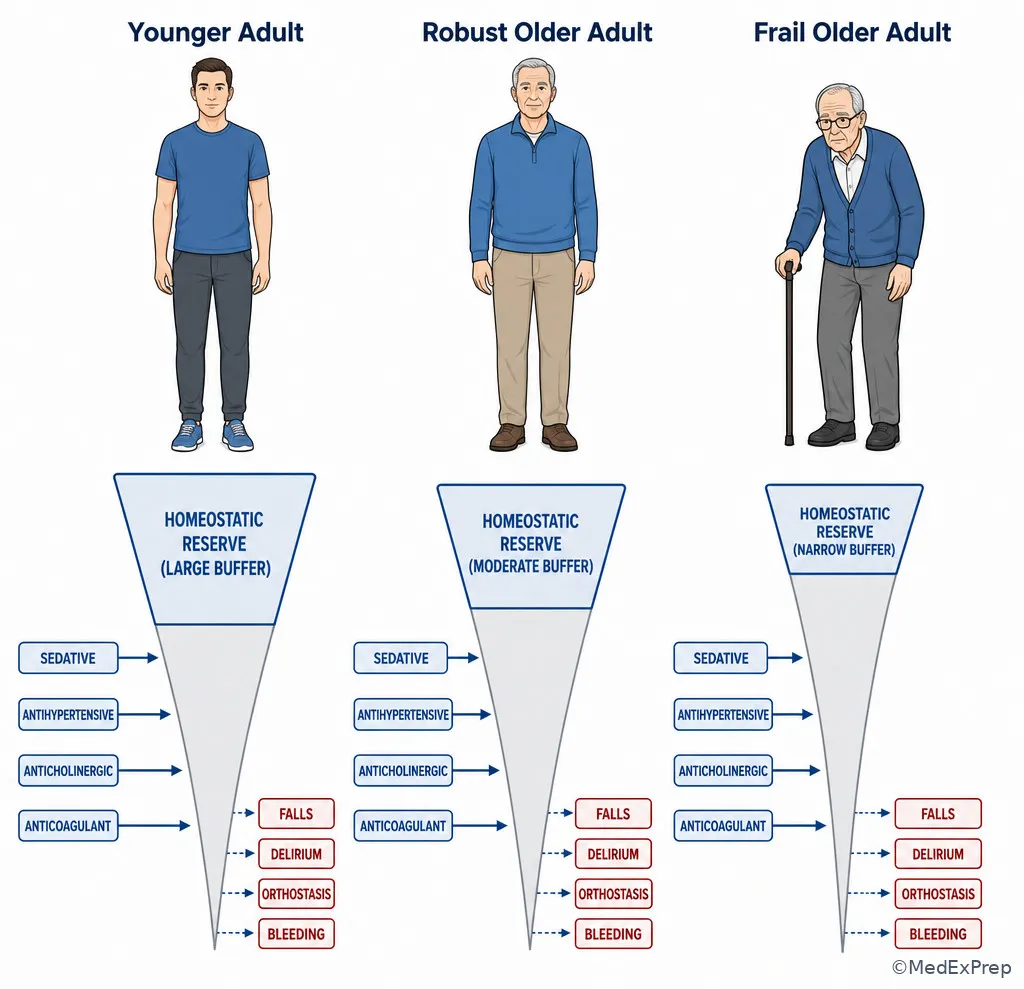
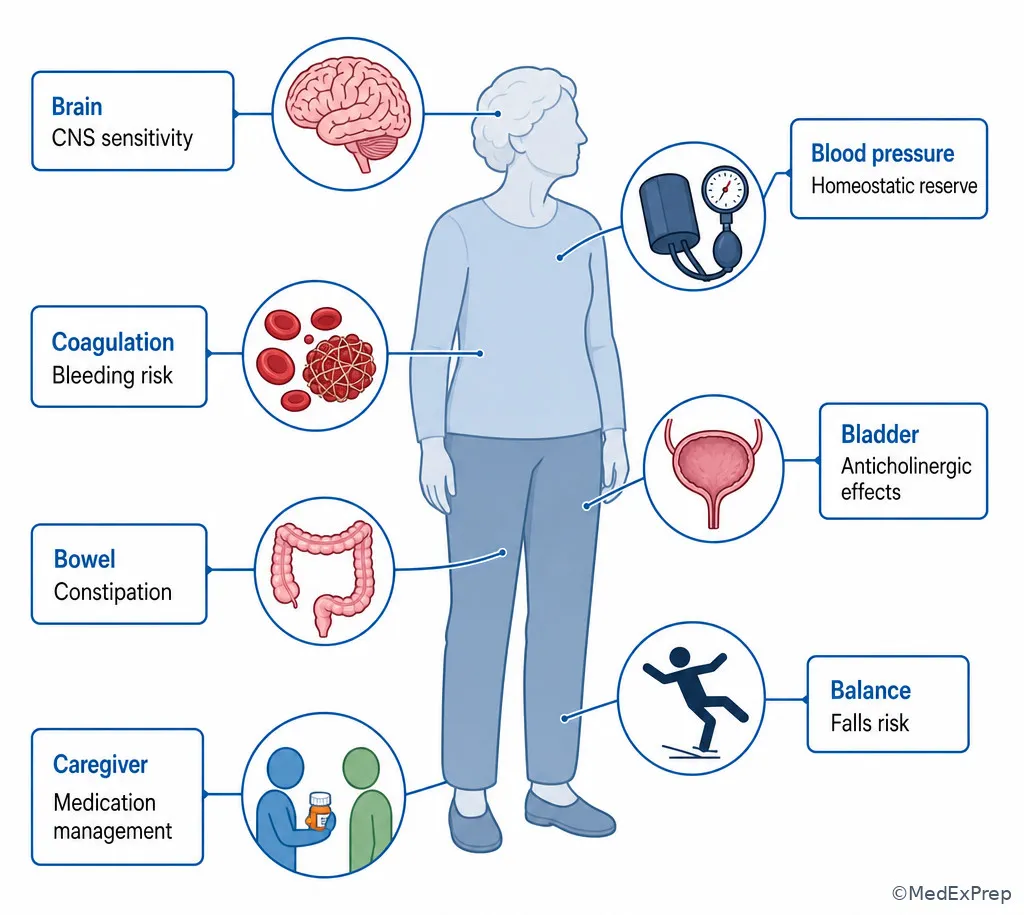
Fig 1. Older adult pharmacodynamic vulnerability map
Exam takeaway: Pharmacodynamic risk is the interaction of drug effect, organ reserve, frailty, cognition, function, and goals of care.
Fig 1. Older adult pharmacodynamic vulnerability map

Use this map as the mental model for the rest of the lesson. When a stem asks about a drug effect in an older adult, first locate the patient vulnerability domain before deciding whether to initiate, continue, reduce, substitute, taper, or monitor. See Fig 1.

CORE

Core content

1.1.2.2 1. PD change is altered response, not just altered exposure

A Explanation

Decision conflict: The patient is receiving a standard adult dose, and the laboratory value or dose history does not obviously prove overdose. Do you accept the regimen because the dose is normal, or do you recognize that the older adult's response may be excessive?

WHY THIS IS TESTED: BCGP questions often separate candidates who memorize doses from candidates who interpret patient response. Pharmacokinetics asks what the body does to the drug. Pharmacodynamics asks what the drug does to the body. In older adults, the same exposure may cause stronger sedation, impaired balance, delirium, orthostasis, bleeding, urinary retention, or hypoglycemia because receptor sensitivity and physiologic reserve have changed.

The practical pharmacist question is: Is the observed clinical effect proportional to the intended benefit, or is it evidence that this older adult is more sensitive than expected? When PD sensitivity is suspected, the best answer usually includes dose reduction, discontinuation, substitution, tapering if withdrawal is relevant, or closer monitoring. The wrong answer often focuses only on whether the dose is within the adult range.

Fig 2. PK versus PD decision split
Exam takeaway: A normal dose or concentration does not exclude pharmacodynamic toxicity in an older adult.
graph TD
A[Older adult has new symptom after medication change]-->B{Is exposure clearly excessive?}
B-->|Yes|C[Consider PK issue such as renal clearance dose accumulation or interaction]
B-->|No or uncertain|D[Assess PD sensitivity and reduced reserve]
D-->E[Link symptom to drug effect: sedation bleeding orthostasis delirium urinary retention]
E-->F[Recommend safest adjustment and monitoring]

See Fig 2 when an item tries to distract you with a dose that appears routine. The governing principle is that clinical response outranks adult-dose familiarity in geriatric medication safety.

Trigger: symptom after drug exposureCheck dose and timingAsk PK or PD?Identify vulnerable systemAdjust and monitor

B Worked example

Vignette with noise: An 82-year-old woman in assisted living has hypertension, osteoarthritis, and mild cognitive impairment. Her serum creatinine is unchanged from last month, and her new sleep medication was prescribed at the usual adult starting dose. She now has morning grogginess and nearly fell while walking to breakfast. A distracting detail is that her blood pressure log looks improved. A tempting clue is that the medication is not above the labeled adult starting dose.

  1. Identify the task: Determine the most appropriate medication-related next step for new sedation and fall risk.
  2. Extract key facts: Age 82, cognitive impairment, assisted living, new sedating medication, morning grogginess, near fall, unchanged creatinine.
  3. Apply the governing principle: PD sensitivity can cause clinically important CNS and balance effects despite a normal adult dose and stable renal marker.
  4. Eliminate alternatives: Do not continue unchanged solely because the dose is standard; do not intensify antihypertensive therapy because the blood pressure log is better if the functional consequence is harm.
  5. Verify safety and monitoring: Recommend reducing or discontinuing the sedating medication when appropriate, assess sleep contributors, monitor alertness and falls, and communicate with caregivers and the prescriber.

C Exam trap

Common wrong answer: Continue the regimen because the dose is within the usual adult range. Why it is tempting: The stem supplies a normal dose and stable creatinine. Single clue that eliminates it: The patient developed a new functional safety outcome, near fall with grogginess, after medication exposure.

D Checkpoint MCQ

An 86-year-old man with atrial fibrillation, mild dementia, and osteoarthritis reports new confusion after a medication is added for nighttime symptoms. His dose is within the usual adult range, and his renal function is unchanged. Which interpretation is most appropriate?

  1. The medication cannot be the cause because renal function is unchanged.
  2. The medication may be causing PD-related CNS toxicity despite a usual dose.
  3. The symptom should be treated by adding an antipsychotic before changing the medication.
  4. The regimen should be continued until the next annual medication review.

Answer: B. A is tempting because stable renal function reduces concern for accumulation, but it ignores altered response. B is correct because PD sensitivity can produce CNS toxicity at usual doses. C is tempting when behavior is disruptive, but it risks a prescribing cascade. D is tempting when the dose looks routine, but new confusion requires prompt assessment.

If you missed this: Review 1. PD change is altered response, not just altered exposure - focus on the rule that clinical response can reveal PD toxicity even when dose and renal function look acceptable.

1.1.2.3 2. Reduced homeostatic reserve converts small effects into major outcomes

A Explanation

Decision conflict: A medication has a predictable effect, such as lowering blood pressure, slowing cognition, relaxing the bladder, decreasing glucose, or impairing platelet/coagulation pathways. Do you view the effect as mild and acceptable, or do you recognize that the older adult may not compensate?

WHY THIS IS TESTED: Many geriatric adverse drug events are not mysterious. They are predictable pharmacology interacting with reduced reserve. A small orthostatic effect may become syncope. Mild sedation may become a fall. Modest anticholinergic activity may become delirium or urinary retention. A small reduction in appetite or intake may magnify hypotension or hypoglycemia. The BCGP decision is to anticipate the clinical consequence before it becomes a hospitalization or loss of independence.

Homeostatic reserve as a shrinking buffer
Exam takeaway: In older adults, the clinical problem is often not the drug effect alone but the reduced ability to compensate for it.
Homeostatic reserve as a shrinking buffer

The safest board answer usually identifies the patient outcome rather than the isolated mechanism. For example, the important issue is not merely alpha blockade; it is orthostatic hypotension leading to falls. It is not merely anticholinergic activity; it is delirium, constipation, urinary retention, and functional impairment.

Drug effectReduced reserveCompensation failsSyndrome appearsModify regimen

B Worked example

Vignette with noise: A 79-year-old man in primary care has diabetes, benign prostatic symptoms, and chronic dizziness. He recently started a medication that improves urinary symptoms. His A1c is 7.4%, a distracting detail suggesting diabetes control is not the immediate issue. He reports lightheadedness when standing and one bathroom fall at night. A tempting clue is that the urinary medication improved nocturia.

  1. Identify the task: Choose the most appropriate medication safety response.
  2. Extract key facts: Older adult, dizziness, nocturnal bathroom trip, fall, medication benefit for urinary symptoms, possible orthostatic effect.
  3. Apply the governing principle: Reduced homeostatic reserve makes orthostatic effects clinically important even when the drug provides symptom benefit.
  4. Eliminate alternatives: Do not continue unchanged solely because nocturia improved; do not add a sedative for nighttime anxiety because that increases falls risk.
  5. Verify safety and monitoring: Assess orthostatic vitals if feasible, review timing and dose, consider alternatives or dose adjustment, address nighttime fall prevention, and monitor urinary symptom control.

C Exam trap

Common wrong answer: Keep the medication unchanged because the target symptom improved. Why it is tempting: The drug appears effective. Single clue that eliminates it: The patient has a new fall linked to a predictable compensatory failure, standing lightheadedness at night.

D Checkpoint MCQ

An 84-year-old long-term care resident with frailty and chronic constipation becomes acutely confused after a medication with anticholinergic properties is started for bladder symptoms. Which principle best explains the event?

  1. Anticholinergic medications are ineffective in all older adults.
  2. Reduced reserve increases vulnerability to predictable anticholinergic CNS and peripheral effects.
  3. Constipation protects against urinary retention by lowering fluid losses.
  4. Confusion should be managed by adding a second CNS-active medication first.

Answer: B. A is tempting because anticholinergics are high risk, but blanket ineffectiveness is inaccurate. B is correct because reduced reserve and anticholinergic sensitivity increase delirium and peripheral adverse effects. C is physiologically distracting and not protective. D is tempting when symptoms are urgent, but it risks a prescribing cascade.

If you missed this: Review 2. Reduced homeostatic reserve converts small effects into major outcomes - focus on linking predictable drug effects to geriatric syndromes.
Quick Recall:

  • Fill in the blank: Pharmacodynamics asks what the ____ does to the ____.
  • True or false: A usual adult dose rules out medication-related harm in an older adult.
  • One-liner: Name two outcomes that may result when reduced reserve meets CNS depressant or orthostatic drug effects.
Fig 3. Reserve-to-syndrome cascade
Exam takeaway: Falls, delirium, and orthostasis often represent predictable PD effects amplified by reduced reserve.
graph LR
A[Medication effect]-->B[Reduced reserve]
B-->C{Vulnerable system}
C-->D[Brain: delirium sedation]
C-->E[Blood pressure: orthostasis]
C-->F[Balance: falls]
C-->G[GI GU: constipation retention]
D-->H[Medication review and monitoring]
E-->H
F-->H
G-->H

When the stem shows a geriatric syndrome shortly after a medication change, use the reserve-to-syndrome cascade in Fig 3 before choosing to add more medication.

1.1.2.4 3. High-yield PD-sensitive drug classes: CNS depressants, anticoagulants, and anticholinergics

A Explanation

Decision conflict: The medication has a real indication, but the class is repeatedly associated with geriatric harm. Do you avoid the class categorically, continue because the indication is valid, or individualize the regimen using risk reduction and monitoring?

WHY THIS IS TESTED: Board questions often use high-risk classes because they force benefit-risk reasoning. CNS depressants may worsen sedation, cognition, respiratory reserve, and falls. Anticoagulants and antiplatelets may prevent stroke or ischemic events but increase bleeding consequence, especially with interacting drugs, renal dysfunction, prior bleeding, or poor monitoring capacity. Anticholinergics may improve urinary, GI, allergy, or sleep symptoms but worsen cognition, constipation, urinary retention, blurry vision, dry mouth, tachycardia, and falls.

Class signal Why it is high-yield in older adults Best pharmacist action pattern
CNS depressants Sedation, impaired balance, cognitive slowing, respiratory concerns, fall risk Confirm indication, assess timing, avoid duplication, taper if chronic dependence risk, monitor function
Anticoagulants and antiplatelets Bleeding consequence rises with frailty, falls, renal issues, drug interactions, monitoring gaps Verify indication, dose, renal function, interactions, bleeding history, adherence, and monitoring plan
Anticholinergics Delirium, cognitive worsening, constipation, urinary retention, dry mouth, blurred vision, falls Calculate cumulative burden qualitatively, seek alternatives, deprescribe or reduce when benefit is marginal
Hypoglycemia-prone therapy Older adults may have severe consequences from hypoglycemia including falls, confusion, and hospitalization Individualize targets, deintensify when appropriate, simplify regimen, monitor glucose symptoms
Orthostasis-promoting drugs Compensation failure leads to dizziness, syncope, falls, and fear of ambulation Review timing, dose, hydration context, other BP-lowering drugs, and symptom log
Fig 4. Choose-versus-avoid screen for PD-sensitive medications
Exam takeaway: High-risk classes are not always forbidden, but they require indication strength, patient vulnerability assessment, and monitoring.
Fig 4. Choose-versus-avoid screen for PD-sensitive medications

The exam rarely rewards reflexive fear of every risky drug. It rewards the ability to separate necessary high-risk therapy with safeguards from low-value high-risk therapy. See Fig 4.

Identify high-risk classConfirm indication strengthAssess vulnerabilityChoose continue adjust substitute taperDefine monitoring

B Worked example

Vignette with noise: An 88-year-old man in an ambulatory cardiology clinic has atrial fibrillation, prior stroke, chronic kidney disease, and a recent minor fall while gardening. His caregiver reports he occasionally forgets evening doses. A distracting detail is that he bruises easily. A tempting clue is the fall history, which may push toward stopping anticoagulation without assessing stroke indication and modifiable risks.

  1. Identify the task: Determine whether the anticoagulant should be stopped, continued with safeguards, or modified.
  2. Extract key facts: Atrial fibrillation with prior stroke suggests strong benefit; CKD and bruising increase safety concerns; adherence gaps matter; fall was minor and context-specific.
  3. Apply the governing principle: PD-related bleeding risk requires individualized assessment, but a strong indication should not be abandoned solely because the patient is old or has one fall.
  4. Eliminate alternatives: Avoid the simplistic answer of stopping anticoagulation based only on age or bruising; avoid ignoring renal function and adherence.
  5. Verify safety and monitoring: Recommend confirming appropriate agent and dose for renal function and indication, reviewing interacting drugs, addressing adherence support, counseling on bleeding signs, and coordinating with the prescriber.

C Exam trap

Common wrong answer: Stop anticoagulation solely because the patient is older and fell once. Why it is tempting: Bleeding risk is a real geriatric concern. Single clue that eliminates it: Prior stroke with atrial fibrillation signals strong therapeutic benefit, so the safer approach is individualized risk mitigation rather than automatic discontinuation.

D Checkpoint MCQ

A 90-year-old woman with dementia, constipation, and urinary urgency is taking a nighttime sedative and a bladder anticholinergic. She has new daytime confusion and a fall. Which medication-review priority is most appropriate?

  1. Add a stimulant during the day to offset sedation.
  2. Assess cumulative CNS depressant and anticholinergic burden and recommend deprescribing or safer alternatives.
  3. Continue both medications because each treats a documented symptom.
  4. Add an antipsychotic because confusion indicates behavioral symptoms.

Answer: B. A is tempting because it seems to counter fatigue, but it creates a prescribing cascade. B is correct because the symptom cluster matches PD-sensitive medication burden. C is tempting because both indications exist, but documented symptoms do not justify preventable harm. D is tempting when confusion is disruptive, but the first step is to remove likely contributors.

If you missed this: Review 3. High-yield PD-sensitive drug classes - focus on matching CNS, bleeding, and anticholinergic harms to medication classes before adding therapy.

1.1.2.5 4. Benefit-risk balance shifts with frailty, function, cognition, and goals

A Explanation

Decision conflict: A medication is guideline-concordant for a disease marker, but the patient has frailty, cognitive impairment, functional dependence, swallowing difficulty, caregiver burden, limited prognosis, or competing goals. Do you pursue the marker, or do you prioritize outcomes meaningful to the patient?

WHY THIS IS TESTED: Geriatric pharmacotherapy is not general adult pharmacotherapy with smaller doses. It is medication optimization in the context of the whole older adult. A drug that improves a disease metric may be lower value if it increases falls, delirium, pill burden, hypoglycemia, monitoring burden, cost, or caregiver workload. Conversely, symptom-relieving or preventive therapy may still be appropriate when the benefit is meaningful and the patient can safely use it.

Benefit-risk seesaw in frailty
Exam takeaway: Frailty and functional vulnerability can shift the best answer from intensification toward simplification, monitoring, or deprescribing.
Benefit-risk seesaw in frailty

In exam stems, function and goals are not background fluff. They are discriminators. A patient with independent living and strong preventive goals may warrant a different recommendation than a frail nursing facility resident with recurrent falls and limited tolerance for monitoring.

Clarify goalEstimate benefit relevanceIdentify PD harmCheck feasibilityRecommend aligned plan

B Worked example

Vignette with noise: An 87-year-old woman in a skilled nursing facility has diabetes, recurrent falls, moderate dementia, and poor oral intake after a recent infection. Her fasting glucose values are sometimes near the lower end of target. A distracting detail is that her most recent A1c is higher than it was five years ago. A tempting clue is that she previously tolerated intensive therapy when she lived independently.

  1. Identify the task: Decide whether to intensify, continue, simplify, or deintensify glucose-lowering therapy.
  2. Extract key facts: Frailty, falls, dementia, poor intake, current low fasting values, changed functional status.
  3. Apply the governing principle: PD consequences of hypoglycemia and reduced reserve can outweigh strict marker control; treatment goals should reflect current function and safety.
  4. Eliminate alternatives: Do not intensify based solely on a historical A1c pattern; do not use past tolerance from a healthier state as proof of current safety.
  5. Verify safety and monitoring: Recommend deintensification or simplification when appropriate, monitor symptomatic hyperglycemia and hypoglycemia, and communicate goals with the care team and caregiver.

C Exam trap

Common wrong answer: Intensify therapy to chase the previous disease-marker target. Why it is tempting: The A1c appears worse than years ago. Single clue that eliminates it: Current frailty with recurrent falls, dementia, poor intake, and low fasting values makes hypoglycemia consequence the dominant concern.

D Checkpoint MCQ

An 85-year-old community-dwelling patient with robust function asks whether a necessary medication should be avoided only because it appears on a high-risk class list. The medication has a strong indication, no safer effective alternative, and a feasible monitoring plan. What is the best principle?

  1. Avoid all high-risk medications in every patient older than 65.
  2. Use age alone as the deciding factor.
  3. Individualize benefit-risk; high-risk status triggers scrutiny, not automatic refusal.
  4. Delay treatment until the patient develops complications.

Answer: C. A is tempting because high-risk lists are memorable, but they are screening tools rather than absolute rules. B is tempting in geriatric safety questions but represents ageism. C is correct because indication strength, alternatives, vulnerability, goals, and monitoring determine appropriateness. D is tempting as a safety posture but may undertreat a meaningful condition.

If you missed this: Review 4. Benefit-risk balance shifts with frailty, function, cognition, and goals - focus on why screening tools prompt individualized review rather than automatic discontinuation.
Quick Recall:

  • True or false: A medication can be guideline-concordant and still be inappropriate for a specific older adult.
  • Fill in the blank: High-risk class status should trigger individualized ____, not automatic refusal.
  • One-liner: Name one situation where undertreatment may be the unsafe answer.
Fig 5. Patient-specific benefit-risk filter
Exam takeaway: The best geriatric pharmacotherapy answer filters drug benefit through frailty, cognition, function, feasibility, and goals.
Fig 5. Patient-specific benefit-risk filter

Use the filter in Fig 5 for any stem that includes functional status, caregiver limitations, cognition, or prognosis. Those details usually determine the safest option.

1.1.2.6 5. Start low and monitor close, but do not undertreat

A Explanation

Decision conflict: The older adult has a legitimate indication for therapy, but the medication carries PD risk. Do you avoid treatment entirely, use the full adult regimen without adjustment, or begin cautiously with explicit monitoring and titration?

WHY THIS IS TESTED: Exam writers use older age to test both safety and bias. The correct geriatric answer is rarely careless intensification, but it is also not automatic non-treatment. Cautious initiation means selecting an appropriate medication, beginning at a conservative dose when applicable, titrating based on response and tolerability, and defining what will be monitored. This protects the patient from harm while avoiding therapeutic nihilism.

Good BCGP reasoning asks four questions: What benefit matters? What harm is most likely? What starting approach reduces risk? What monitoring proves the plan is working and safe?

Fig 6. Start-low without undertreatment algorithm
Exam takeaway: Cautious dosing is paired with monitoring and titration so the patient receives benefit without avoidable harm.
graph TD
A[Legitimate indication exists]-->B{Is medication benefit meaningful for this patient?}
B-->|No or low value|C[Deprescribe avoid or choose non-drug approach]
B-->|Yes|D[Choose safer agent and conservative starting plan]
D-->E[Set efficacy and toxicity endpoints]
E-->F[Titrate continue reduce or stop based on response]

See Fig 6. The phrase start low should always be paired with what you will monitor and how you will know whether to titrate.

Confirm indicationAvoid age-only denialSelect safer optionStart conservativelyMonitor and titrate

B Worked example

Vignette with noise: A 76-year-old independent patient with chronic neuropathic pain, controlled hypertension, and insomnia has avoided treatment because a previous medication caused dizziness. A distracting detail is a mildly abnormal lipid panel. A tempting clue is the prior dizziness, which may lead to denying all pharmacologic options.

  1. Identify the task: Choose a safe initial medication-management approach for a symptomatic condition.
  2. Extract key facts: Persistent pain affects quality of life, prior dizziness signals PD vulnerability, independent function means benefit may be meaningful, lipid panel is not the immediate issue.
  3. Apply the governing principle: Avoid therapeutic nihilism; choose a safer option when available, start conservatively, counsel, and monitor dizziness, sedation, falls, and pain response.
  4. Eliminate alternatives: Do not use a high sedating dose immediately; do not refuse treatment solely because the patient is older or had one adverse effect.
  5. Verify safety and monitoring: Establish baseline pain and function, schedule follow-up, assess balance and sedation, and adjust only if benefit exceeds harm.

C Exam trap

Common wrong answer: Withhold all therapy because older adults are sensitive to adverse effects. Why it is tempting: Safety is central in geriatrics. Single clue that eliminates it: The condition is symptomatic and meaningful, so the safer response is cautious individualized therapy with monitoring, not therapeutic nihilism.

D Checkpoint MCQ

A 78-year-old patient with bothersome symptoms has a medication indication, but the drug class can cause dizziness and sedation. Which recommendation best reflects geriatric PD principles?

  1. Use the standard adult target dose immediately to avoid undertreatment.
  2. Avoid treatment solely because the patient is older than 75.
  3. Start with a conservative regimen, define efficacy and toxicity monitoring, and titrate if tolerated.
  4. Add a second sedating medication to prevent early discontinuation.

Answer: C. A is tempting because undertreatment is a concern, but it ignores PD sensitivity. B is tempting as a safety shortcut, but age alone is not a contraindication. C is correct because it balances benefit and PD risk. D is tempting if symptoms are difficult, but it increases cumulative harm.

If you missed this: Review 5. Start low and monitor close, but do not undertreat - focus on pairing cautious initiation with measurable follow-up.

1.1.2.7 6. Monitoring turns PD risk into a manageable care plan

A Explanation

Decision conflict: The medication is continued or initiated because benefit is reasonable, but PD risk remains. Do you simply document that the drug is risky, or do you create a monitoring plan that detects harm early and confirms benefit?

WHY THIS IS TESTED: BCGP items often ask for the most appropriate next step after identifying risk. The answer is frequently not a laboratory test alone. PD monitoring often includes symptoms, function, cognition, falls, caregiver report, orthostatic symptoms, bowel and bladder effects, bleeding signs, sedation, sleep, appetite, adherence, and treatment burden. Labs may matter for selected drugs, but clinical monitoring is central to pharmacodynamics.

Medication effect concern Monitoring endpoint Why it matters
CNS depression Daytime alertness, gait stability, falls, cognition, respiratory symptoms when relevant Detects harm that may not appear in a lab value
Orthostasis Dizziness, standing symptoms, falls, home or clinic BP pattern when available Links BP lowering to functional safety
Anticholinergic effect Confusion, constipation, urinary retention, dry mouth, blurred vision Captures cumulative muscarinic burden
Bleeding risk Bruising pattern, melena, hematuria, falls with trauma, interacting drugs, renal function when relevant Combines clinical signs with exposure risk
Hypoglycemia risk Sweats, shakiness, confusion, falls, meal intake, glucose pattern if available Older adults may present atypically and consequences are high
Deprescribing or taper Withdrawal symptoms, recurrence of target symptom, function, caregiver observations Ensures stopping is safe and goal-concordant
PD monitoring dashboard for older adults
Exam takeaway: Pharmacodynamic monitoring is clinical and functional, not only laboratory-based.
PD monitoring dashboard for older adults

The best monitoring plan is specific: what to watch, who will report it, when to reassess, and what action threshold prompts dose change, taper, substitution, or urgent escalation.

Continue or start medicationName expected benefitName likely harmAssign monitoring sourceSet action threshold

B Worked example

Vignette with noise: An 81-year-old man transitions from hospital to home after pneumonia. He has COPD, atrial fibrillation, and mild cognitive impairment. His discharge list includes a new medication with sedating potential and continuation of anticoagulation. A distracting detail is that his antibiotic course is complete. A tempting clue is that hospital vitals were stable.

  1. Identify the task: Build a monitoring-focused medication safety plan after transition.
  2. Extract key facts: Recent hospitalization, cognition impairment, COPD, sedating drug, anticoagulant, home setting, transition risk.
  3. Apply the governing principle: PD risks require early clinical monitoring after medication changes, especially during transitions.
  4. Eliminate alternatives: Do not rely solely on stable inpatient vitals; do not focus only on the completed antibiotic if active PD-risk drugs remain.
  5. Verify safety and monitoring: Counsel caregiver to monitor sedation, breathing changes, confusion, falls, bruising or bleeding, adherence, and follow-up timing; communicate concerns to prescriber.

C Exam trap

Common wrong answer: Order only routine labs and ignore symptoms and function. Why it is tempting: Labs feel objective and familiar. Single clue that eliminates it: The risk is pharmacodynamic sedation, falls, cognition, and bleeding signs after transition, so symptom and functional monitoring are essential.

D Checkpoint MCQ

Which monitoring plan best fits an older adult started on a medication with CNS depressant potential?

  1. Check only a lipid panel in 12 months.
  2. Ask about daytime alertness, balance, falls, cognition, and caregiver-observed functional change within an appropriate follow-up interval.
  3. Wait for the patient to request discontinuation.
  4. Monitor only the medication acquisition cost.

Answer: B. A is tempting because it is a common monitoring test, but it does not assess CNS PD harm. B is correct because it monitors clinical outcomes tied to the drug effect. C is tempting in patient-centered care, but passive monitoring misses preventable harm. D matters for feasibility but is insufficient as a safety plan.

If you missed this: Review 6. Monitoring turns PD risk into a manageable care plan - focus on matching monitoring endpoints to expected drug effects and geriatric harms.
TRAPS

Exam Traps & Differentiators

Most common wrong answer: Continue or intensify therapy because the dose is guideline-concordant or within the usual adult range. Why: The stem is testing whether you recognize patient-specific response and reserve rather than memorized adult dosing.
Looks similar But is not Discriminator
Pharmacokinetic toxicity Pharmacodynamic sensitivity PK focuses on exposure and clearance; PD focuses on excessive effect at expected exposure
Appropriate high-risk therapy Low-value high-risk therapy Strong indication, feasible monitoring, and no safer alternative support continuation with safeguards
Cautious prescribing Therapeutic nihilism Cautious prescribing includes monitoring and titration; nihilism denies useful therapy based on age alone
Symptom treatment Prescribing cascade If the new symptom began after a medication change, evaluate the upstream drug first
Clinical monitoring Lab-only monitoring PD harms often appear as falls, confusion, sedation, bleeding signs, constipation, or function change
Looks similar but is not: PD exam differentiators
Exam takeaway: The single clue usually identifies whether to adjust exposure, manage response, avoid undertreatment, or stop a prescribing cascade.
Looks similar but is not: PD exam differentiators

1.1.2.8 If the stem says, think

  • New confusion after anticholinergic or sedative exposure - think PD sensitivity and delirium risk before adding another CNS drug.
  • Fall after BP-lowering or sedating medication - think reduced homeostatic reserve, orthostasis, balance impairment, and timing.
  • Usual adult dose but exaggerated clinical effect - think pharmacodynamics, not dose reassurance.
  • Strong indication but high-risk class - think individualized benefit-risk and monitoring, not automatic discontinuation.
  • Frailty, dementia, poor intake, or recurrent falls - think shifted goals and lower tolerance for hypoglycemia, sedation, and orthostasis.
  • New medication added to treat a new symptom - think prescribing cascade if the symptom matches an adverse effect of an existing drug.
Review connection: Return to High-yield PD-sensitive drug classes and Start low and monitor close when an answer choice seems to choose between medication safety and undertreatment.
ALGO

Algorithm / Approach

Medication response algorithm for older adults
Exam takeaway: Identify the symptom, match it to a drug effect, then choose the least harmful action that preserves meaningful benefit.
graph TD
A[Older adult has medication decision or new symptom]-->B[Identify task: start continue adjust taper stop monitor]
B-->C[Extract geriatric risk: frailty cognition falls reserve goals caregiver]
C-->D[Match drug effect to harm: CNS bleeding anticholinergic orthostasis hypoglycemia]
D-->E[Balance indication strength against risk and feasibility]
E-->F[Recommend action plus monitoring endpoint]
1. Identify task2. Extract vulnerability3. Match drug effect4. Weigh benefit vs harm5. Act and monitor
Pharmacist medication review at transition of care
Exam takeaway: Transitions magnify PD risk because new drugs, old drugs, cognition, and caregiver execution all collide.
{"prompt":"Realistic but non-identifying illustration of a geriatric pharmacist reviewing a discharge medication list with an older adult and caregiver at a clinic table; highlighted icons for falls, delirium, bleeding, adherence, pill burden, and follow-up; professional healthcare education style","caption":"Pharmacist medication review at transition of care","size":"1024x1024"}
QUIZ

Self-check quiz

1.1.2.9 Question 1

An 83-year-old assisted living resident with mild cognitive impairment develops daytime sedation after starting a medication at the usual adult starting dose. Renal function is stable. What is the best interpretation?

  1. The drug cannot be responsible because renal function is stable.
  2. The patient may have PD sensitivity causing CNS adverse effects at usual exposure.
  3. The dose should be increased to overcome tolerance.
  4. The symptom should be treated first with a stimulant.

1.1.2.10 Question 2

An 87-year-old nursing facility resident with recurrent falls, poor intake, and dementia has low fasting glucose readings while receiving an intensive diabetes regimen. Which action is most consistent with geriatric PD principles?

  1. Intensify therapy because strict disease-marker control is always preferred.
  2. Consider deintensification or simplification and monitor for symptomatic hyperglycemia and hypoglycemia.
  3. Add a sedative to reduce nighttime wandering.
  4. Ignore the glucose values because dementia prevents symptom reporting.

1.1.2.11 Question 3

An 80-year-old patient with atrial fibrillation and prior stroke has a minor fall while gardening. The patient takes an anticoagulant and has no major bleeding. What is the best pharmacist approach?

  1. Recommend automatic discontinuation because any fall history outweighs stroke prevention.
  2. Assess indication strength, dose appropriateness, renal function, interactions, adherence, bleeding history, and fall mitigation before recommending changes.
  3. Add aspirin to compensate for missed anticoagulant doses.
  4. Ignore the fall because anticoagulation decisions are unrelated to function.

1.1.2.12 Question 4

A new medication is added to treat urinary urgency in a 78-year-old with constipation and memory concerns. Two weeks later, the patient has confusion and urinary retention. What is the most appropriate first medication-review step?

  1. Add a medication to treat confusion.
  2. Evaluate the new medication as a likely contributor to anticholinergic burden and consider safer alternatives or discontinuation.
  3. Continue the drug because urinary urgency is documented.
  4. Focus only on annual preventive care needs.

1.1.2.13 Question 5

Which monitoring plan best reflects pharmacodynamic risk after initiating a sedating medication in an older adult?

  1. Monitor only serum creatinine.
  2. Monitor daytime alertness, cognition, gait stability, falls, caregiver observations, and symptom benefit.
  3. Monitor only medication cost.
  4. Delay reassessment until the next yearly visit.
ANSWERS

Answer key & explanations

1.1.2.14 Question 1: Answer B

A: Tempting because stable renal function lowers concern for accumulation, but wrong because PD toxicity can occur without a renal change. B: Correct because sedation at a usual dose can reflect increased CNS pharmacodynamic sensitivity. C: Tempting if one assumes symptoms reflect undertreatment or tolerance, but wrong because sedation signals harm. D: Tempting as a quick fix, but wrong because it creates a prescribing cascade.

If you missed this: Review 1. PD change is altered response, not just altered exposure - focus on the rule that usual adult dose does not exclude PD toxicity.

1.1.2.15 Question 2: Answer B

A: Tempting because marker control feels objective, but wrong because frailty, poor intake, dementia, and falls increase hypoglycemia consequence. B: Correct because goals and safety should shift toward avoiding hypoglycemia while monitoring for loss of control. C: Tempting if wandering is disruptive, but wrong because sedation increases falls and may worsen cognition. D: Tempting because symptom reporting is limited, but wrong because impaired reporting increases the need for proactive monitoring.

If you missed this: Review 4. Benefit-risk balance shifts with frailty, function, cognition, and goals - focus on current vulnerability rather than historical targets.

1.1.2.16 Question 3: Answer B

A: Tempting because falls increase bleeding concern, but wrong because a strong stroke-prevention indication requires individualized assessment rather than automatic discontinuation. B: Correct because anticoagulant decisions require benefit-risk review, dosing, renal function, interactions, adherence, bleeding signs, and fall mitigation. C: Tempting if missed doses raise concern, but wrong because aspirin does not solve adherence and may increase bleeding risk. D: Tempting if focusing narrowly on thromboembolism, but wrong because function and falls affect safety planning.

If you missed this: Review 3. High-yield PD-sensitive drug classes - focus on strong indication plus safeguards rather than reflexive stopping.

1.1.2.17 Question 4: Answer B

A: Tempting because confusion is clinically urgent, but wrong as the first medication step because adding therapy may create a cascade. B: Correct because confusion, constipation context, and urinary retention after a bladder medication suggest anticholinergic burden. C: Tempting because the indication is real, but wrong because benefit does not override serious PD harm. D: Tempting because preventive care is important, but wrong because the acute medication-related syndrome is the priority.

If you missed this: Review 2. Reduced homeostatic reserve converts small effects into major outcomes - focus on matching anticholinergic effects to delirium and urinary retention.

1.1.2.18 Question 5: Answer B

A: Tempting because renal function is commonly monitored, but wrong because it does not capture CNS PD harm. B: Correct because PD monitoring must include clinical and functional endpoints. C: Tempting because cost affects adherence, but wrong because it is not sufficient safety monitoring. D: Tempting when follow-up systems are delayed, but wrong because early adverse effects may cause preventable falls or delirium.

If you missed this: Review 6. Monitoring turns PD risk into a manageable care plan - focus on monitoring the expected drug effect and patient-centered harm.
RAPID

Rapid review / cheat-sheet

  • PD change - discriminator is altered response at expected exposure.
  • Usual adult dose - does not rule out geriatric toxicity.
  • CNS depressant sensitivity - look for sedation, cognitive slowing, gait impairment, and falls.
  • Anticholinergic burden - confusion plus constipation or urinary retention is a classic clue.
  • Orthostatic vulnerability - standing dizziness or bathroom falls point to reduced reserve.
  • Anticoagulation in older adults - strong indication requires individualized safeguards, not automatic stopping.
  • Frailty and poor intake - lower tolerance for hypoglycemia, hypotension, and sedation.
  • Start low - only complete when paired with monitoring and titration.
  • Therapeutic nihilism - age-only refusal of beneficial therapy is not patient-centered care.
  • Prescribing cascade - new symptom after drug change means evaluate the upstream medication first.
  • Monitoring PD risk - symptoms, function, cognition, falls, caregiver report, and benefit matter as much as labs.
  • Best exam answer - preserves meaningful benefit while reducing predictable geriatric harm.

Blueprint anchor recap

This lesson maps to Geriatric Patient Population - Physiological Factors of Aging - Age-Related Physiological Changes and supports Therapeutics and Patient Management through pharmacodynamics, goals of treatment, adverse drug events, drug interactions, medication adherence, and monitoring. The core learner-facing competency tags are: Patient Assessment and Individualized Care of Older Adults: Physiologic aging - PD sensitivity; Medication Safety, Adverse Effects, and Monitoring: Risk recognition - homeostatic reserve; Comprehensive Medication Review, Optimization, and Deprescribing: Benefit-risk review - medication value; Therapeutic Decision-Making in Common Geriatric Pharmacotherapy Areas: Individualized dosing - start low and monitor close; Patient-Centered Communication, Ethics, and Shared Decision-Making: Goals of care - patient priorities.

See also

  • Age-Related PK Changes
  • Pathophysiology In Older Adults
  • Prioritizing Medication Problems
  • Behavioral Symptom Drug Risks
  • Opioid Risk Mitigation

References / further study

Blueprint-only lesson generated from the supplied BCGP course and exam context. No external citations were added because the provided source pack specifies blueprint-only/no external citation policy.

Keep reading, free

Enter your email to read lesson 2 now.

Free. We may also email you about our programs. No spam, and you can ask us to remove your email at any time.

Liked it?

BCGP Prep Course (BCGP) has 74 lessons.

BPSPrep
Programs
For organizations
ContactLog inGet a free guide