


BPSPrep

Free lesson

USP And Regulatory Sources

The first lesson of BCSCP Prep Course (BCSCP), free to read.

USP And Regulatory Sources

What you'll learn:

  • DOMAIN: Standards Interpretation → Source hierarchy — choose the governing compendial, regulatory, or institutional source for a sterile compounding decision.
  • DOMAIN: Environmental Quality and Engineering Controls → Standards application — identify which source typically addresses facilities, engineering controls, and environmental expectations.
  • DOMAIN: Hazardous Drug Handling → Source selection — distinguish when hazardous drug handling requirements are driven by USP hazardous drug standards versus other oversight sources.
  • DOMAIN: Quality Assurance and Documentation → Compliance framework — separate enforceable expectations, accreditation expectations, and local policy requirements.
  • DOMAIN: Pharmacist Decision Framework → Escalation and safest compliant action — determine what to do when standards, policies, or facts appear incomplete or conflicting.

Blueprint mapping:

  • Standards interpretation → compendial versus regulatory source recognition
  • Environmental quality and engineering controls → source-based requirement identification
  • Hazardous drug handling → applicable standard selection
  • Quality management → policy, documentation, and escalation framework
  • Workflow and contamination risk assessment → safest compliant action when source authority is unclear

Estimated time: 45–60 minutes

Prereqs: None for this first topic; forward links: Sterile Compounding Scope, Standards Conflict Resolution

Key outputs: You should be able to identify the most authoritative applicable source, explain why a tempting alternative source is weaker, and choose a pharmacist-level stop/clarify/escalate action when standards are uncertain.

Why it matters

  • BCSCP questions often test which source governs before they test the technical detail itself.
  • The safest compliant answer usually depends on recognizing whether the issue is compendial, regulatory, accreditation, or local policy.
  • Wrong answers are commonly attractive because they cite a real source that is relevant, but not the best governing source for the specific scenario.
  • When source authority is unclear, the pharmacist’s best move is typically to stop unsafe processing, verify the applicable source, and escalate through policy.

Key Terms & Must-Know Facts

Key terms

  • USP: United States Pharmacopeia; publishes compendial standards.
  • Compendial standard: Official standard that may become enforceable through law, regulation, or adoption.
  • USP <797>: Sterile compounding standard for compounded sterile preparations.
  • USP <800>: Hazardous drug handling standard.
  • FDA: Federal agency overseeing drugs, manufacturing, labeling, and certain compounded product frameworks.
  • State board of pharmacy: Jurisdictional regulator for pharmacy practice and facility operations.
  • The Joint Commission / accreditation body: Accrediting organization; influential but not itself a substitute for compendial requirements.
  • Institutional policy: Local procedures that operationalize standards and regulations.
  • Enforceable: A requirement that can be required by law, rule, regulation, or adopted standard.
  • Guidance: Influential interpretation or recommendation that may not independently function as the primary governing rule.
  • SOP: Standard operating procedure; local document specifying how a site implements requirements.
  • Insanitary condition: Condition creating contamination risk or rendering product quality questionable.
  • Escalation pathway: Required chain for reporting, halting, investigating, and resolving risk.

Must-know facts

  • USP chapters are central sources for sterile compounding questions, especially <797> and <800>.
  • FDA labeling can guide product-specific handling and compatibility questions, but it does not replace sterile compounding standards.
  • State law and board rules may be more specific or more restrictive; follow current applicable requirements.
  • Institutional policy can be stricter than baseline standards and usually governs internal workflow if it does not conflict with higher authority.
  • Accreditation standards matter operationally, but on exam questions the primary issue is often the most directly applicable sterile compounding standard.
  • If facts are incomplete, do not guess; hold unsafe processing and verify the governing source.
  • The exam tests pharmacist scope: interpret, verify, hold, clarify, document, and escalate.
  • Do not answer from the perspective of an engineer, regulator issuing citations, or prescriber establishing therapy.
Memory anchor: Think U-F-S-P for source triage: USP chapter, FDA/product labeling, State law, Policy. On exam stems, ask: which of these is the most directly applicable and highest-authority source for this exact task?

Core content

1.1.1.1 Foundational source hierarchy for sterile compounding decisions

A. Explanation

The first decision conflict in this topic is simple but heavily tested: Which source should the pharmacist use first when a sterile compounding question asks for the safest compliant response? The resolution rule is: choose the source most directly governing the activity in the stem, then apply any more restrictive law or institutional policy that also validly applies. For sterile compounding operations, that usually means starting with USP sterile compounding standards rather than a general hospital policy memo or a broad accreditation manual. WHY THIS IS TESTED: exam writers know candidates can recognize terms like FDA, Joint Commission, and board of pharmacy, but the score turns on whether you can identify the best governing source for the precise task.

Use a layered approach. If the stem is about sterile preparation design, environmental controls, aseptic processing, personnel practices, release conditions, or documentation tied to sterile preparation quality, start with USP sterile compounding standards. If the stem turns on hazardous drug handling, containment, PPE, or hazardous workflow, bring USP hazardous drug standards to the front. If the stem focuses on a product-specific issue like reconstitution instruction, storage after vial puncture, light protection, concentration limits, or container recommendations, manufacturer labeling and authoritative drug information become highly relevant—but still within the compounding framework. If the stem asks about licensure, legal operation, or jurisdictional pharmacy requirements, state law and board rules may control.

The most common mistake is choosing the most famous source instead of the most applicable source. For example, FDA is critical in drug oversight, but many day-to-day sterile compounding exam questions are really asking about USP implementation. Likewise, a local SOP matters greatly in practice, but it must rest on a valid standard or institutional adoption pathway. See Fig 1.

Fig 1. Source selection hierarchy for sterile compounding questions
Exam takeaway: Start with the most directly applicable compendial or legal source, then apply stricter local policy if it validly fits.
flowchart TD
A[Identify the task in the stem] --> B{What is being governed?}
B -->|Sterile compounding process| C[Start with USP 797]
B -->|Hazardous drug handling| D[Start with USP 800]
B -->|Product-specific use/storage info| E[Check FDA labeling or authoritative drug info]
B -->|Licensure or jurisdiction rule| F[Check state law or board rule]
C --> G[Apply local policy if stricter and consistent]
D --> G
E --> G
F --> G
G --> H[If unclear or unsafe: hold, verify, escalate]
Concept flow: Picking the governing source in a stem
Exam takeaway: The fastest correct answer starts with classifying the problem before looking for details.
Name the task
Environmental control, hazardous handling, product instruction, or legal/policy issue.

Choose the primary source
Match the task to the most direct governing standard, law, or product source.

Check stricter overlays
State rules and institutional policy may be more restrictive.

Protect first
If uncertainty affects sterility or safety, stop processing and escalate.

Pharmacist Action: NOTICE whether the stem is asking about process, product, legal authority, or hazardous handling. SAY “I need to verify the governing source before release or continued compounding.” MONITOR whether local policy adds stricter implementation details each time a workflow decision is made. HOLD/CLARIFY/ESCALATE if the answer depends on a source not yet verified or if conflicting documents would change product disposition.

B. Worked example

A 450-bed hospital pharmacy receives an order to compound vancomycin 1.5 g in 250 mL D5W IV every 12 hours for a 67-year-old patient with heart failure, obesity, and chronic kidney disease. During verification, a new pharmacist notices that the unit’s laminated “cleanroom quick guide” permits a workflow shortcut for staging supplies on a cart near the PEC. The cleanroom technician also mentions that “the accreditor was okay with our setup last year.” An irrelevant distraction in the chart shows mildly elevated AST/ALT. The question asks for the most appropriate next step from the sterile compounding pharmacist perspective.

Identify task: This is not a dosing question; it is a sterile compounding workflow and source-authority question. Extract key facts: local quick guide suggests a shortcut, accreditor comment is secondhand, and the issue affects PEC workflow. Apply rule: workflow in and around sterile compounding operations is governed primarily by applicable USP sterile compounding standards and valid institutional policy implementing them—not by hearsay about accreditation impressions. Eliminate distractors: do not accept the shortcut because it appears efficient; do not rely on an accreditation anecdote; do not change drug therapy because the patient’s AST/ALT is irrelevant here. Verify safest compliant action: hold use of the shortcut, compare the local guide with current governing standards and policy, and escalate for correction if inconsistent.

C. Exam trap

Common wrong answer: “Follow the local quick guide because institutional policy always controls.” WHY IT IS TEMPTING: in real practice, frontline workflow often runs through SOPs and quick-reference sheets. The SINGLE CLUE that eliminates it: the stem suggests the local document may conflict with the governing sterile compounding standard, so you must verify the higher authority before relying on the shortcut.

D. Checkpoint

Question: A pharmacist is asked to verify whether a nonhazardous sterile compounding workflow change near the PEC is acceptable for cefazolin 2 g in 100 mL NS IV every 8 hours. Which source should be checked first as the most directly applicable primary source?

  1. USP <797>
  2. Manufacturer package insert for cefazolin
  3. Accreditation survey tracer notes
  4. Unit nursing preference document

Answer: A

  • A is tempting and right because the question is about nonhazardous sterile compounding workflow near the PEC, which points directly to the sterile compounding standard.
  • B is tempting but wrong because package inserts help with product-specific preparation and storage, not primary governance of cleanroom workflow design.
  • C is tempting but wrong because accreditation findings matter operationally, yet they are not the primary sterile compounding standard for this question.
  • D is tempting but wrong because local preference documents are low-authority unless supported by the governing standard and institutional policy chain.
If you missed this: Review 1.1.1.1 Foundational source hierarchy for sterile compounding decisions — focus on matching the stem’s task to the most directly governing source before considering local overlays.

1.1.1.2 What each major source contributes: USP, FDA, state law, accreditation, and policy

A. Explanation

The second major conflict is not “Which source exists?” but “What does each source actually do?” Candidates lose points by overextending a source beyond its proper role. USP supplies practice standards for compounding. FDA supplies federal oversight, approved labeling, manufacturing distinctions, and product-specific information. State boards and state law control practice authority, licensure, and jurisdiction-specific implementation. Accreditation organizations evaluate compliance structures and system performance. Institutional policy translates all of that into daily steps, logs, forms, restrictions, and escalation rules.

A fast exam strategy is to sort sources by function. USP answers “How should sterile compounding be performed safely and compliantly?” FDA labeling answers “What does the approved product information say about formulation, storage, handling, dilution, and stability constraints?” State law answers “What is legally required in this jurisdiction for the pharmacy’s operations?” Accreditation answers “What organizational systems and documentation structures are being assessed?” Institutional policy answers “How does this organization implement the requirements in day-to-day workflow?” This framework is especially useful when two answers are both true statements but only one is the best source for the action in the stem. See Fig 2.

Forward reference: in the upcoming lesson on Standards Conflict Resolution, you will build from this section to decide what to do when two sources appear to disagree. For now, learn the distinct function of each source before trying to resolve conflicts among them.

Fig 2. Functional map of major sterile compounding sources
Exam takeaway: Source questions are easiest when you classify each authority by what kind of answer it is designed to provide.
flowchart LR
A[USP] --> A1[Compounding process standards]
B[FDA labeling and oversight] --> B1[Product-specific instructions]
C[State law and board rules] --> C1[Jurisdiction requirements]
D[Accreditation] --> D1[System evaluation expectations]
E[Institutional policy] --> E1[Local implementation steps]
A1 --> F[Daily sterile compounding decisions]
B1 --> F
C1 --> F
D1 --> F
E1 --> F
Fig 3. Labeled compliance stack for sterile compounding operations
Exam takeaway: Visualize USP standards at the operational core with state law and institutional policy layered around day-to-day implementation.
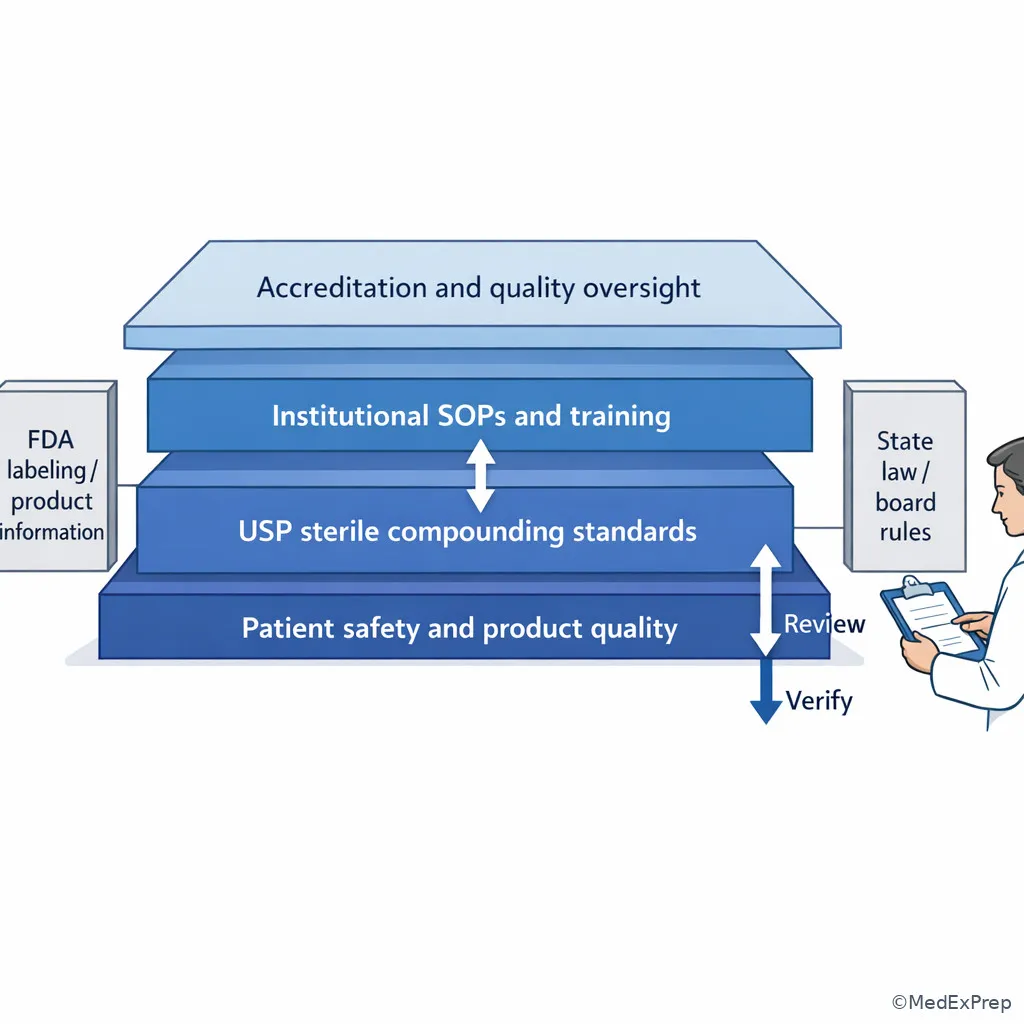
Fig 3. Labeled compliance stack for sterile compounding operations
Concept flow: Assigning each source a role
Exam takeaway: Pick the source by function, not by fame.
USP
Operational standard for sterile compounding practice.

FDA/product info
Drug-specific preparation, storage, and labeling details.

State law
Jurisdictional legal requirements and board authority.

Policy
Local implementation, training, and documentation steps.

Recall: In the upcoming topic Sterile Compounding Scope, we will define the pharmacist’s allowed actions. Here, we build on that by identifying which source tells the pharmacist what safe and compliant action should be taken.
High-Yield Connection: This concept is tested alongside Master Formulation Records and Compounding Record Completeness. Know both where a requirement originates and how it is documented locally for exam day — they are frequently paired in stems.
Pharmacist Action: NOTICE whether the question asks for a practice standard, a product-specific instruction, or a jurisdictional rule. SAY “USP governs the process; I will verify whether product labeling or state requirements add constraints.” MONITOR SOP alignment with current standards during updates and competency reviews. HOLD/CLARIFY/ESCALATE when local documents cite outdated source material or when product labeling appears inconsistent with routine workflow.

B. Worked example

A pharmacist verifies amphotericin B liposomal 50 mg IV to be prepared in D5W, while a covering technician references a homegrown dilution chart that lists NS as an option. The patient is 58 years old with acute leukemia, diabetes, and a tunneled central catheter. A distracting lab shows mild hypomagnesemia. Another pharmacist says, “Our accreditor mostly focuses on documentation, so it’s probably fine.” The question asks which source is most appropriate to clarify immediately.

Identify task: This is a product-specific compatibility and preparation instruction question, not a general cleanroom workflow question. Extract key facts: amphotericin B liposomal has specific dilution constraints, and the chart may be wrong. Apply rule: use authoritative product-specific information such as FDA-approved labeling or authoritative drug information, while keeping compounding standards in mind for the sterile process. Eliminate distractors: accreditation comments do not answer the diluent question; the electrolyte abnormality is clinically relevant but does not govern compounding feasibility. Verify safest compliant action: stop preparation until the product-specific instruction is confirmed through the proper source and correct the local chart if inaccurate.

C. Exam trap

Common wrong answer: “Use USP first for every sterile question, no exceptions.” WHY IT IS TEMPTING: USP is central and often correct. The SINGLE CLUE that eliminates it: the stem is asking for a drug-specific diluent instruction, which requires product-specific authoritative information rather than relying only on the general compounding standard.

D. Checkpoint

Question: Which source is usually most helpful first when a pharmacist must confirm whether a specific lyophilized injectable product may be reconstituted with sterile water versus normal saline before compounding?

  1. FDA-approved product labeling or authoritative drug information
  2. Accreditation tracer methodology documents
  3. Environmental monitoring trend reports
  4. General orientation slides for new technicians

Answer: A

  • A is tempting and right because the question is product-specific and turns on reconstitution instructions.
  • B is tempting but wrong because accreditation documents assess systems, not the exact drug’s approved reconstitution details.
  • C is tempting but wrong because trend reports inform quality management, not product formulation instructions.
  • D is tempting but wrong because training slides may summarize practice but are not the authoritative first source for drug-specific preparation details.
If you missed this: Review 1.1.1.2 What each major source contributes — focus on USP for process, product labeling for product-specific preparation instructions.
Quick Recall:

  • The primary sterile compounding process standard for most nonhazardous CSP workflow questions is USP <797>.
  • True or False: Accreditation findings usually replace drug-specific labeling when a diluent question arises. False.
  • Name the 3 most common source categories in exam stems: compendial standard, product-specific information, jurisdiction/policy.

1.1.1.3 Applied source recognition in common sterile compounding scenarios

A. Explanation

Once the source types are clear, the next exam move is pattern recognition: what kind of scenario points to what source? Foundational exam stems often hide this behind clinical noise, staffing distractions, or references to previous survey comments. The deciding rule is to classify the trigger in the stem. If the trigger is facility, garbing, PEC use, workflow, aseptic manipulations, environmental quality, labeling elements, or release process, think USP sterile compounding standard first. If the trigger is hazardous drug receipt, compounding, containment, PPE, decontamination, waste, or exposure response, think hazardous drug standard. If the trigger is specific vial handling, required diluent, light protection, filter use, concentration limit, or compatibility, think product-specific source plus compounding standard. If the trigger is who may perform an activity, registration, permit, or legal requirement, think law and board rules.

This is where test writers insert attractive distractors. A statement like “the vendor trainer said this is acceptable” sounds experienced but is not the governing source. Likewise, “the technician has done it that way for years” tests whether you recognize habit as a poor authority. See Fig 4 for a quick scenario-to-source map.

Fig 4. Scenario-to-source decision tree for sterile compounding stems
Exam takeaway: Match the trigger word in the stem to the source category before evaluating the options.
flowchart TD
A[Read the trigger in the stem] --> B{Trigger type?}
B -->|Garbing, PEC, airflow, release, aseptic workflow| C[USP 797 pathway]
B -->|Hazardous drug, PPE, containment, spill, waste| D[USP 800 pathway]
B -->|Diluent, filter, concentration, storage, vial instruction| E[Product-specific pathway]
B -->|License, permit, jurisdiction, practice authority| F[State law pathway]
C --> G[Then verify local SOP]
D --> G
E --> G
F --> G
G --> H[If conflict or uncertainty: hold and escalate]
Workflow trigger map for source recognition
Exam takeaway: Trigger words in the stem often tell you which source to open before reading answer choices.
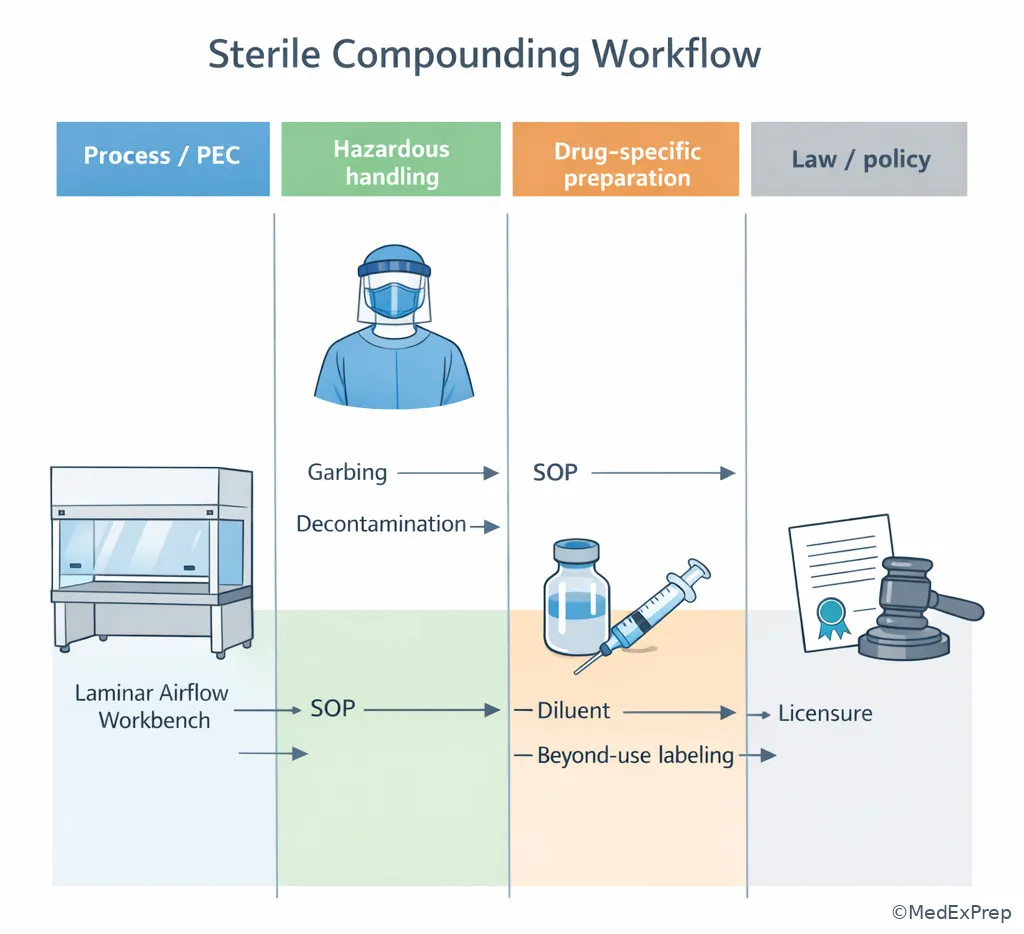
Workflow trigger map for source recognition
Concept flow: Scenario triage before action
Exam takeaway: Classify the risk source before deciding whether to continue, hold, or escalate.
Spot the trigger
What exact issue is being tested in the stem?

Match source to issue
Use process, hazardous, product, or legal pathway.

Apply local workflow
Confirm SOP and training materials align with the governing source.

Protect product and people
If discrepancy affects safety, stop processing and investigate.

Memory anchor: Use “P-H-P-L” for source triggers: P\(rocess = USP process standard\), H\(azardous = hazardous standard\), P\(roduct-specific = labeling/drug info\), L\(egal = law/board rule\).
High-Yield Connection: This concept overlaps with Hazardous Drug Classification and Cleaning And Disinfection Sequence. On exam day, know whether the question is asking for which standard applies or how to execute the procedure once the standard is chosen.
Pharmacist Action: NOTICE trigger words such as PPE, spill, diluent, PEC, labeling, licensure, or SOP conflict. SAY “This looks like a source-selection issue, so I will identify the governing standard before acting.” MONITOR recurring scenario types that commonly generate source confusion in your department. HOLD/CLARIFY/ESCALATE whenever staff rely on habit, vendor instruction, or informal survey recollection instead of an authoritative source.

B. Worked example

A batch of norepinephrine 4 mg in 250 mL D5W for ICU use is being prepared during a staffing shortage. A technician asks whether a face shield is required for a step involving a nonhazardous sterile preparation. Another staff member references the hazardous drug spill kit checklist because “it has all the PPE rules.” The patient linked to the first bag is a 72-year-old with septic shock, atrial fibrillation, and chronic anemia; a distracting chart note documents a penicillin allergy. The pharmacist must choose the most appropriate source category to answer the PPE question.

Identify task: PPE question in nonhazardous sterile compounding. Extract key facts: nonhazardous, sterile process, not spill response, not hazardous drug handling. Apply rule: use the source governing sterile compounding garbing and aseptic process expectations, not the hazardous drug checklist. Eliminate distractors: the spill kit checklist is attractive because it mentions PPE; the patient allergy is irrelevant; ICU urgency does not remove the need to use the right standard. Verify safest compliant action: answer the PPE question using the nonhazardous sterile compounding source and applicable local garbing policy.

C. Exam trap

Common wrong answer: “Any PPE-related question should be answered from the hazardous drug standard.” WHY IT IS TEMPTING: hazardous drug standards contain detailed PPE language and are memorable. The SINGLE CLUE that eliminates it: the product in the stem is nonhazardous, so the governing question is sterile compounding garbing/process rather than hazardous containment.

D. Checkpoint

Question: A pharmacist must clarify whether a technician’s decontamination step after compounding cyclophosphamide 1 g IV is sufficient. Which source category is most directly applicable first?

  1. USP hazardous drug handling standard
  2. Manufacturer insert for cyclophosphamide alone
  3. Accreditation environment-of-care chapter
  4. Nursing infusion administration manual

Answer: A

  • A is tempting and right because the issue is hazardous drug handling, decontamination, and exposure control.
  • B is tempting but wrong because manufacturer information may help with reconstitution but does not primarily govern hazardous area decontamination workflow.
  • C is tempting but wrong because accreditation language is broader and less direct than the hazardous compounding standard for this task.
  • D is tempting but wrong because administration manuals do not govern hazardous compounding cleanup steps.
If you missed this: Review 1.1.1.3 Applied source recognition in common sterile compounding scenarios — focus on using trigger words in the stem to identify the correct source category.

1.1.1.4 Handling ambiguity, apparent conflict, and missing information

A. Explanation

The final foundational skill is what to do when the source answer is not immediately clean. This is the bridge to pharmacist judgment. Board-style questions often present outdated internal documents, partial facts, ambiguous references, or competing expectations. The tested conflict is not “Can you quote a rule?” but “What is the safest compliant response while authority is uncertain?” The single resolving rule is conservative: if uncertainty could affect sterility, product quality, containment, worker safety, or patient safety, do not continue on assumption alone. Hold the affected process or product as appropriate, verify facts against the governing source, document the issue, and escalate through the proper pathway.

Important nuance: “escalate” does not mean abandon judgment. The pharmacist is expected to recognize the risk, stop unsafe continuation, and involve the right operational owner—quality leader, designated supervisor, infection prevention, occupational safety, or prescriber when order clarification is needed. You are not expected to redesign HVAC systems or certify engineering controls; those are out of role. But you are absolutely expected to identify when uncertified, unclear, or conflicting conditions make continued compounding unsafe.

See Fig 5 for a practical conflict pathway. This same stop-verify-escalate approach will recur across future topics such as environmental monitoring excursions, documentation defects, and beyond-use dating uncertainty.

Fig 5. Conflict-resolution path when sources or facts are unclear
Exam takeaway: If unresolved uncertainty affects sterility, quality, or safety, stop the process, verify the source, document, and escalate.
flowchart TD
A[Potential conflict or missing fact] --> B{Could safety, sterility, or containment be affected?}
B -->|Yes| C[Hold product or stop processing]
B -->|No immediate risk| D[Verify source before proceeding]
C --> E[Check governing source and current policy]
D --> E
E --> F[Document discrepancy]
F --> G[Escalate to quality or responsible leader]
G --> H[Resume only when clarified and compliant]
Conflict response workflow in a sterile compounding pharmacy
Exam takeaway: When documents conflict, the pharmacist protects the patient first by holding risky work and tracing authority.
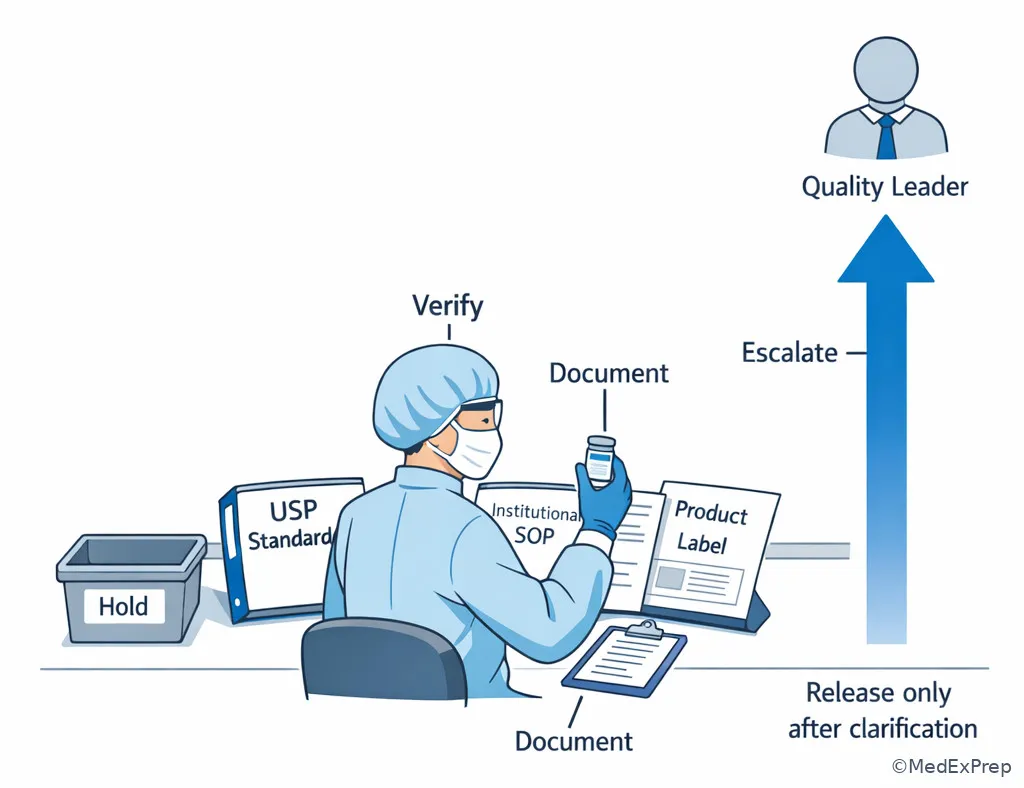
Conflict response workflow in a sterile compounding pharmacy
Concept flow: Stop-versus-proceed under uncertainty
Exam takeaway: The correct board answer usually favors patient and product protection over convenience when facts are incomplete.
Recognize the gap
Outdated SOP, conflicting source, missing certification fact, or unclear product instruction.

Risk decision
If sterility, quality, or containment may be affected, do not proceed on assumption.

Verify authority
Consult the governing source and current institutional policy.

Escalate and document
Create traceability before release or restart.

Key rule: “I’m not sure” is not a reason to continue. In sterile compounding questions, uncertainty that could affect product quality or safety is itself a trigger for hold/clarify/escalate.
Pharmacist Action: NOTICE outdated dates, conflicting documents, uncertified conditions, or missing product facts. SAY “We need to pause and verify the governing source before release.” MONITOR discrepancy logs, policy revision cycles, and repeat source-conflict patterns. HOLD/CLARIFY/ESCALATE immediately when continuation could compromise sterility, containment, or product integrity.

B. Worked example

A pharmacist reviewing a batch worksheet for cefepime 2 g in 100 mL NS IV every 8 hours notices that the institutional SOP revision date is older than the current compendial reference kept in the department binder. The batch is intended for a 64-year-old patient with neutropenia, hypertension, and type 2 diabetes. A distracting note indicates the patient prefers evening infusions earlier in the night. A technician says the batch should go out now because “we passed inspection with this SOP.” The question asks for the safest compliant response.

Identify task: source discrepancy affecting sterile compounding procedure. Extract key facts: local SOP may be outdated relative to current governing reference; product release is pending. Apply rule: do not rely on an outdated local procedure when a current governing source may require different practice; verify and hold if the discrepancy could matter. Eliminate distractors: inspection history is not proof of current compliance; patient scheduling preference is irrelevant; there is no basis to improvise a middle-ground procedure without verification. Verify safest compliant action: quarantine or pause affected workflow as appropriate, compare current standards and SOP requirements, document the discrepancy, and escalate for quality review before release.

C. Exam trap

Common wrong answer: “Proceed because the pharmacy has used this SOP successfully before.” WHY IT IS TEMPTING: prior routine use feels reassuring and reduces workflow disruption. The SINGLE CLUE that eliminates it: the SOP appears older than the current governing reference, so prior use does not prove current compliance.

D. Checkpoint

Question: A sterile compounding pharmacist finds that an internal worksheet for a hazardous CSP conflicts with the current departmental hazardous drug policy, and the discrepancy could change cleaning steps after compounding. What is the best initial action?

  1. Continue using the worksheet because it was approved when created
  2. Choose the faster method to avoid delaying therapy
  3. Hold the affected workflow, verify the governing source and current policy, then escalate
  4. Ask the prescriber which cleaning method is preferred

Answer: C

  • A is tempting but wrong because historical approval does not override a current conflict that may affect safety.
  • B is tempting but wrong because speed is never the deciding factor when source ambiguity could affect hazardous cleaning compliance.
  • C is tempting and right because it protects safety, establishes authority, and follows pharmacist-level escalation responsibilities.
  • D is tempting but wrong because the prescriber does not govern sterile compounding cleaning procedures.
If you missed this: Review 1.1.1.4 Handling ambiguity, apparent conflict, and missing information — focus on hold/verify/escalate when unresolved uncertainty could affect safety or quality.
Quick Recall:

  • True or False: Prior successful use of a workflow proves current compliance. False.
  • The safest first action when a source conflict could affect sterility is hold or stop the affected process.
  • Name the 3 immediate moves after a meaningful source conflict is identified: verify, document, escalate.

1.1.1.5 Integration: building a practical pharmacist source-check routine

A. Explanation

For exam performance, you need a repeatable routine that works under pressure. The best routine is: identify the task → identify the governing source category → check for stricter overlays → decide whether risk requires hold → document and escalate when needed. This routine keeps you inside pharmacist scope and prevents common reasoning errors. It also protects against the exam’s favorite distractor pattern: a locally convenient answer that sounds practical but bypasses source verification.

This section is integrative because it combines source recognition with action discipline. A pharmacist does not need to memorize every line from every authority to answer many exam questions. Instead, the pharmacist must know which source to consult first, when a product can proceed, and when uncertainty itself requires interruption. See Fig 6. In the next two topics, this framework will extend to role boundaries and formal conflict resolution.

Fig 6. Pharmacist verification routine for source-based decisions
Exam takeaway: A consistent source-check routine improves both compliance and exam accuracy when answer choices are all plausible.
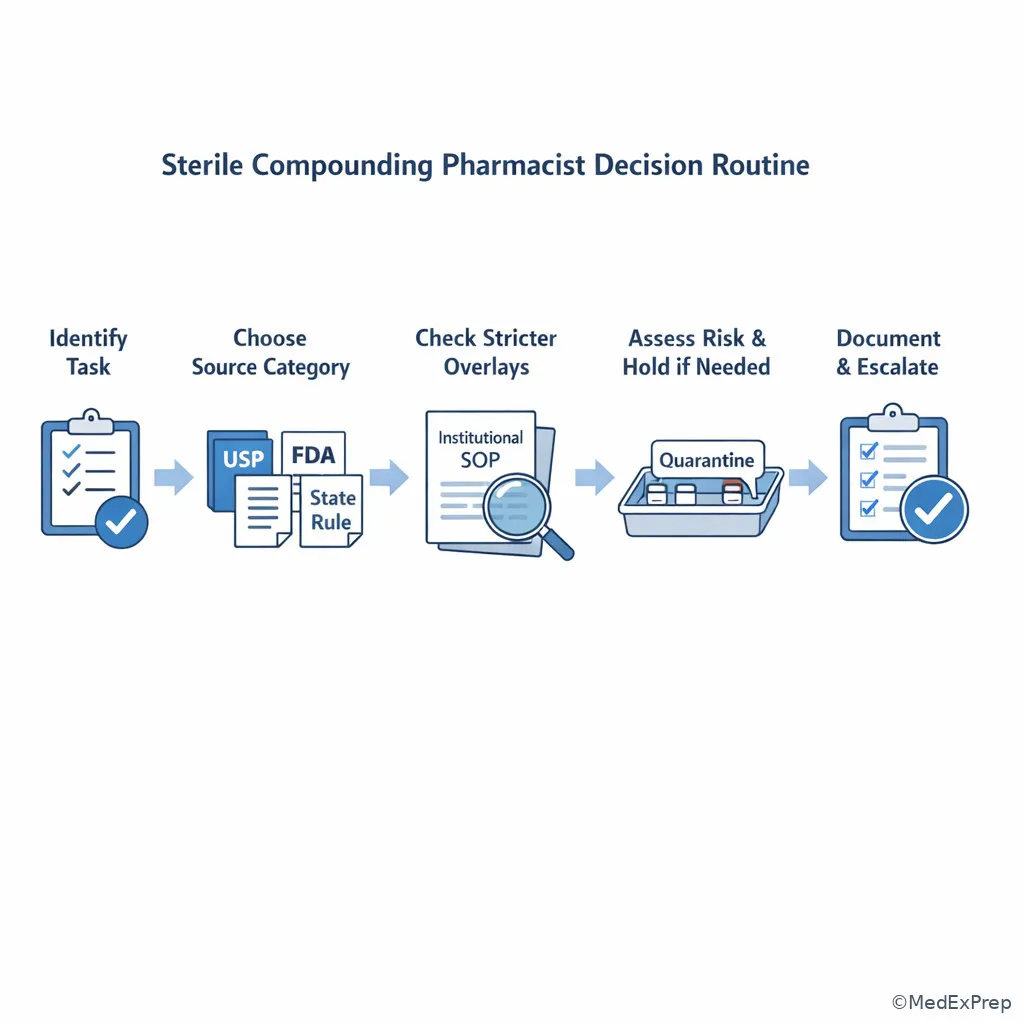
Fig 6. Pharmacist verification routine for source-based decisions
Compounding source dashboard with decision checkpoints
Exam takeaway: Organizing source checkpoints visually helps separate process standards from product instructions and local implementation documents.
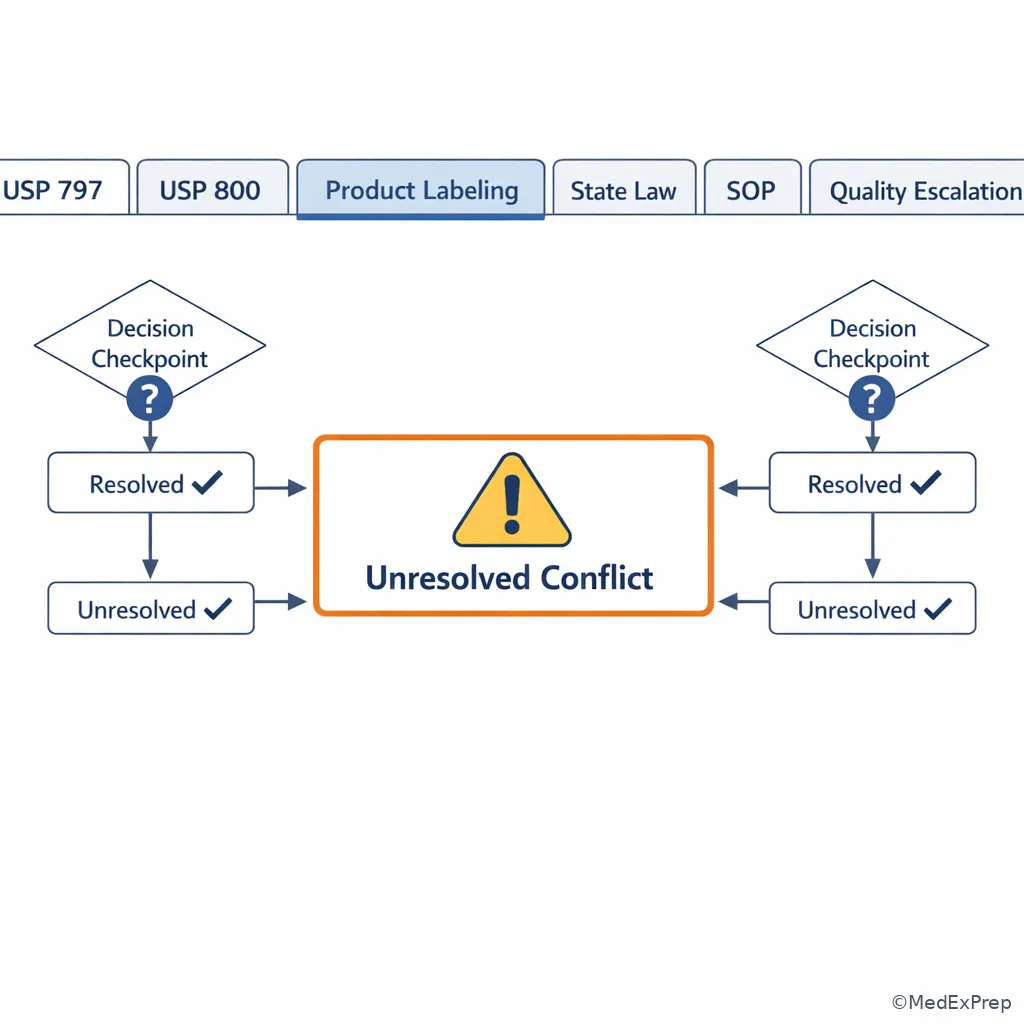
Compounding source dashboard with decision checkpoints
Concept flow: Repeatable source-check routine
Exam takeaway: Use the same disciplined sequence on every stem to avoid being distracted by operational noise.
Identify the task
Ask what decision the pharmacist is actually being tested on.

Choose the source
Match process, hazardous, product-specific, or legal/policy issue.

Check overlays
Apply stricter law or institutional policy if valid and current.

Protect first
If unresolved risk remains, hold and escalate.

Document outcome
Create traceability for any deviation, clarification, or release decision.

Recall: In the upcoming topic Standards Conflict Resolution, we will move beyond identifying the source to prioritizing among multiple valid sources. This section gives you the stepwise routine that makes those later decisions manageable.
Pharmacist Action: NOTICE whether the stem includes an outdated SOP, a survey comment, a technician habit, or a vendor statement. SAY “I will use the governing source and then confirm current local implementation.” MONITOR source update cycles, SOP review intervals, and repeated areas of confusion in staff questions. HOLD/CLARIFY/ESCALATE if any unresolved discrepancy could alter sterile process quality, hazardous containment, or product release.

B. Worked example

A pharmacist covering evening operations is asked to release an epidural infusion bag prepared earlier: fentanyl 2 mcg/mL with bupivacaine 0.125% in 250 mL NS, route epidural, continuous infusion. The patient is 41 years old with obesity and sleep apnea; a distracting note says the patient is anxious about needles. The bag label appears complete, but the preparation record references an institutional worksheet that lacks a recent revision date. A senior technician reports that the formula and label format are “what we’ve always used.” The question asks for the best pharmacist response before release.

Identify task: product release decision with documentation/source validity concern. Extract key facts: unclear document currency; release depends on confidence that current source-based requirements were met. Apply rule: release should not rely only on tradition; verify the current governing procedure and documentation basis. Eliminate distractors: patient anxiety is irrelevant; technician experience does not establish current compliance; a superficially complete label does not resolve whether the workflow was governed by a current approved process. Verify safest compliant action: hold release pending verification of the current source-backed worksheet/SOP, document the discrepancy, and escalate if needed.

C. Exam trap

Common wrong answer: “Release the preparation because the label is complete and the product was already made.” WHY IT IS TEMPTING: the visible output looks finished and usable. The SINGLE CLUE that eliminates it: the supporting compounding documentation may not be current or valid, so release integrity has not been fully verified.

D. Checkpoint

Question: Which sequence best reflects a pharmacist’s repeatable source-check routine on BCSCP-style questions?

  1. Read the answer choices first, choose the strictest-sounding one, then document if needed
  2. Identify the task, choose the governing source, check stricter overlays, assess risk, then hold/escalate if unresolved
  3. Ask the technician how the task is usually done, then compare with accreditation comments
  4. Use product labeling for all compounding decisions, then consult policy only if a survey is pending

Answer: B

  • A is tempting but wrong because “strictest-sounding” is not a substitute for identifying the governing source.
  • B is tempting and right because it reflects the disciplined order needed for safe source-based decision making.
  • C is tempting but wrong because habit and survey recollection are not primary decision authorities.
  • D is tempting but wrong because product labeling does not govern all sterile compounding process questions.
If you missed this: Review 1.1.1.5 Integration: building a practical pharmacist source-check routine — focus on task first, source second, overlays third, risk action fourth.

Exam Traps & Differentiators

Most common wrong answer and why: choosing the most familiar authority instead of the most directly applicable one. FDA, accreditation, local policy, and senior staff habits all sound authoritative. The exam rewards choosing the source that actually governs the task in the stem.

Looks similar But isn't the best answer because Think instead
FDA labeling It gives drug-specific instructions, not the full sterile compounding process standard Use it for product-specific preparation details
Accreditation language It evaluates systems but is often less direct than USP for compounding procedure questions Use USP for process questions first
Institutional SOP It may be outdated or incomplete if not aligned with current authority Confirm it is current and supported by higher authority
Vendor training Operationally helpful but not itself the governing authority Verify against official standards and local policy
Technician habit Experience does not establish compliance Follow source-based workflow, not custom
  • If the stem says garbing, PEC, first air, compounding area workflow, release checks think USP sterile compounding standard.
  • If the stem says hazardous drug, containment, PPE, decontamination, spill, waste think hazardous drug handling standard.
  • If the stem says reconstitute with, dilute in, protect from light, use filter, concentration limit think product-specific labeling or authoritative drug information.
  • If the stem says license, permit, legal authority, jurisdiction requirement think state law and board rules.
  • If the stem says policy conflict, outdated SOP, uncertain applicability think hold/verify/document/escalate.
Common traps & distractors:

  • “The accreditor accepted it.” Tempting because it sounds validated. Eliminating clue: accreditation recollection does not replace the governing compendial source.
  • “We always do it this way.” Tempting because habit suggests reliability. Eliminating clue: routine use does not prove current compliance.
  • “The package insert says how to mix it, so that answers the whole question.” Tempting because product instructions are authoritative. Eliminating clue: the stem may really be about process governance rather than the drug’s reconstitution details.
  • “The local SOP is enough.” Tempting because policy drives daily workflow. Eliminating clue: if the SOP appears outdated or conflicts with higher authority, it cannot be accepted without verification.
Related trap from neighboring topics: In Sterile Compounding Scope, a frequent confusable pair is knowing the right answer versus acting outside pharmacist authority. Here, the related trap is choosing a source correctly but then selecting an out-of-scope action such as certifying engineering systems yourself.
Review connection: The traps above test source selection and conservative pharmacist judgment. If any felt unfamiliar, revisit 1.1.1.1 Foundational source hierarchy and 1.1.1.4 Handling ambiguity, apparent conflict, and missing information before attempting the Self-check quiz.

Tables

Source Best use in exam stems Common trap
USP <797> Nonhazardous sterile compounding process, environment, aseptic workflow, release-related practice standards Ignoring it in favor of local habit or accreditation commentary
USP <800> Hazardous drug handling, containment, PPE, decontamination, waste, exposure control Applying it to every PPE question, even when the product is nonhazardous
FDA labeling / authoritative drug info Diluent, reconstitution, concentration, storage, light protection, filter, product-specific instructions Using it as the only source for process workflow questions
State law / board rules Licensure, legal requirements, jurisdiction-specific rules, facility authority Forgetting that legal overlays may be stricter than baseline standards
Institutional policy / SOP Local implementation, forms, training, documentation steps, escalation chain Assuming it is always current and valid without checking authority
Accreditation standards System quality expectations and organizational oversight context Treating accreditation language as the most direct source for technical compounding details
Question asks about Choose first Then consider
PEC workflow for cefazolin IV admixture USP <797> Current SOP and any stricter law/policy
Cyclophosphamide decontamination steps USP <800> Current hazardous compounding SOP
Whether a lyophilized vial must use SWFI or NS FDA labeling / authoritative drug info Compounding workflow controls and local worksheet accuracy
Whether the pharmacy may perform a regulated activity in a jurisdiction State law / board rules Institutional licensing and policy process
Internal release procedure when worksheet is outdated Current governing source + institutional policy Quality escalation and documentation
Differential source problem Discriminator Best response
Process standard vs product labeling Is the stem about how compounding is performed or how this drug is prepared? Choose USP for process; choose labeling/drug info for product specifics
USP vs local SOP Is the SOP current and aligned with higher authority? If uncertain, verify before relying on SOP
Hazardous standard vs nonhazardous garbing rule Is the preparation hazardous? Use hazardous standard only when the task involves hazardous handling
Accreditation note vs governing standard Does the note directly answer the technical sterile compounding requirement? Usually no; go back to the direct governing source
Old worksheet vs current reference Could the discrepancy affect sterility, containment, or release? Hold, verify, document, escalate
Authority type Strength on exam Typical wrong use
Compendial Strong for sterile practice standards Ignored when a local shortcut seems convenient
Regulatory/legal Strong for jurisdiction and legal operation questions Overapplied to technical product-specific details
Product-specific Strong for reconstitution and storage details Overapplied to all workflow questions
Institutional Strong for implementation if current and valid Assumed correct even when outdated
Informal/custom Weak Treated as if it were an official source

Algorithm / Approach

Concept flow: Five-step approach to source-based sterile compounding decisions
Identify the decision
Define whether the stem is asking about process, hazardous handling, product-specific instruction, or legal authority.

Choose the primary source
USP process standard, hazardous standard, product labeling/drug info, or state law/board rule.

Check overlays
Apply stricter current state requirements and institutional policy if they validly fit.

Assess risk
If unresolved uncertainty could affect sterility, product quality, containment, or patient safety, hold or stop.

Document and escalate
Create traceability, notify the proper responsible party, and resume only after clarification.

Rapid Review

  • USP <797> → first stop for nonhazardous sterile process questions, not drug-specific diluent questions.
  • USP <800> → think hazardous handling, containment, PPE, decontamination, waste.
  • FDA/product labeling → best for reconstitution, dilution, filter, storage, light-protection details.
  • State law → legal authority and jurisdiction questions, not first-line for routine product-specific mixing instructions.
  • Institutional SOP → implementer, not independent higher authority.
  • Accreditation note → system-level clue, not usually the primary technical compounding source.
  • Habit/tradition → never enough when the stem asks what governs.
  • Outdated document → treat as a risk signal, not a convenience signal.
  • Unclear authority → hold/verify/escalate beats guess-and-proceed.
  • PPE question → first decide hazardous versus nonhazardous before selecting the source.
  • Label complete but source uncertain → do not release until source validity is confirmed.
  • Survey memory → weak compared with current governing standard text.
Memory anchor: “Task before text.” Before reading answer choices, classify the task: process, hazardous, product, or legal. That single habit removes many close-call distractors.

Self-check quiz

1. A pharmacist is reviewing workflow for ceftriaxone 1 g in 50 mL NS IV every 24 hours prepared as a nonhazardous CSP. A technician asks which source most directly governs the sterile compounding process near the PEC. Which is the most appropriate source?

  1. USP <797>
  2. USP <800>
  3. FDA package insert only
  4. Accreditation survey summary

2. A pharmacist must confirm whether a vial of meropenem 1 g should be reconstituted with a specific diluent before preparing an IV bag for a 70-year-old patient with CKD and COPD. Which source is the best first reference for that drug-specific question?

  1. Current institutional holiday staffing plan
  2. FDA-approved product labeling or authoritative drug information
  3. General garbing SOP
  4. Accreditation environment-of-care chapter

3. A pharmacist reviews an order for cyclophosphamide 750 mg IV once, to be compounded in the hazardous area. The technician asks which source should be checked first for decontamination steps after completion. The patient is 55 years old with breast cancer, diabetes, and hypertension; a distracting note mentions a prior contrast reaction. Which is the most appropriate next step?

  1. Use USP <800> as the primary source, then follow current local hazardous SOP
  2. Use USP <797> only because all sterile compounding starts there
  3. Use the manufacturer insert only because the drug is product-specific
  4. Ask the prescriber which cleaning sequence is preferred

4. A pharmacist is about to release norepinephrine 4 mg in 250 mL D5W IV continuous infusion for a 68-year-old patient with septic shock, atrial fibrillation, and CKD. The label is complete, but the worksheet used for compounding lacks a current revision date and may not match the latest source. A distracting lab shows low albumin. What is the safest compliant response?

  1. Release the bag because the label is complete and the drug is urgently needed
  2. Hold release, verify the current governing source and worksheet validity, then document and escalate if needed
  3. Discard immediately without verifying because any date gap proves contamination
  4. Ask nursing whether they have used this worksheet format before

5. A pharmacist must clarify whether liposomal amphotericin B 50 mg IV should be diluted in D5W or NS for a 62-year-old patient with AML, diabetes, and a central line infection history. A colleague points to a local chart; another mentions that “surveyors liked our documentation.” Which option is the best first source category for immediate clarification?

  1. Accreditation comments because they reflect external review
  2. Manufacturer labeling or authoritative drug information because the question is product-specific
  3. USP <800> because amphotericin is a high-risk IV medication
  4. Nursing administration handbook because it describes infusion handling

6. During evening shift, a pharmacist overseeing piperacillin/tazobactam 3.375 g in 100 mL NS IV every 6 hours learns that the unit-specific “cleanroom shortcut” allows staging supplies closer to the PEC than the current department compounding manual appears to allow. The patient is 73 years old with CKD, CHF, and delirium; a distracting note reports a remote latex sensitivity. Which action best reflects pharmacist-level source judgment?

  1. Continue using the shortcut because local workflow documents are always controlling
  2. Use the shortcut for urgent doses only, then review later
  3. Pause use of the shortcut, verify the governing sterile compounding source and current policy alignment, then escalate if inconsistent
  4. Call the accrediting body for immediate permission to proceed

7. A pharmacist is asked whether a technician can continue compounding a hazardous CSP after noticing that the posted cleaning sequence in the room conflicts with the newly issued hazardous drug SOP. The preparation is fluorouracil 4,000 mg in an ambulatory pump, and the patient is 49 years old with colon cancer, obesity, and poorly controlled nausea. A distracting issue is that the courier pickup is in 20 minutes. What is the best initial action?

  1. Continue using the posted sequence because posted signs are operationally approved
  2. Use the newer SOP without documenting the discrepancy so the dose is not delayed
  3. Stop the affected workflow, verify the governing hazardous source, document the conflict, and escalate per policy
  4. Ask the oncologist whether either cleaning sequence is acceptable

8. A pharmacist must decide which source to prioritize for a question about whether a lyophilized nonhazardous antibiotic requires a specific diluent and concentration limit before compounding. The local SOP is current, but it summarizes only workflow steps and does not list drug-specific instructions. The patient is 80 years old with ESRD and COPD; a distracting note mentions a family request for earlier discharge. Which option is the most appropriate first source?

  1. USP <797> only, because all sterile compounding details are contained there
  2. Manufacturer labeling or authoritative drug information, then apply institutional workflow controls
  3. Accreditation standards because they are external and broad
  4. State board rule first, because any preparation question is primarily jurisdictional

Answer key

1. Correct answer: A — USP <797>

  • A: Tempting because it is the core sterile compounding standard for nonhazardous process questions; correct because the stem is about workflow near the PEC for a nonhazardous CSP. The discriminating clue is “nonhazardous CSP” and “process near the PEC”. Source: USP General Chapter <797>.
  • B: Tempting because it is also a famous sterile compounding chapter; incorrect because USP <800> governs hazardous drug handling, not routine nonhazardous process workflow. The discriminating clue is absence of hazardous drug handling. Source: USP General Chapter <800>.
  • C: Tempting because package inserts are authoritative for drug details; incorrect because the question is about compounding process governance, not ceftriaxone-specific reconstitution. The discriminating clue is workflow question rather than product instruction. Source: FDA labeling plus USP <797> framework.
  • D: Tempting because surveys influence practice; incorrect because survey summaries are not the most direct technical source for PEC workflow. The discriminating clue is need for a direct governing practice standard. Source: USP <797> and accreditation framework distinctions.
If you missed this: Review 1.1.1.1 Foundational source hierarchy for sterile compounding decisions — focus on USP <797> as the primary source for nonhazardous sterile process questions.

2. Correct answer: B — FDA-approved product labeling or authoritative drug information

  • A: Tempting because operational plans are part of local workflow; incorrect because staffing plans do not answer drug-specific reconstitution questions. The discriminating clue is specific diluent question. Source: FDA labeling and drug information references.
  • B: Tempting because it directly addresses product-specific preparation; correct because reconstitution diluent is a product instruction. The discriminating clue is “should be reconstituted with a specific diluent”. Source: FDA label, AHFS, Lexicomp, Clinical Pharmacology.
  • C: Tempting because garbing SOPs matter in sterile compounding; incorrect because they do not determine meropenem’s reconstitution diluent. The discriminating clue is drug-specific rather than process-garbing issue. Source: institutional SOP role distinction.
  • D: Tempting because accreditation chapters are broad and official; incorrect because they are not the best first source for a product-specific reconstitution instruction. The discriminating clue is preparation detail tied to a specific vial. Source: accreditation versus product source distinctions.
If you missed this: Review 1.1.1.2 What each major source contributes — focus on using product-specific sources for reconstitution and diluent decisions.

3. Correct answer: A — Use USP <800> as the primary source, then follow current local hazardous SOP

  • A: Tempting because it names both the governing hazardous standard and local implementation; correct because decontamination after hazardous compounding is a hazardous drug handling question. The discriminating clue is cyclophosphamide in the hazardous area with decontamination steps. Source: USP <800> and local SOP implementation.
  • B: Tempting because all CSPs involve sterile compounding; incorrect because the specific issue is hazardous decontamination, making USP <800> more directly applicable. The discriminating clue is hazardous handling rather than general sterile workflow. Source: USP <800>.
  • C: Tempting because product inserts can be authoritative; incorrect because manufacturer information does not primarily govern area decontamination steps. The discriminating clue is post-compounding cleaning workflow. Source: USP <800>.
  • D: Tempting because prescribers are involved in patient therapy; incorrect because prescribers do not set hazardous cleaning protocol. The discriminating clue is operational compounding process within pharmacist scope. Source: pharmacist role and USP hazardous workflow standards.
If you missed this: Review 1.1.1.3 Applied source recognition in common sterile compounding scenarios — focus on hazardous trigger words pointing to USP <800>.

4. Correct answer: B — Hold release, verify the current governing source and worksheet validity, then document and escalate if needed

  • A: Tempting because urgency and a complete label make release feel reasonable; incorrect because worksheet validity may affect whether the product was prepared under a current compliant process. The discriminating clue is worksheet may not match the latest source. Source: USP quality/documentation principles and institutional quality management.
  • B: Tempting because it is conservative; correct because unresolved source-document discrepancy affecting release should trigger hold, verification, documentation, and escalation. The discriminating clue is uncertain current source alignment before release. Source: USP practice framework and quality systems principles.
  • C: Tempting because it seems safety-first; incorrect because lack of revision date does not automatically prove contamination or require discard before verification. The discriminating clue is documentation uncertainty, not confirmed product compromise. Source: deviation investigation and quality management principles.
  • D: Tempting because nurses may know the product’s routine use; incorrect because nursing familiarity does not verify source authority or worksheet currency. The discriminating clue is need for authoritative source verification. Source: pharmacist verification role.
If you missed this: Review 1.1.1.4 Handling ambiguity, apparent conflict, and missing information — focus on holding release when unresolved documentation/source issues could matter.

5. Correct answer: B — Manufacturer labeling or authoritative drug information because the question is product-specific

  • A: Tempting because external review sounds strong; incorrect because accreditation comments do not directly answer amphotericin’s required diluent. The discriminating clue is product-specific diluent question. Source: product labeling hierarchy for drug-specific details.
  • B: Tempting because it directly matches the question; correct because D5W versus NS is a drug-specific preparation issue. The discriminating clue is diluent selection for one drug product. Source: FDA labeling, AHFS, Lexicomp, Clinical Pharmacology.
  • C: Tempting because amphotericin is clinically high risk; incorrect because hazard level in a clinical sense does not make USP <800> the right source unless the drug is being handled as a hazardous drug under that framework. The discriminating clue is product-specific diluent, not hazardous containment workflow. Source: USP source function distinctions.
  • D: Tempting because nursing handbooks discuss infusion administration; incorrect because they are not the best first authority for compounding preparation instructions. The discriminating clue is preparation clarification before compounding. Source: product-specific authoritative references.
If you missed this: Review 1.1.1.2 What each major source contributes — focus on drug-specific source selection for diluent and concentration questions.

6. Correct answer: C — Pause use of the shortcut, verify the governing sterile compounding source and current policy alignment, then escalate if inconsistent

  • A: Tempting because local documents usually direct daily work; incorrect because they are not automatically controlling if they conflict with the current governing sterile compounding source. The discriminating clue is apparent inconsistency with the current department compounding manual. Source: USP <797> and policy-alignment principles.
  • B: Tempting because urgency invites a temporary workaround; incorrect because urgency does not justify using an unverified shortcut that may affect sterile workflow integrity. The discriminating clue is workflow may contradict the governing source. Source: USP <797> conservative safety approach.
  • C: Tempting because it may delay work; correct because this is the proper pharmacist response to a possible source conflict affecting sterile process. The discriminating clue is shortcut versus current manual discrepancy near the PEC. Source: USP <797> and quality escalation expectations.
  • D: Tempting because accrediting organizations matter; incorrect because calling the accreditor for operational permission is outside the expected immediate pharmacist response. The discriminating clue is need for internal verification and escalation first. Source: institutional quality pathways and pharmacist role boundaries.
If you missed this: Review 1.1.1.1 Foundational source hierarchy and 1.1.1.4 Handling ambiguity — focus on not letting local convenience outrank current governing authority.

7. Correct answer: C — Stop the affected workflow, verify the governing hazardous source, document the conflict, and escalate per policy

  • A: Tempting because posted signs feel official and operational; incorrect because a visible sign does not resolve conflict with a newer hazardous SOP. The discriminating clue is posted sequence conflicts with newly issued SOP. Source: USP <800> and policy currency principles.
  • B: Tempting because it uses the newer document and avoids delay; incorrect because silently switching without documenting the discrepancy fails quality traceability and conflict resolution expectations. The discriminating clue is documented conflict requiring formal response. Source: quality management and hazardous compounding policy principles.
  • C: Tempting because it is conservative; correct because hazardous workflow conflict with safety implications requires stop, verify, document, and escalate. The discriminating clue is hazardous CSP plus conflicting cleaning instructions. Source: USP <800> and institutional escalation practice.
  • D: Tempting because oncologists own cancer therapy decisions; incorrect because cleaning-sequence governance is not a prescriber decision. The discriminating clue is operational hazardous handling issue rather than therapeutic choice. Source: pharmacist scope and hazardous workflow standards.
If you missed this: Review 1.1.1.4 Handling ambiguity, apparent conflict, and missing information — focus on documentation plus escalation when hazardous source conflicts are identified.

8. Correct answer: B — Manufacturer labeling or authoritative drug information, then apply institutional workflow controls

  • A: Tempting because USP <797> is central to sterile compounding; incorrect because it does not contain every drug-specific diluent and concentration instruction. The discriminating clue is specific diluent and concentration limit question. Source: USP <797> role distinction.
  • B: Tempting because it directly matches the missing information; correct because drug-specific instructions should come from authoritative product information, with local workflow controls applied after. The discriminating clue is SOP lacks drug-specific instructions. Source: FDA labeling, AHFS, Lexicomp, Clinical Pharmacology.
  • C: Tempting because external standards feel authoritative; incorrect because accreditation is too broad and indirect for a precise drug-specific preparation question. The discriminating clue is need for exact diluent/concentration instruction. Source: accreditation versus product-reference distinction.
  • D: Tempting because board rules are legally important; incorrect because jurisdictional law is not usually the first source for a specific antibiotic’s diluent and concentration limit. The discriminating clue is technical product preparation rather than legal authority. Source: source function framework.
If you missed this: Review 1.1.1.2 What each major source contributes — focus on using product-specific authoritative references when USP and SOP do not provide the exact drug detail.

References

  • United States Pharmacopeial Convention. USP General Chapter <797> Pharmaceutical Compounding—Sterile Preparations. USP-NF, current revision.
  • United States Pharmacopeial Convention. USP General Chapter <800> Hazardous Drugs—Handling in Healthcare Settings. USP-NF, current revision.
  • U.S. Food and Drug Administration. Approved Drug Products Labeling. FDA, current access.
  • American Society of Health-System Pharmacists. AHFS Drug Information. Current edition.
  • Lexicomp Online. Drug Monographs and Injectable Administration/Preparation Information. Wolters Kluwer, current access.
  • Clinical Pharmacology. Drug Monographs and Product Preparation Data. Elsevier, current access.

Last reviewed: March 15, 2026

Lesson 2

Sterile Compounding Scope

What you will learn

  • DOMAIN: Professional Practice -> Scope Boundaries: Answer BCSCP questions from the sterile compounding pharmacist role rather than from the role of a prescriber, nurse, engineer, regulator, or manufacturer.
  • DOMAIN: Professional Practice -> Scope Boundaries: Distinguish allowed pharmacist actions from out-of-scope actions when a sterile compounding scenario includes patient, facility, documentation, or safety concerns.
  • DOMAIN: Compounded Sterile Preparations -> Compounding Process and Release: Choose hold, quarantine, discard, document, clarify, or escalate when facts are insufficient or safety may be compromised.
  • DOMAIN: Facilities and Environmental Control -> Environmental Response: Prioritize patient protection, personnel protection, sterility assurance, containment, and traceable documentation during operational deviations.
  • DOMAIN: Quality Management -> Safety Culture: Apply a conservative decision sequence that protects patients and personnel before convenience, speed, or production pressure.
Blueprint mapping

BCSCP blueprint: Professional Practice -> regulations, standards, personnel and patient safety; Compounded Sterile Preparations -> process, release, materials, equipment, facilities. Exact subtopic percentage for this topic is not separately provided.

Estimated time

35-50 minutes

Prereqs

USP and Regulatory Sources; basic sterile compounding vocabulary; pharmacist scope of practice principles.

Key outputs

You should be able to choose pharmacist action versus prescriber, nurse, certifier, or regulator action; stop unsafe processing when needed; and escalate with enough documentation to protect sterility, quality, containment, and patient safety.

Why it matters

  • BCSCP stems often test role recognition: the best answer is not always the most technically detailed answer, but the safest action within the sterile compounding pharmacist role.
  • Scope errors create attractive distractors: prescribing without authority, certifying engineering controls, ignoring environmental failure, or continuing production while facts are incomplete.
  • Foundational scope reasoning supports later topics: environmental monitoring, hazardous drug containment, beyond-use dating, product release, recall, and CAPA all begin with knowing who can do what.
  • When local policy or current standards govern the details, exam-safe reasoning favors conservative compliance, documentation, and escalation rather than convenience-based shortcuts.

Key Terms & Must-Know Facts

Term Exam-ready meaning Scope discriminator
Sterile compounding pharmacist Pharmacist responsible for standards-informed verification, process oversight, product-quality decisions, documentation review, and escalation. Acts to protect sterility, product quality, worker safety, and patient safety.
Pharmacist-level decision A decision within pharmacy authority, such as holding a preparation, clarifying an order, reviewing documentation, or initiating investigation. Does not require diagnosing, prescribing without authority, or engineering certification.
Out-of-scope action An action belonging primarily to another professional role, such as diagnosing disease, administering as the nurse, certifying a cleanroom, or issuing regulatory enforcement. Reject answers that change the tested role.
Escalation Contacting the appropriate responsible party when facts, authority, safety, or compliance are insufficient. Escalation is active risk control, not indecision.
Quarantine Segregating a preparation, component, supply, or batch so it is not used while quality or sterility concerns are investigated. Best when potential compromise exists but final disposition is not yet established.
Hold Temporarily stopping release, use, or processing until required verification or clarification is complete. Best initial action when information is incomplete and continued use could harm patients.
Discard Removal from use when sterility, quality, labeling, containment, or acceptability cannot be assured. Appropriate when the defect cannot be corrected or verified safely.
Deviation A departure from approved process, standard, policy, documentation, environmental condition, or expected control. Requires documentation and evaluation; do not normalize it because no harm is yet observed.
Safety culture A practice environment that prioritizes error prevention, hazard communication, transparency, and patient/personnel protection. Production pressure never outranks safety.
Institutional policy Local procedure that operationalizes standards, laws, accreditation requirements, and facility risk decisions. Use when details vary; do not invent universal local rules.

Must-know facts

  • The candidate role is a sterile compounding pharmacist, not a physician, nurse, cleanroom certifier, regulator, or industrial plant operator.
  • The safest compliant response may be to stop processing, hold product, verify facts, document the deviation, and escalate.
  • Pharmacists may interpret standards and policies, evaluate compounding feasibility, verify calculations, review documentation, and recommend corrective action within authority.
  • Pharmacists should not diagnose independently, prescribe without authority, certify engineering controls, or present local preference as a universal rule.
  • If facts are insufficient, continuing routine compounding is usually less defensible than pausing and clarifying.
  • Patient safety and personnel protection are co-equal priorities in sterile compounding scope, especially when hazardous drugs, exposure, contamination, or release decisions are involved.
  • Compendial and institutional requirements may evolve; exam-safe wording emphasizes current standards, local policy, and appropriate escalation.
  • Documentation is not clerical decoration; it is evidence that a safe and reproducible process occurred.
Role boundary visual
Exam takeaway: Separate pharmacist actions from prescriber, nurse, engineer, and regulator actions before choosing an answer.
{"prompt":"Professional educational illustration showing a sterile compounding pharmacist at the center reviewing a sterile preparation record, with four surrounding boundary icons labeled prescriber diagnosis, nurse administration, engineer certification, and regulator enforcement, emphasizing role boundaries in a cleanroom pharmacy context","caption":"Role boundary visual","size":"1024x1024"}

Core content

1. Define the tested role before solving the stem

A. Explanation

Decision conflict: choose the action a sterile compounding pharmacist can take versus an answer that belongs to another profession. BCSCP questions frequently include realistic details about the prescriber, nurse, facility certifier, quality leader, or regulator. Those details are not invitations to leave the pharmacist role. The pharmacist should interpret sterile compounding standards, evaluate the order or process, verify calculations and documentation, and take immediate protective actions such as hold, quarantine, clarification, documentation, or escalation.

WHY THIS IS TESTED: sterile compounding failures can look like clinical, engineering, nursing, regulatory, or manufacturing problems. The exam expects a pharmacist-level response that protects sterility and safety without overstepping authority. See Fig 1.

Fig 1. Role boundary map
Exam takeaway: The correct first move is usually the safest pharmacist action within authority, not the most dramatic action in the room.
graph TD
A[BCSCP stem]-->B{Who is the tested actor?}
B-->C[Sterile compounding pharmacist]
B-->D[Prescriber nurse engineer regulator]
C-->E[Verify order process documentation and safety]
E-->F[Hold clarify quarantine document or escalate]
D-->G[Reject if answer requires another role]
1. Identify the actor named or implied in the stem.
2. Match the answer choice to pharmacist authority.
3. Reject options that diagnose, prescribe without authority, administer, certify, or enforce.
4. Select the action that protects sterility, quality, containment, and patient safety.

B. Worked example

A 67-year-old patient with heart failure and chronic kidney disease has a sterile infusion order in the queue. The pharmacist notices the prescriber entered an unusual concentration, the nurse left a message asking for rapid delivery, and the cleanroom certification report from last month is filed in the department drive. A technician says the concentration is probably fine because the patient received the same medication last admission. The most appropriate next step is not to diagnose the patient's condition, rewrite the prescription independently, or rely on prior admission history. Identify task: determine a pharmacist-level action. Extract key facts: unusual concentration, patient-specific risk, nursing time pressure, irrelevant certification report. Apply rule: verify the order for feasibility and safety and clarify when authority or facts are insufficient. Eliminate distractors: rapid delivery pressure and prior admission history do not replace order verification. Verify: hold compounding and clarify the order with the prescriber while documenting the concern according to policy.

C. Exam trap

Common wrong answer: proceed because the prescriber is responsible for the clinical order. Why it is tempting: the prescriber selected the therapy. Single clue that eliminates it: the pharmacist identified a compounding feasibility or safety concern before preparation or release.

D. Checkpoint MCQ

A sterile compounding pharmacist identifies that a proposed sterile preparation has an unclear final concentration and no documented clarification. Which action best fits the pharmacist role?

  1. Compound the preparation because concentration selection is solely a prescriber responsibility.
  2. Hold preparation and clarify the order before compounding or release.
  3. Administer a test dose to determine whether the concentration is tolerated.
  4. Certify the cleanroom before deciding whether to proceed.

Answer: B. A is tempting because prescribers write orders, but pharmacists must verify compounding feasibility and safety. B is correct because holding and clarifying is within pharmacist scope and protects patients. C is tempting because it addresses patient tolerance, but administration is not the tested pharmacist role. D is tempting because certification sounds safety-oriented, but engineering certification is outside pharmacist scope.

If you missed this: Review 1. Define the tested role before solving the stem - focus on matching the answer to pharmacist authority before solving clinical details.

2. Classify actions as allowed, conditional, or out of scope

A. Explanation

Decision conflict: some actions are always pharmacist-relevant, some are appropriate only through escalation or policy, and some should be rejected because they change the tested role. Allowed actions include interpreting standards, verifying orders, reviewing records, assessing workflow risks, holding or quarantining product, initiating deviation documentation, and consulting appropriate parties. Conditional actions may depend on collaborative authority, local policy, or designated responsibility. Out-of-scope actions include independent diagnosis, unauthorized prescribing, primary nursing administration, engineering certification, and regulatory enforcement.

WHY THIS IS TESTED: scope classification prevents two common exam errors: under-acting when safety is compromised and over-acting beyond authority. See Fig 2.

Fig 2. Allowed versus conditional versus out-of-scope actions
Exam takeaway: Conditional authority requires policy or escalation; out-of-scope actions should not become the answer simply because they sound decisive.
flowchart LR
A[Answer choice]-->B{Within pharmacist authority?}
B--Yes-->C[Allowed: verify hold clarify document quarantine]
B--Depends-->D[Conditional: follow policy collaborative authority designated role]
B--No-->E[Reject: diagnose prescribe administer certify enforce]
D-->F[Escalate and verify facts]
C-->G[Proceed with safest compliant action]
1. Label the action, not just the topic.
2. Ask whether pharmacist authority clearly supports it.
3. If authority depends on policy, choose clarify or escalate.
4. If authority is absent, reject even if the outcome sounds safer.
Action type Examples Best exam response
Allowed Verify formula, review compounding record, hold product, quarantine suspected compromised preparation, document deviation. Choose when it directly protects sterility, quality, containment, or patient safety.
Conditional Therapy adjustment under protocol, local release decision pathway, designated quality investigation role. Follow current compendial, regulatory, and institutional requirements; local policies may vary.
Out of scope Diagnose, prescribe without authority, administer as nurse, certify cleanroom as engineer, issue regulatory citation. Reject unless the stem explicitly grants that role or authority.

B. Worked example

A 54-year-old patient with diabetes and neutropenia is scheduled for an infusion prepared in the pharmacy. During final verification, the pharmacist sees that the compounding log lacks a required lot number, the technician recalls the lot from memory, and the prescriber is in a procedure. The patient's potassium is mildly low, which is not relevant to the missing traceability issue. A tempting choice is to release the product and update the lot later because the patient is neutropenic and needs timely therapy. Identify task: determine release decision within pharmacist scope. Extract key facts: missing traceability element, memory-based reconstruction, time pressure, irrelevant potassium. Apply rule: documentation gaps that affect traceability require resolution before release or use. Eliminate distractors: urgency does not convert incomplete documentation into acceptable documentation. Verify: hold the preparation, resolve the record if verifiable, or follow deviation/disposition policy.

C. Exam trap

Common wrong answer: release now and correct the record later. Why it is tempting: timely treatment feels patient-centered. Single clue that eliminates it: missing lot traceability affects product quality documentation before release.

D. Checkpoint MCQ

Which option is most clearly out of scope for the sterile compounding pharmacist in a BCSCP-style question?

  1. Quarantining a batch after a suspected process deviation.
  2. Reviewing a master formulation record for reproducibility.
  3. Independently diagnosing a bloodstream infection from fever alone.
  4. Escalating a failed environmental control concern to the designated quality or facilities contact.

Answer: C. A is tempting if viewed as a quality leader role, but quarantine is a pharmacist-level protective action. B is central to sterile compounding documentation. C is correct because diagnosing infection is outside pharmacist scope. D is appropriate because escalation is required when technical or safety issues exceed immediate authority.

If you missed this: Review 2. Classify actions as allowed, conditional, or out of scope - focus on separating protective pharmacist action from diagnosis or unauthorized prescribing.
Quick Recall:

  • Fill in: When authority is unclear, the safest initial pharmacist action is to _____, verify facts, document, and escalate.
  • True/false: A technically detailed answer is correct if it protects safety, even when it requires the pharmacist to certify engineering controls. False.
  • One-liner: What is the single clue that often makes urgent release wrong? Unresolved sterility, quality, documentation, or containment uncertainty.

3. Use the stop-hold-escalate sequence when facts or safety are insufficient

A. Explanation

Decision conflict: continue workflow to avoid delay versus stop or hold because a safety or compliance uncertainty exists. In sterile compounding, incomplete facts are not neutral. A missing record, unexplained environmental excursion, garbing breach, questionable component, or possible hazardous exposure can make continued processing unsafe. The pharmacist should stop unsafe processing, hold affected materials or preparations, protect personnel when relevant, verify facts, document the event, and escalate to the appropriate responsible party.

WHY THIS IS TESTED: many exam stems add operational pressure: short staffing, an urgent dose, a busy infusion center, or a supervisor unavailable. Those pressures are noise unless the stem gives a compliant pathway. See Fig 3.

Fig 3. Stop-hold-escalate sequence
Exam takeaway: When facts are insufficient and product or personnel safety may be compromised, routine continuation is rarely the safest answer.
graph TD
A[Uncertainty or deviation detected]-->B{Could sterility quality containment or patient safety be affected?}
B--Yes-->C[Stop affected work]
C-->D[Hold or quarantine affected items]
D-->E[Verify facts and document]
E-->F[Escalate per policy]
B--No-->G[Continue only if policy supports and documentation is complete]
1. Identify whether the uncertainty could affect safety or compliance.
2. Stop only the affected process when possible.
3. Hold or quarantine items at risk.
4. Verify facts before release or disposal.
5. Document and escalate according to policy.
Hold area for suspected compromised sterile preparations
Exam takeaway: Holding or quarantining creates time for verification without allowing questionable product to reach the patient.
{"prompt":"Clean educational illustration of a hospital pharmacy quarantine shelf for compounded sterile preparations, with red hold tags, a pharmacist reviewing a deviation form, and separate bins for released, hold, and discard status, no real brand names","caption":"Hold area for suspected compromised sterile preparations","size":"1024x1024"}

B. Worked example

A 72-year-old patient with COPD and atrial fibrillation is waiting for a sterile infusion. The cleanroom is short-staffed, a technician reports a glove tear during manipulation, and the preparation is already labeled. A nearby refrigerator temperature log is normal, which is distracting but unrelated to the glove breach. Another pharmacist says the dose is urgent and the tear happened near the end. Identify task: respond to a possible aseptic breach. Extract key facts: glove tear during manipulation, labeled product, urgent dose, irrelevant refrigerator log. Apply rule: possible contamination of critical manipulation requires stopping affected workflow and evaluating product disposition. Eliminate distractors: urgency and normal refrigerator logs do not restore sterility assurance. Verify: hold or discard affected preparation per policy, document deviation, and coordinate replacement if needed.

C. Exam trap

Common wrong answer: finish and release because the breach occurred near the end. Why it is tempting: the product appears complete and urgent. Single clue that eliminates it: a glove tear during manipulation can compromise critical-site protection.

D. Checkpoint MCQ

During compounding, a pharmacist learns that an aseptic manipulation may have occurred after a glove tear. The preparation is needed urgently. What is the safest compliant response?

  1. Release the preparation because the label is complete.
  2. Release the preparation after adding an auxiliary warning label.
  3. Hold or discard the affected preparation according to policy, document the deviation, and arrange a compliant replacement.
  4. Ask the nurse to inspect the bag at bedside for particulate matter.

Answer: C. A is tempting because completed labeling feels like completion, but labeling does not prove sterility. B is tempting because warnings seem transparent, but a warning label cannot correct a sterility concern. C is correct because the pharmacist must protect sterility and document the deviation. D is tempting because bedside inspection is a safety step, but it cannot rule out microbial contamination or replace compounding deviation response.

If you missed this: Review 3. Use the stop-hold-escalate sequence when facts or safety are insufficient - focus on treating possible sterility compromise as a release barrier.

4. Protect both patients and personnel, especially when hazardous or exposure risk exists

A. Explanation

Decision conflict: focus only on patient dose delivery versus balancing patient safety with worker protection and environmental containment. Sterile compounding scope includes personnel safety, hazard communication, PPE, containment workflow, spill response, and exposure escalation. The pharmacist does not need to be the occupational health clinician to take immediate protective action. The scope-appropriate response is to stop affected work, contain the hazard if trained and equipped, remove contaminated items from use, follow spill or exposure procedures, document, and escalate to occupational safety, quality, or leadership as appropriate.

WHY THIS IS TESTED: hazardous sterile compounding scenarios mix contamination risk, worker exposure, and patient urgency. The safest response protects all three: patient, personnel, and environment. See Fig 4.

Fig 4. Patient-personnel-environment triad
Exam takeaway: A sterile compounding pharmacist must not sacrifice worker safety or containment to meet production pressure.
flowchart TD
A[Hazard or exposure concern]-->B[Patient protection]
A-->C[Personnel protection]
A-->D[Environmental containment]
B-->E[Hold questionable product]
C-->F[Use PPE exposure procedure medical surveillance pathway]
D-->G[Contain clean decontaminate document]
E-->H[Escalate per policy]
F-->H
G-->H
1. Identify whether the issue threatens patient, personnel, environment, or all three.
2. Stop affected work and restrict access if needed.
3. Protect personnel using policy-directed PPE and exposure procedures.
4. Hold or discard affected product as indicated.
5. Document and escalate to quality, occupational safety, or leadership.
Hazardous sterile compounding exposure response
Exam takeaway: Exposure response is within pharmacist safety responsibility even when occupational health performs medical follow-up.
{"prompt":"Training-style illustration of a hazardous drug spill near a biological safety cabinet in a sterile compounding pharmacy, with a pharmacist directing staff to stop work, use PPE, place a spill sign, and secure affected sterile preparations, no gore, no brand labels","caption":"Hazardous sterile compounding exposure response","size":"1024x1024"}
Stem clue Tempting narrow response Safer scope-based response
Hazardous drug spill Replace the dose and keep workflow moving. Stop affected work, protect staff, contain spill per policy, evaluate product, document, escalate.
Possible worker exposure Only check whether the patient dose is late. Follow exposure procedure and occupational safety pathway while also addressing dose replacement.
Containment device failure Move product to any available hood. Hold affected process and use only compliant containment controls per policy.
Urgent oncology dose Bypass containment because therapy is time-sensitive. Coordinate safe replacement; urgency does not erase containment requirements.

B. Worked example

A 61-year-old patient with metastatic cancer, anemia, and mild renal impairment is scheduled for a hazardous sterile preparation. A pharmacy technician reports a small splash on the outer glove and work surface during manipulation. The patient's hemoglobin is low, which is clinically relevant to care but not the immediate compounding scope issue. A nurse calls twice asking whether the preparation can be sent now. Identify task: respond to a hazardous exposure and product-quality concern. Extract key facts: hazardous splash, surface contamination, possible glove contamination, patient urgency, irrelevant hemoglobin. Apply rule: personnel protection and containment must be addressed before routine release. Eliminate distractors: repeated calls and patient disease severity do not make exposure controls optional. Verify: stop affected work, follow spill/exposure and decontamination procedures, evaluate/discard affected product per policy, document, and escalate.

C. Exam trap

Common wrong answer: send the product after wiping the outside because the dose is urgent. Why it is tempting: it seems to balance speed and visible cleanup. Single clue that eliminates it: hazardous splash during manipulation creates personnel, environmental, and product-quality concerns that require full policy-directed response.

D. Checkpoint MCQ

A hazardous drug splash occurs during sterile compounding. Which pharmacist action best reflects BCSCP scope priorities?

  1. Continue compounding because the patient has an urgent oncology appointment.
  2. Stop affected work, follow spill/exposure procedures, evaluate affected product, document, and escalate.
  3. Ask the prescriber whether the drug is hazardous enough to require PPE.
  4. Have the nurse inspect the final bag for leaks and administer if intact.

Answer: B. A is tempting because oncology doses may be time-sensitive, but urgency does not override containment. B is correct because it protects personnel, environment, product quality, and patient safety. C is tempting because the prescriber ordered the therapy, but hazard controls are governed by compounding safety standards and policy. D is tempting because leak inspection is relevant to administration, but it does not address exposure or contamination during compounding.

If you missed this: Review 4. Protect both patients and personnel, especially when hazardous or exposure risk exists - focus on the patient-personnel-environment triad.
Quick Recall:

  • True/false: Patient urgency can justify bypassing hazardous containment if the prescriber agrees. False.
  • Fill in: Hazardous exposure response protects the patient, the personnel, and the _____.
  • One-liner: What clue eliminates simple release after cleanup? Exposure or contamination occurred during manipulation, not merely after delivery.

5. Convert vague authority problems into a reproducible pharmacist decision sequence

A. Explanation

Decision conflict: memorize isolated rules versus use a repeatable approach when a stem is incomplete, operationally messy, or policy-dependent. The BCSCP learner should use a consistent sequence: identify the task, extract key facts, determine the governing standard or principle, choose the safest compliant action, and verify against sterility, quality, containment, documentation, and patient safety. This sequence is especially useful when the exact local requirement is not provided. Do not invent a local policy; choose the conservative pharmacist action that preserves safety until policy or authority is confirmed.

WHY THIS IS TESTED: sterile compounding practice is standards-driven but operationally variable. The exam can test judgment without giving every local detail. See Fig 5.

Fig 5. Pharmacist decision sequence for scope questions
Exam takeaway: A reproducible sequence prevents both unsafe continuation and out-of-scope overreach.
graph TD
A[Identify task]-->B[Extract key facts]
B-->C[Find governing principle]
C-->D[Choose safest compliant pharmacist action]
D-->E[Verify sterility quality containment documentation patient safety]
E-->F[Escalate if facts authority or safety remain insufficient]
1. Name the tested decision: release, compound, hold, clarify, discard, investigate, or escalate.
2. Separate decisive facts from operational noise.
3. Apply the governing standard-informed principle without inventing local policy.
4. Choose the safest compliant pharmacist action.
5. Confirm that no sterility, quality, containment, documentation, or patient-safety barrier remains.
Pharmacist decision dashboard for sterile compounding scope
Exam takeaway: Scope questions become manageable when the pharmacist checks task, facts, principle, action, and verification in order.
{"prompt":"Clean visual dashboard for sterile compounding pharmacist decision-making with five panels labeled task, facts, standard principle, safest action, and verification, showing icons for sterility, quality, containment, documentation, and patient safety in a hospital pharmacy setting","caption":"Pharmacist decision dashboard for sterile compounding scope","size":"1024x1024"}
Operational noise versus decisive facts
Exam takeaway: Board-style stems may include urgent calls, staffing shortages, and unrelated labs that should not override the decisive safety clue.
{"prompt":"Split-screen educational illustration showing a sterile compounding pharmacist sorting exam stem details into two columns: operational noise such as phone calls and staffing pressure, and decisive facts such as missing documentation, glove tear, failed monitoring, and hazardous splash","caption":"Operational noise versus decisive facts","size":"1024x1024"}

B. Worked example

A 45-year-old patient with Crohn disease and a central venous catheter needs a sterile preparation for home infusion. The pharmacist discovers the beyond-use date was copied from a previous order, but the current formulation uses a different diluent. The patient's weight changed by 1 kg, the home infusion nurse is already scheduled, and the delivery driver is waiting. Identify task: decide whether the product can be released. Extract key facts: copied BUD, different diluent, home infusion route, timing pressure, insignificant weight change. Apply rule: BUD assignment must be supported by the current preparation-specific facts and applicable standards or evidence. Eliminate distractors: scheduled delivery and similar prior order do not validate the new formulation. Verify: hold release, reassess BUD using current evidence and policy, correct documentation, and escalate if support is insufficient.

C. Exam trap

Common wrong answer: use the previous BUD because the medication is the same. Why it is tempting: the drug name did not change. Single clue that eliminates it: the diluent changed, so preparation-specific stability and dating assumptions may have changed.

D. Checkpoint MCQ

A pharmacist finds that a sterile preparation's BUD was copied from a prior order, but the current formulation has a different diluent. Which decision sequence is best?

  1. Release because the active drug is unchanged.
  2. Release if the patient has used the preparation before.
  3. Hold release, verify current BUD support for the actual formulation, correct documentation, and escalate if needed.
  4. Ask the delivery driver to keep the product cold and proceed.

Answer: C. A is tempting because the drug is unchanged, but diluent can affect preparation-specific dating. B is tempting because prior use feels reassuring, but it does not validate current stability documentation. C is correct because BUD support must match the actual preparation. D is tempting because transport control matters, but cold transport cannot correct unsupported BUD assignment.

If you missed this: Review 5. Convert vague authority problems into a reproducible pharmacist decision sequence - focus on matching the governing principle to the actual current facts.

Exam Traps & Differentiators

Most common wrong answer: continue workflow because delay is undesirable. Why it is tempting: sterile compounding often serves urgent patient needs. Single clue that eliminates it: unresolved risk to sterility, product quality, containment, documentation, or patient safety.
Looks similar But is not Discriminator
Clarifying an order Prescribing independently Clarification resolves an unsafe or unclear order; prescribing initiates or changes therapy without authority.
Escalating to facilities or certifier Certifying the cleanroom yourself Pharmacists can recognize and escalate engineering-control concerns but should not act as the certifier.
Holding product Delaying care without reason Holding is justified by a specific unresolved safety or quality concern.
Documenting a deviation Fixing the deviation by paperwork alone Documentation records and triggers evaluation; it does not restore sterility or quality by itself.
Following policy Inventing local rules Use current compendial, regulatory, and institutional requirements; local policies may vary.
Choose versus reject in BCSCP scope questions
Exam takeaway: Choose actions that pharmacists can perform or initiate; reject options that shift the role to another profession.
{"prompt":"Educational comparison visual with two columns titled choose and reject for BCSCP sterile compounding scope, choose column showing hold product, verify formula, document deviation, clarify order, escalate; reject column showing diagnose disease, administer infusion as nurse, certify cleanroom, issue citation, prescribe without authority","caption":"Choose versus reject in BCSCP scope questions","size":"1024x1024"}

If the stem says..., think...

  • Unclear order, concentration, diluent, or route -> hold and clarify before compounding or release.
  • Possible aseptic breach -> stop affected work and evaluate product disposition; visual inspection alone is insufficient.
  • Missing traceability documentation -> resolve before release when it affects quality, reproducibility, or recall readiness.
  • Hazardous splash, spill, or exposure -> protect personnel and environment as well as the patient.
  • Cleanroom or equipment concern beyond pharmacist expertise -> stop affected processing and escalate; do not self-certify.
  • Policy-dependent detail not provided -> choose conservative compliance and appropriate escalation, not invented specificity.
Review connection: Revisit 5. Convert vague authority problems into a reproducible pharmacist decision sequence when a stem contains operational noise, missing local policy, or multiple professional roles.

Algorithm / Approach

Operational algorithm for sterile compounding scope questions
Exam takeaway: The safest answer is the pharmacist action that resolves or contains the first unresolved safety barrier.
flowchart TD
A[Read stem]-->B[Identify tested role]
B-->C[Name the decision]
C-->D[Find safety barrier]
D-->E{Barrier unresolved?}
E--Yes-->F[Stop hold clarify document escalate]
E--No-->G[Proceed only if compliant]
F-->H[Verify sterility quality containment documentation patient safety]
1. Identify role: confirm the answer must fit the sterile compounding pharmacist role.
2. Name decision: release, compound, hold, discard, clarify, investigate, or escalate.
3. Locate barrier: sterility, quality, containment, documentation, patient safety, or personnel safety.
4. Choose action: stop, hold, quarantine, clarify, document, or escalate when the barrier is unresolved.
5. Verify: do not proceed until the safety barrier is resolved through standards-informed and policy-consistent steps.

Self-check quiz

Question 1

A pharmacist identifies an unexplained discrepancy between the master formulation record and the current compounding record before product release. The infusion center calls asking for immediate delivery. What is the most appropriate next step?

  1. Release now and reconcile the records after administration.
  2. Hold release and resolve the discrepancy before dispensing.
  3. Ask the nurse to compare the label to the medication order at bedside.
  4. Assume the master formulation record is correct and ignore the compounding record.

Question 2

A technician asks whether the pharmacist can certify that the cleanroom airflow is compliant after an alarm. What is the best response?

  1. Certify the airflow if the pharmacist has reviewed the alarm log.
  2. Continue compounding because alarms are engineering issues only.
  3. Stop affected work if safety may be compromised and escalate to the designated engineering/certification pathway.
  4. Ask the prescriber whether doses are urgent enough to continue.

Question 3

Which action is most consistent with sterile compounding pharmacist scope?

  1. Diagnose catheter-related bloodstream infection based only on fever.
  2. Administer the infusion to evaluate patient tolerance.
  3. Review a compounding record, identify a missing lot number, and hold the preparation until traceability is resolved.
  4. Issue a regulatory citation to the facility.

Question 4

A hazardous drug spill occurs during manipulation. The patient dose is time-sensitive. What is the best initial action?

  1. Finish the preparation and wipe the work surface after delivery.
  2. Stop affected work and follow spill/exposure procedures while evaluating product disposition.
  3. Send the preparation if no visible leak is present.
  4. Ask the nurse to wear gloves during administration and proceed.

Question 5

A BUD was copied from a prior sterile preparation, but the current preparation uses a different diluent. What is the safest compliant pharmacist response?

  1. Use the copied BUD because the active ingredient is unchanged.
  2. Hold release until the BUD is supported for the actual current formulation and documentation is corrected.
  3. Use the longer BUD if the product will be refrigerated.
  4. Ask the patient whether the prior formulation was tolerated.

Answer key & explanations

Question 1 answer: B

A: Tempting because urgent delivery feels patient-centered, but unresolved record discrepancy is a release barrier. B: Correct because hold-and-resolve protects reproducibility, traceability, and product quality. C: Tempting because bedside checks are safety checks, but nursing comparison cannot resolve compounding documentation integrity. D: Tempting because the master formulation record is authoritative, but the current record must also be accurate and complete.

If you missed this: Review 2. Classify actions as allowed, conditional, or out of scope — focus on documentation gaps as pharmacist-level release barriers.

Question 2 answer: C

A: Tempting because reviewing logs seems technical, but certification is not the pharmacist's role. B: Tempting because alarms involve engineering systems, but pharmacists must stop unsafe processing when environmental control may be compromised. C: Correct because it protects safety while using the appropriate responsible pathway. D: Tempting because urgency matters clinically, but prescriber urgency cannot override environmental-control concerns.

If you missed this: Review 1. Define the tested role before solving the stem — focus on escalating engineering concerns without self-certifying.

Question 3 answer: C

A: Tempting because infection control is relevant to sterile compounding, but diagnosis is outside this tested role. B: Tempting because administration relates to patient response, but nursing administration is not the pharmacist action being tested. C: Correct because record review, traceability concern, and holding product are within pharmacist scope. D: Tempting because regulations matter, but enforcement citation is a regulator role.

If you missed this: Review 2. Classify actions as allowed, conditional, or out of scope — focus on allowed pharmacist actions: verify, hold, document, clarify, quarantine, and escalate.

Question 4 answer: B

A: Tempting because the patient dose is urgent, but it ignores exposure and contamination risk. B: Correct because hazardous sterile compounding scope includes patient protection, personnel protection, environmental containment, documentation, and escalation. C: Tempting because visible leak checks are concrete, but absence of a visible leak does not address hazardous exposure or aseptic breach. D: Tempting because gloves are protective, but administration PPE alone does not correct a compounding spill.

If you missed this: Review 4. Protect both patients and personnel, especially when hazardous or exposure risk exists — focus on the patient-personnel-environment triad.

Question 5 answer: B

A: Tempting because the active drug is unchanged, but diluent change may affect preparation-specific stability and BUD support. B: Correct because release requires dating support for the actual current preparation and accurate documentation. C: Tempting because refrigeration can affect stability, but storage condition cannot create unsupported BUD evidence. D: Tempting because prior tolerance seems reassuring, but tolerance does not establish stability or dating.

If you missed this: Review 5. Convert vague authority problems into a reproducible pharmacist decision sequence — focus on matching BUD support to the actual formulation.

Rapid review / cheat-sheet

  • Tested role -> sterile compounding pharmacist, not prescriber, nurse, certifier, regulator, or manufacturer.
  • Unclear authority -> stop, verify facts, document, and escalate rather than improvise.
  • Order ambiguity -> hold and clarify before compounding or release.
  • Aseptic breach -> visual inspection cannot restore sterility assurance.
  • Documentation gap -> traceability and reproducibility problems are release barriers.
  • Hazardous exposure -> protect patient, personnel, and environment together.
  • Engineering-control concern -> recognize and escalate; do not self-certify.
  • Urgency -> does not override sterility, quality, containment, or patient-safety barriers.
  • Policy-dependent detail -> follow current compendial, regulatory, and institutional requirements; local policies may vary.
  • Best answer pattern -> safest compliant pharmacist action that contains the first unresolved risk.
Scope pearls for exam-day recall
Exam takeaway: Most scope questions collapse to role, risk, authority, action, and verification.
{"prompt":"Compact exam-day memory card for BCSCP sterile compounding scope showing five icons labeled role, risk, authority, action, verification, with small cleanroom pharmacy background and pharmacist reviewing a checklist","caption":"Scope pearls for exam-day recall","size":"1024x1024"}

Blueprint anchor recap

This lesson maps to DOMAIN: Professional Practice -> Scope Boundaries and the regulations-and-standards subject area. It also supports cross-domain reasoning for compounded sterile preparations, facilities and environmental control, hazardous sterile compounding, quality management, documentation, deviation response, and patient/personnel safety.

See also

  • USP And Regulatory Sources
  • Standards Conflict Resolution
  • Personnel And Patient Safety Rules
  • Sterile Preparation Standards Set

References / further study

  • Board of Pharmacy Specialties. Board Certified Sterile Compounding Pharmacist Content Outline. BPS.
  • United States Pharmacopeial Convention. USP General Chapter <797> Pharmaceutical Compounding--Sterile Preparations. USP.
  • National Institute for Occupational Safety and Health. NIOSH List of Hazardous Drugs in Healthcare Settings. Centers for Disease Control and Prevention.

Keep reading, free

Enter your email to read lesson 2 now.

Free. We may also email you about our programs. No spam, and you can ask us to remove your email at any time.

Liked it?

BCSCP Prep Course (BCSCP) has 69 lessons.

BPSPrep
Programs
For organizations
ContactLog inGet a free guide